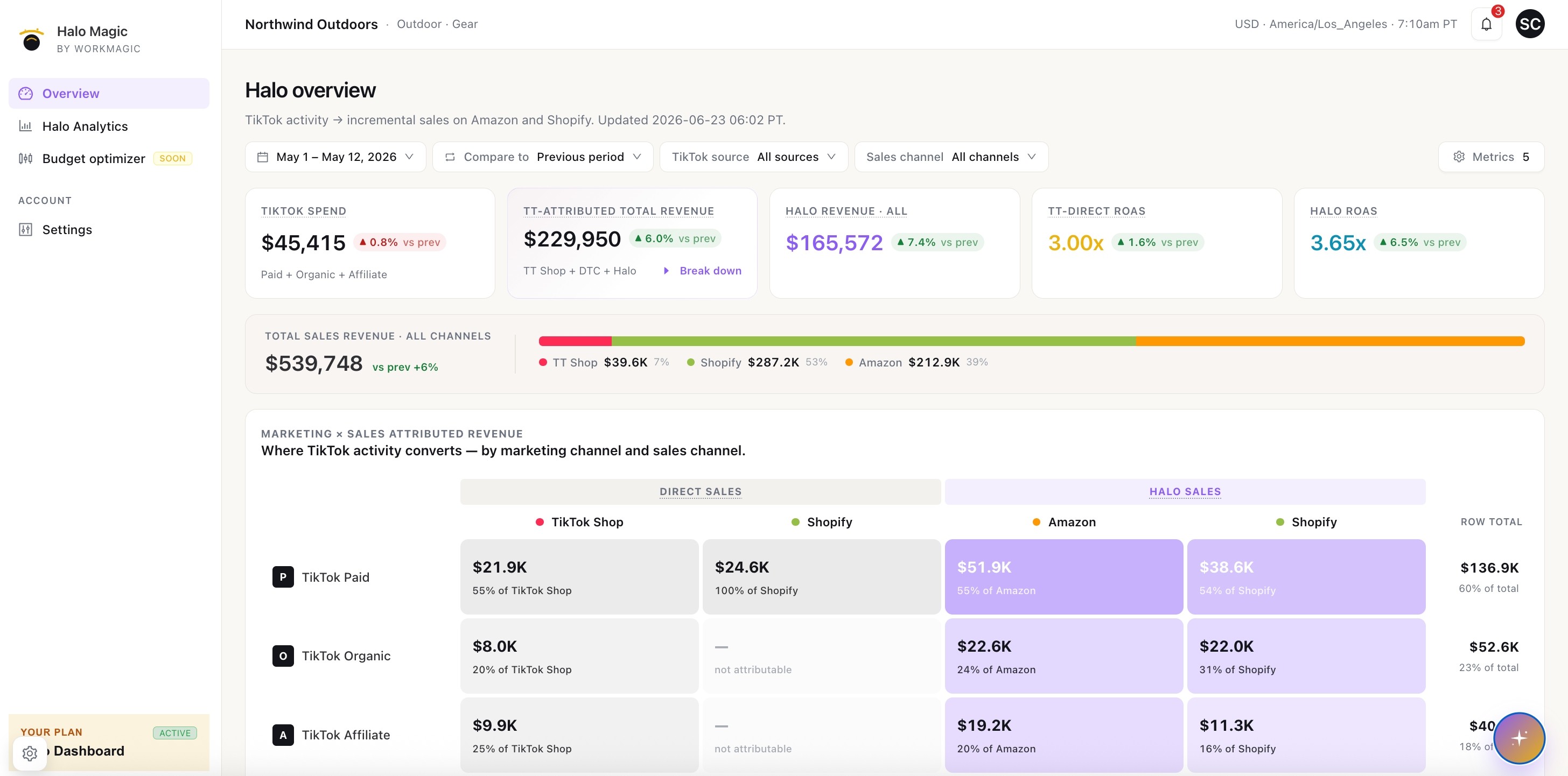


Recover your invisible sales
Finally uncover the Amazon and Shopify revenue that you know your ads are driving.

Insights down to the video level
The only tool that splits TikTok's impact across every content type at the video level.

No annual contracts
Get enterprise-grade marketing measurement without paying huge annual fees.
01
Connect your accounts
Easily connect all your online stores and advertising platforms in just a matter of minutes. Our secure integration seamlessly pulls in your data to set the foundation for accurate tracking.
02
The model runs
Our advanced attribution model works behind the scenes to analyze your data and discover TikTok's true impact on all your marketing channels.
03
See your Halo report
Receive a comprehensive breakdown detailing your full TikTok ROI across every aspect of your business.
What is halo effect?
The halo effect is the indirect lift your marketing on one channel creates on sales in other channels it doesn't directly track, like a TikTok ad driving a purchase on Amazon days later. Traditional attribution can't see this because the click and the sale happen on different platforms. Halo Magic measures this hidden contribution, showing TikTok's true impact beyond what its own in-platform numbers report.
Why is it important to consider the halo effect?
Without halo measurement, channels that quietly drive sales elsewhere look inefficient and get their budget cut, even though they're paying for growth you're seeing on Amazon, Shopify, or retail. For TikTok-first brands especially, in-platform attribution is capped low, so ignoring halo makes TikTok look like a bad investment when it may be your biggest incremental growth driver.
How do you calculate the halo effect?
HaloMagic runs a counterfactual model that takes your TikTok activity (Paid, Organic, Affiliate spend) alongside daily sales on your other channels, then estimates what those channels would have sold without TikTok's influence. The gap between that baseline and actual sales is the halo: the incremental revenue TikTok indirectly drove to Amazon, Shopify, and beyond.
How do you account for external factors when calculating the halo effect?
The counterfactual model builds seasonal and holiday controls directly into its baseline, so normal demand swings like holidays or promos aren't mistaken for TikTok's halo effect. It also uses your own historical sales patterns as a reference point rather than a flat average. Of course, the strongest way to measure halo would be to include recent incrementality tests into the model, which is available to customers who want to upgrade to the full WorkMagic platform.
Aren't pixels required to attribute orders to ads?
Not with HaloMagic. Pixels can only track what happens on the same platform they're installed on, so if a customer sees a TikTok ad and buys on Amazon, TikTok's pixel never sees that sale. Halo Magic doesn't rely on click-level pixel matching; it models aggregate sales patterns across channels instead, so it works even if you've never connected a pixel, including cold-start for brand-new accounts.
How do I know that the numbers I see on HaloMagic are accurate?
Every number in HaloMagic comes from one unified counterfactual model, so Direct and Halo revenue are calculated consistently with no double-counting. Confidence improves with more data (30+ days minimum), and we'd restrain from showing data we aren't confident about. For the highest levels of accuracy, WorkMagic Enterprise adds incrementality lift testing to calibrate and validate these numbers against real controlled experiments.