Attribution Signals vs. True Attribution: Why the Difference Matters

by
Lauren Lauth, VP of Measurement
Most brands think they have attribution. What they actually have are signals — and the difference between the two is driving misallocation across their entire media mix.
The terms get used interchangeably. They shouldn't. A signal and causal attribution are not the same thing, they don't answer the same question, and building budgets on one while calling it the other is one of the most expensive mistakes in modern marketing measurement.
What is an attribution signal?
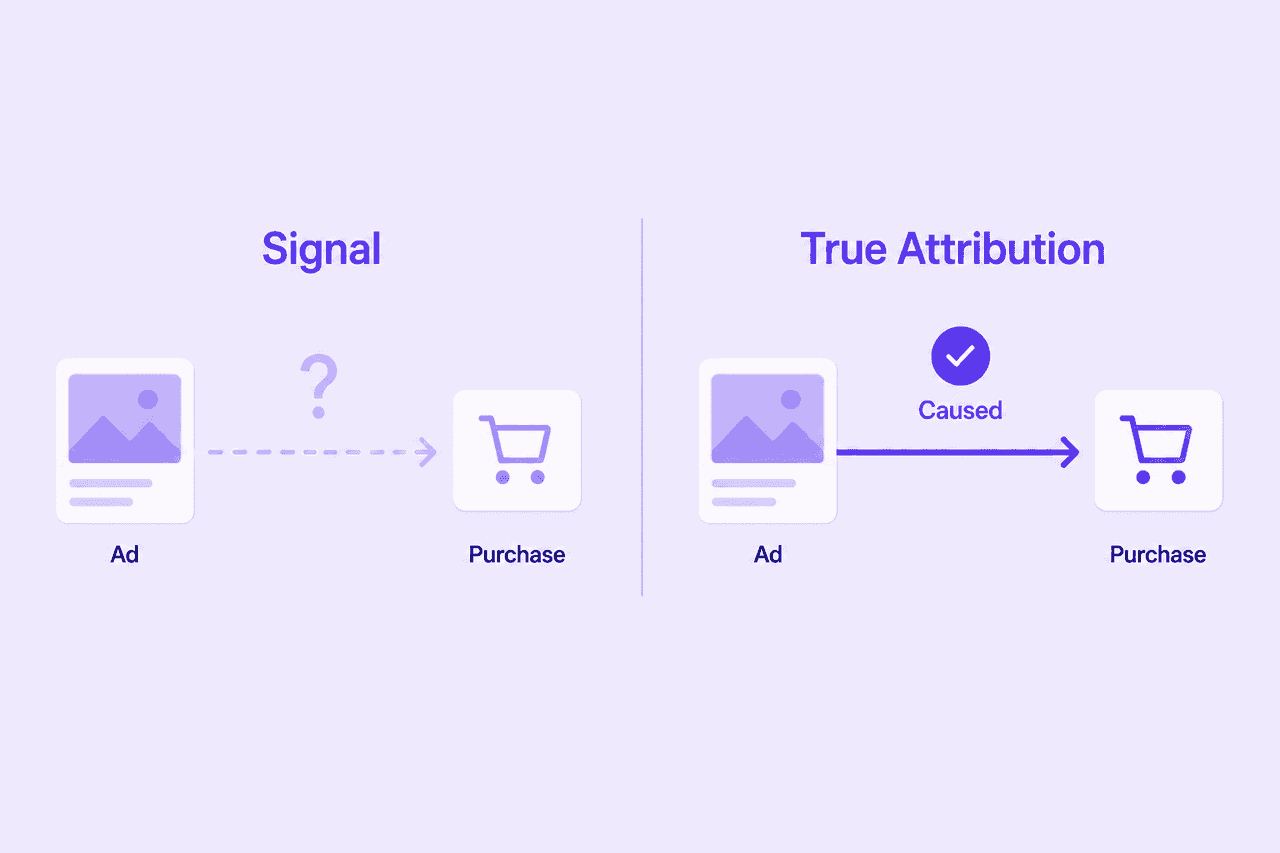
A signal is directional. It's based on observable data points — clicks, video views, modeled touchpoints, and attribution windows — that indicate a user may have been influenced by an ad before converting. Signals tell you what might have happened. They suggest correlation between ad exposure and purchase.
Every major ad platform runs on signals. When Meta Platforms reports that a campaign drove conversions, it is reporting outcomes that occurred within a defined window after an ad interaction. The signal was present: a click, a view, an exposure. What the signal cannot tell you is whether the purchase required the ad. The customer may have already decided to buy. The signal was there. The causation was not.
This distinction matters even more today because signals are becoming increasingly incomplete. Since App Tracking Transparency, a significant share of users have opted out of cross-app tracking. Cookie deprecation across browsers has removed another layer of observable data. WorkMagic is actively monitoring and measuring the impact of these changes — especially those in the iOS26 release — but their true impact has yet to be fully measured. As a result, the signals platforms rely on are narrower and noisier than they were just a few years ago, and the gap between what can be observed and what actually drives purchases continues to widen.
What causal attribution actually means
Causal attribution answers a harder question: Would this sale have happened without the ad?
That is a causal question. Signals cannot answer it. Correlation — even strong correlation — between ad exposure and purchase does not establish that the ad caused the purchase. Proving causality requires a counterfactual: what would have happened in the absence of the marketing activity?
Incrementality testing provides that counterfactual. A portion of the addressable market is held out from seeing the ad. Revenue in the exposed group is compared to revenue in the holdout group over the same period. The difference is the incremental impact — what the ad actually caused, not what happened alongside it. That is causal attribution: not credit assigned to a signal, but impact measured through controlled comparison. It is the closest measurable representation of true marketing contribution.
Where the gap shows up most: the halo effect
The gap between signal-based measurement and causal attribution becomes most visible in the halo effect — the incremental impact an ad generates on channels outside the one being measured.
When a customer sees a TikTok ad and purchases on Amazon three days later, no signal is captured. The TikTok pixel never fires on Amazon. The click never registers. The conversion doesn't appear in platform reporting or attribution windows. The purchase happened. The causal relationship is real. It just produced no signal.
For omnichannel brands, this is not an edge case. In many cases, it represents a significant share of total impact. Channels like TikTok frequently drive purchases at retailers such as Sephora, Ulta Beauty, Target, Walmart, and Amazon — environments where the originating platform has limited or no visibility. Signal-based measurement classifies those purchases as organic. Causal measurement captures them.
One leading TikTok Shop brand found that after measuring TikTok's full incremental impact, including halo revenue across retail and marketplace channels, they were able to grow revenue 4x. The signal-based view had significantly undercounted TikTok's contribution. The causal view told a very different story — and it changed how they invested.
Why geo lift testing bypasses signals entirely
Geo incrementality testing does not depend on signals. There are no pixels, no click IDs, and no attribution windows. Instead, the method operates at the geography level: test regions run ads as normal while matched control regions are held out. Revenue is then measured across all channels — Shopify, Amazon, TikTok Shop, and retail — for both groups over the same period.
The difference in revenue between test and control is the incremental impact of the campaign. Because the measurement is based on total revenue, not tracked events, signal loss from privacy changes or platform limitations does not affect the result.
This is why signal-based reporting and geo lift testing often produce very different answers. One reflects correlation from partial data. The other measures causation from total business impact.
Once geo lift results are established, they can be used to calibrate an incrementality-adjusted attribution model so that day-to-day reporting better reflects true causal contribution, not just observable signals.
The practical consequence
Signal-based measurement fails quietly. It makes bottom-funnel channels look more effective than they are and undervalues channels that drive demand but convert elsewhere. As a result, brands over-invest in retargeting and under-invest in channels like TikTok and CTV that generate incremental demand across the broader ecosystem.
The question that actually matters
The question is not: "What signals did we capture?"
The question is: "Would these sales have happened if we did nothing?"
Only causal measurement methodologies answer that. Everything else is directional.