How to Calculate Incremental Lift: Formula, Examples, and What the Number Means

by
Isaac Lee, Content Marketing Lead
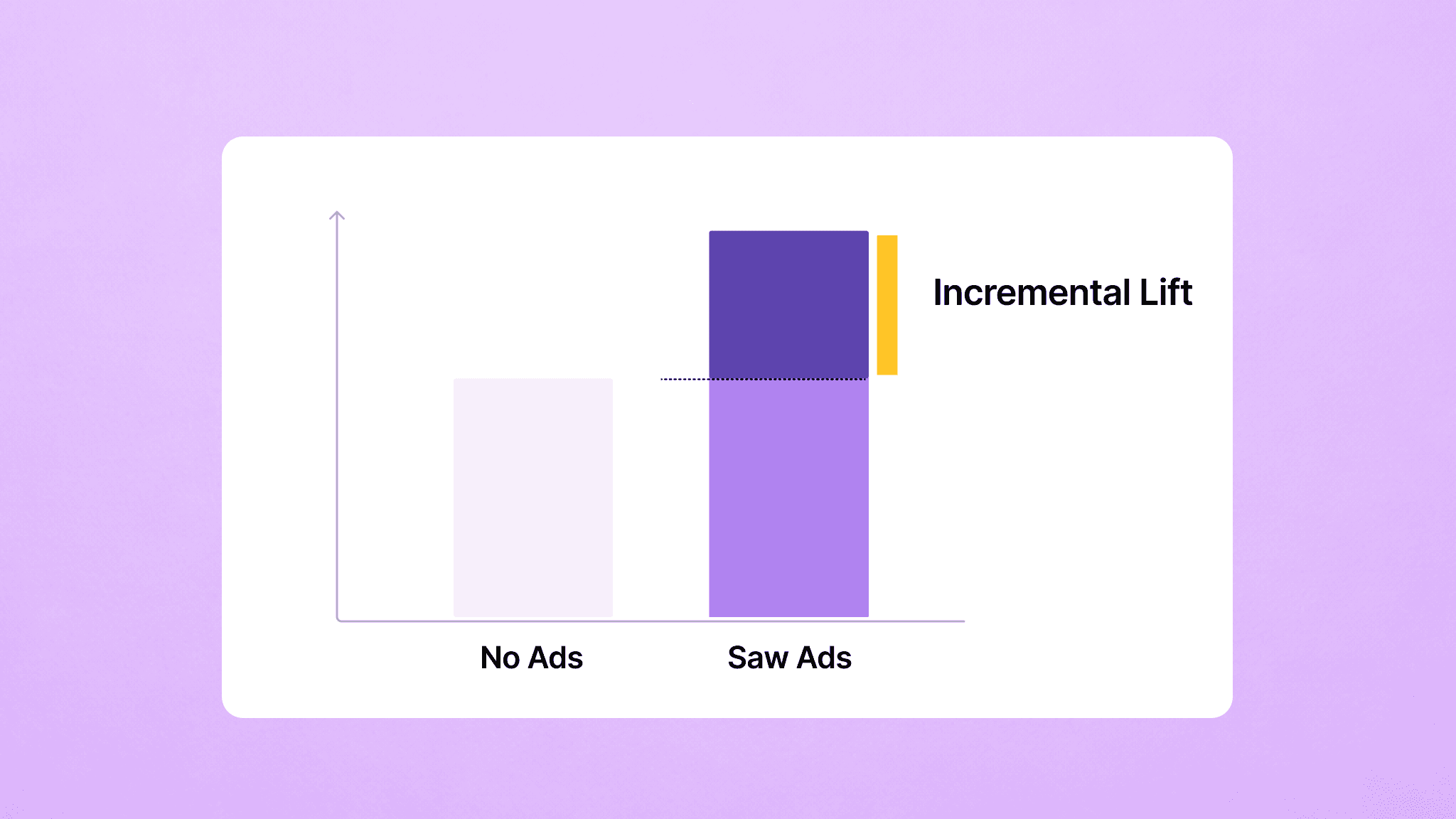
Say you run a Meta campaign for two weeks and see 1,000 purchases in Ads Manager. Before declaring success, ask one question: how many of those customers would have bought anyway?
Maybe 700 of them had already bookmarked the product. They were loyal customers due for a reorder, or they were mid-research and would have found you through organic search the next day. The ad was there — it just wasn't the reason. The remaining 300 are the ones who bought because of the ad. Those are your incremental sales. And the measure of those additional results, above what would have happened without advertising, is incremental lift.
What incremental lift means
Incremental lift is the percentage increase in conversions, revenue, or another outcome that is directly caused by a marketing activity, above the baseline that would have occurred without it.
The word "incremental" is doing the work here. Total conversions include everything: purchases driven by ads, organic demand, returning customers, and brand awareness built by prior campaigns. Incremental lift strips out what was already going to happen and isolates the causal contribution of the specific activity being measured.
It is the answer to the question every finance team eventually asks: did this campaign actually move the needle, or were these customers already on their way?
The incremental lift formula
The standard formula is:

To make this concrete: say your test group of 5,000 customers is exposed to a campaign and 130 convert. Your control group of 5,000 customers sees no ads and 100 convert. The lift is:
(130 − 100) / 100 × 100 = 30%
The campaign produced 30% more conversions than would have happened without it. That 30% is the incremental lift.
In absolute terms, the incremental conversions are simply the difference between what the test group produced and what the control group produced, scaled to the full audience. The control group is what makes the number meaningful: it is the closest approximation of what would have happened without the campaign, giving you a genuine counterfactual rather than a guess.
Brand lift, conversion lift, and incremental lift: what's the difference
These terms are often used interchangeably, but they measure different things.
Conversion lift measures the incremental impact on direct actions: purchases, sign-ups, app installs. It answers whether ads caused more people to complete a transaction or take a specific action.
Brand lift measures the incremental impact on awareness, consideration, and recall. It answers whether ads changed how audiences perceive or think about the brand, typically through surveys comparing exposed and unexposed groups.
Incremental lift is the broader term that covers both. Conversion lift and brand lift are each a type of incremental lift, just applied to different KPIs. When marketers say "we ran a lift test," they most often mean a conversion lift test, because conversion lift connects directly to revenue and budget decisions.
How a lift test works
A lift test splits an audience into two groups: a test group that receives the ads, and a control group that is held out. Both groups are otherwise identical in their characteristics and exposed to the same market conditions — same time period, same seasonality, same competitive environment. The only variable that differs is ad exposure.
After the test period, conversion rates or revenue are compared between the two groups. The difference, statistically validated, is the lift generated by the campaign.
The integrity of the test depends on two things: proper holdout design (the control group must not be contaminated by ad exposure) and measurement across all relevant channels. If a DTC brand runs a lift test but only measures Shopify revenue, a campaign that drove purchases on Amazon goes undetected. The true lift appears smaller than it is.
Within-platform lift studies vs. geo lift tests
Most ad platforms offer their own lift measurement tools. Meta's Conversion Lift, Google's Search Lift, and TikTok's in-platform lift studies all use holdout testing within their own audience to estimate the incremental impact of campaigns on that platform.
These tools are useful, but they share the same structural ceiling as platform attribution: they can only measure conversions that touch the platform's own tracking infrastructure. A Meta Conversion Lift study captures DTC purchases where the Meta pixel fires. It does not capture purchases on Amazon, at retail, or the lift in branded search that a Meta campaign generates on Google. The holdout methodology is sound; the scope is narrow.
Geo incrementality testing runs the same holdout logic across geographies rather than across individual user IDs. Test geographies run ads normally; control geographies are held dark. Revenue is measured across every channel — Shopify, Amazon, retail, TikTok Shop — for both sets of geographies over the same period. The difference is total incremental lift, regardless of where the purchase was completed.
This is how Graza discovered that Meta's true causal impact was 2.7x higher than last-click reporting had shown. The incremental lift was real — it was just landing across multiple channels that a within-platform lift study couldn't see.
Geo lift testing is also the only reliable method for measuring incremental lift from channels that have no pixel at all. Direct mail is the clearest example. When you send postcards to a segment of your customer list or to households in specific zip codes, there is no tracking link, no cookie, no conversion event to fire. The only way to calculate incremental lift from a postcard campaign is to designate matched control geographies that receive no mail, run the campaign in test geographies, and compare total revenue across both — measuring lift the same way you would for any other channel, through the revenue difference rather than individual-level tracking.
What you do with the lift number
Incremental lift becomes most useful when it feeds directly into budget decisions. The output of a lift test — incremental revenue divided by the ad spend that generated it — is incremental ROAS (iROAS). Where platform-reported ROAS includes organic baseline sales, iROAS strips them out, leaving only the causal return.
Once you have lift results across your active channels, you can rank them by iROAS, identify where the next dollar will generate the most incremental return, and build saturation curves that show how each channel's lift changes as investment scales. Lift testing done once gives you a snapshot. Built into a regular measurement cadence and used to calibrate an incrementality-adjusted attribution model, it gives you a continuously improving picture of what your advertising is actually doing.
Frequently asked questions
What does incremental lift mean?
Incremental lift is the measurable increase in conversions, revenue, or another outcome that is directly caused by a marketing campaign, above what would have happened organically without it. If 1,000 purchases occurred during a campaign period and 700 would have happened anyway, the incremental lift is based on the additional 300 purchases the campaign caused. It is calculated by comparing outcomes between a group exposed to ads and a matched control group that was not.
What does incremental mean in simple terms?
In marketing, incremental means "additional, above the baseline." Incremental sales, incremental revenue, and incremental lift all refer to results that would not have existed without the specific marketing activity being measured. The baseline is what your business generates on its own, through organic demand, brand awareness, and returning customers. Anything above that line, caused by a campaign or ad, is the incremental contribution.
How to calculate incremental uplift?
Incremental uplift (or incremental lift) is calculated by comparing conversion rates between a test group exposed to ads and a control group that was not: (Test Group Conversion Rate − Control Group Conversion Rate) / Control Group Conversion Rate × 100. For example, if your test group converts at 2.6% and your control group at 2.0%, your incremental uplift is 30%. In practice, this requires a properly designed holdout test — a control group that is genuinely isolated from ad exposure and matched to the test group in all other characteristics.
Is incremental sales a lift?
Yes. Incremental sales and incremental lift describe the same underlying concept from different angles. Incremental lift is typically expressed as a percentage increase above the baseline. Incremental sales is the absolute number or revenue figure that represents that increase. If your campaign produced a 30% incremental lift and your baseline was 1,000 sales, your incremental sales figure is 300. Both measure the causal contribution of marketing activity above what would have occurred organically.