The Challenges of Marketing Attribution (That Better Tracking Alone Can't Solve)

by
James Gerber, VP Strategy
The most common advice for fixing attribution is to improve your tracking: server-side events, better pixel coverage, first-party data. That advice solves one set of problems. It doesn't solve the structural ones.
Two of the most significant challenges of marketing attribution have nothing to do with how well your pixels fire. First, ad platforms can only count conversions that touch their own infrastructure; they cannot see purchases that happen on other channels after an ad exposure. Second, they cannot distinguish between purchases they caused and purchases that were going to happen regardless. Both are design constraints, not technical gaps. Better tracking doesn't fix them.
Challenge 1: Each platform reports its own version of the truth
The walled garden problem isn't just that platforms don't share data. Each platform calculates attributed revenue independently, using its own attribution window and its own logic, without any visibility into what the others reported for the same conversion.
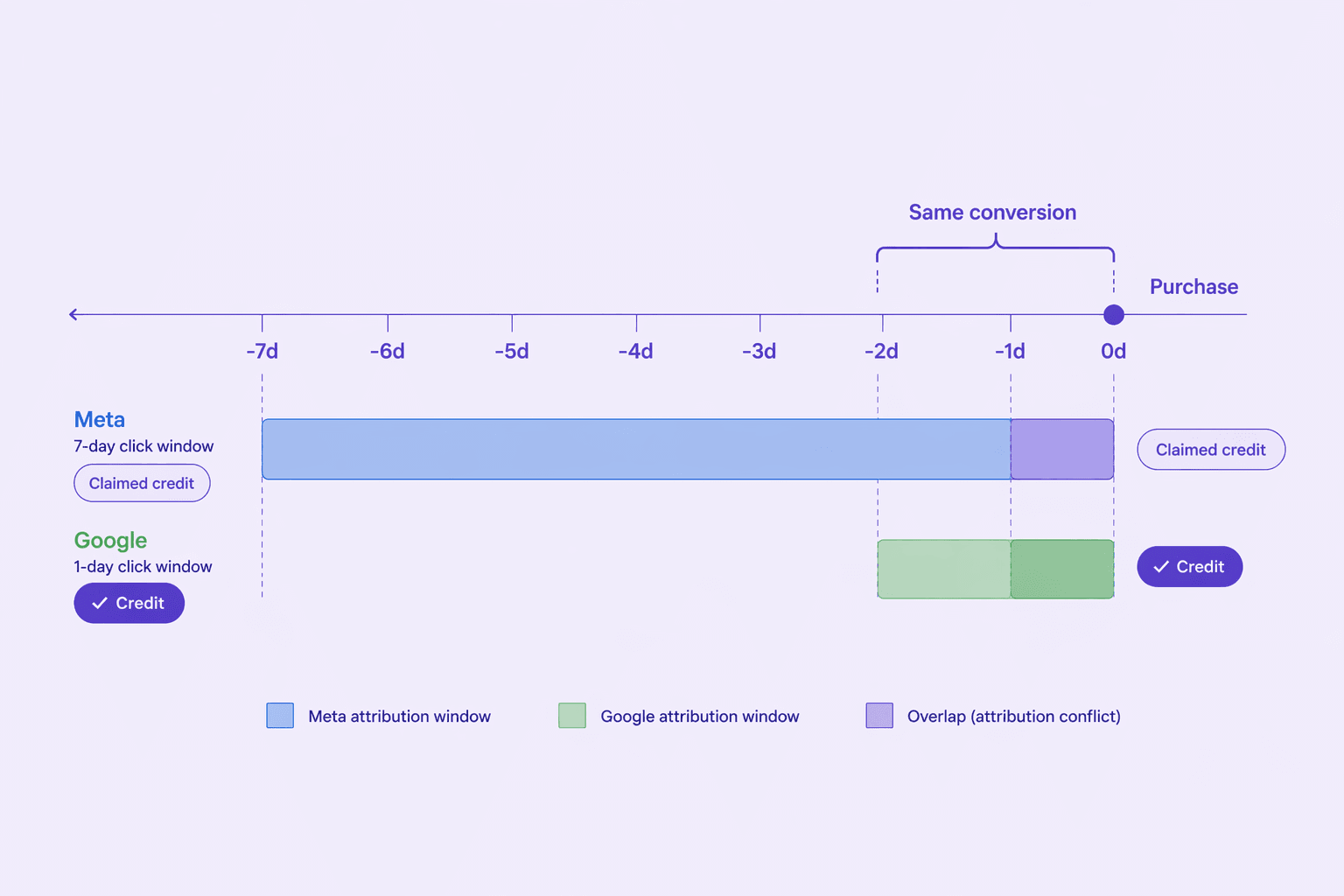
A customer sees a Meta ad, later searches the brand on Google, and converts. Meta attributes the purchase within its 7-day click window. Google attributes the same purchase as a last-click conversion. Two platforms, one sale, two attribution credits. Scale that across a multi-channel campaign and aggregate reported ROAS frequently exceeds actual business performance. Total attributed revenue across Meta, Google, and TikTok can run 2-3x real revenue — not because any single platform is wrong by its own logic, but because each is counting from a separate vantage point.
Multi-touch attribution addresses some of this by distributing credit across touchpoints, but it still depends on observing the full customer journey. That's exactly what the next challenge makes impossible.
Challenge 2: The halo effect is invisible by design
When a customer sees a Meta ad on Monday and purchases on Amazon on Thursday, Meta never learns about the purchase. It doesn't appear in Ads Manager. It doesn't flow into Conversion Lift. It isn't captured by Meta's Incremental Attribution reporting. Attribution can only count conversions that touch the platform's own tracking infrastructure, and Amazon purchases don't.
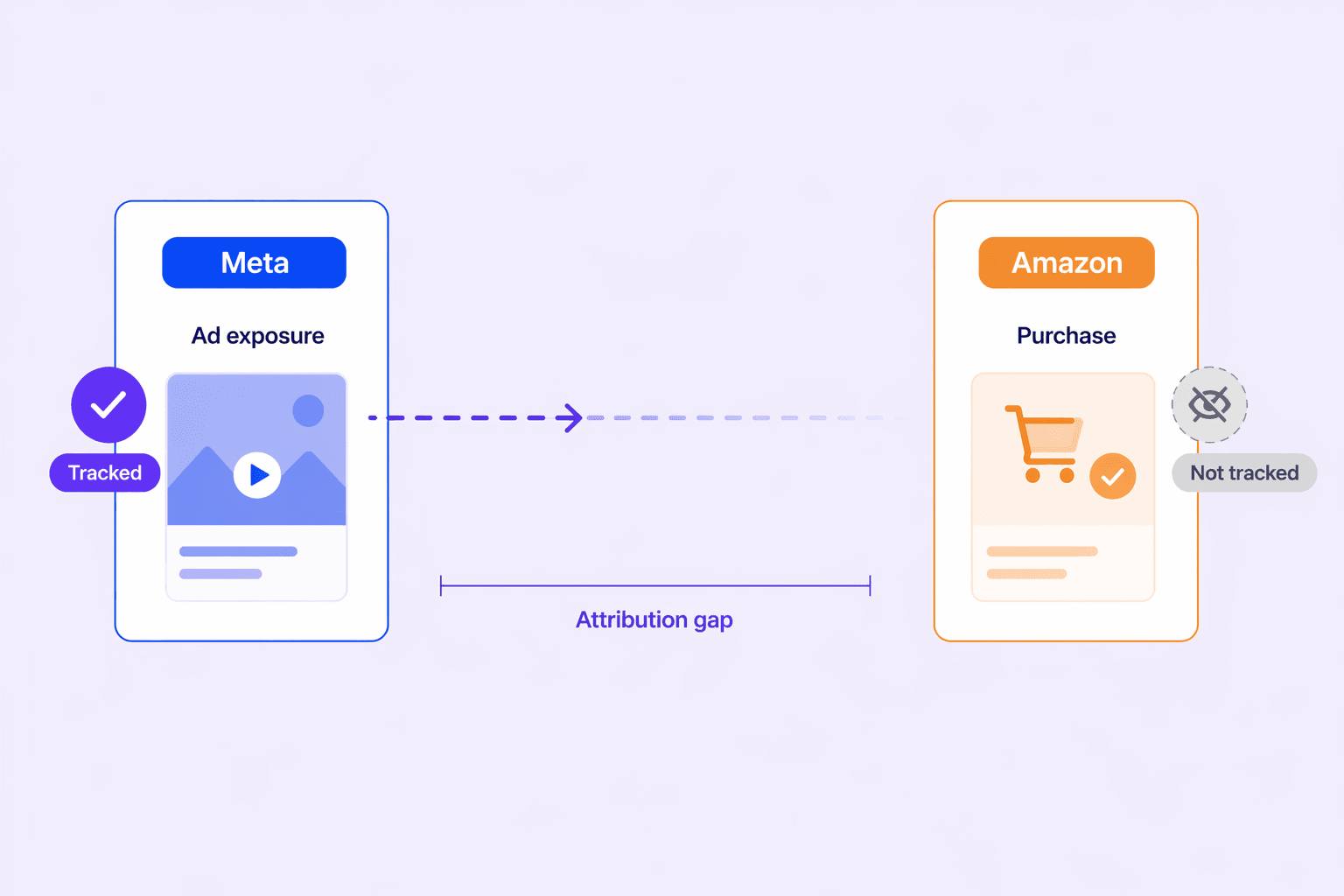
For omnichannel DTC brands, this isn't a minor data gap. It's a systematic blind spot for some of the highest-value conversions your ads generate.
Nordic Naturals ran a pause-to-measure geo incrementality test on TikTok and found that 99.6% of TikTok's incremental impact landed on Amazon, not on the DTC site the campaign was directing traffic to. The entire causal relationship between TikTok spend and revenue was invisible to TikTok's own attribution. Semaine Health's 3-cell lift test on Pinterest revealed an 87% halo effect: the vast majority of Pinterest-driven revenue occurred off-platform, making standard attribution a significant undercount.
These aren't anomalies. They're a predictable consequence of how attribution works: the platform counts what it can track. What happens outside its ecosystem doesn't count.
Challenge 3: Privacy signal degradation
Since Apple's App Tracking Transparency rollout, roughly 75-85% of iOS users opt out of cross-app tracking. Pixels that once captured a high share of conversion events now see a fraction of them. The algorithmic optimization that depends on that feedback loop degrades when the signal becomes incomplete. Cookie deprecation across browsers compounds the problem on the web side, and consent requirements under GDPR and CCPA create additional gaps by geography and user behavior.
Server-side tracking recovers some of the lost signal, and it's worth implementing. But it only makes attribution more accurate within its existing structural limits. It can't fix challenges one and two.
Challenge 4: Attribution assigns credit without establishing cause
This is the most underappreciated attribution challenge, and often the most costly.
Attribution assigns credit to any ad touchpoint that precedes a conversion. It has no mechanism for determining whether that conversion required the ad. A loyal customer who was going to reorder this week, happened to see a retargeting ad on Tuesday, and completed the purchase on Wednesday is counted as an attributed conversion. The platform takes credit for revenue it didn't generate.
David Protein found that traditional attribution was overstating DTC orders by 36%. That overcount wasn't a tracking error — those were real purchases that appeared in the attribution window; they simply would have happened without the ad. Retargeting campaigns that reach high-intent customers near the end of their natural repurchase cycle can report strong ROAS while generating minimal incremental revenue. The attributed numbers look healthy. The causal contribution is far lower.
Why incrementality solves what attribution structurally cannot
Geo incrementality testing bypasses all four challenges simultaneously. It doesn't depend on cross-platform identity resolution, pixel coverage, or within-platform attribution windows. It doesn't require observing individual customer journeys at all.
The method works at the geography level: a portion of the addressable market is held dark while the rest continues to see ads. Revenue is then compared across all connected channels — Shopify, Amazon, TikTok Shop, retail — for test and control geographies over the same period. The difference is total incremental revenue caused by the ad spend, regardless of where the purchase was completed.
Privacy signal degradation doesn't affect the result because the comparison is between total channel revenue in two geographies, not individual conversion events. The halo effect is captured automatically because Amazon and retail revenue are measured in the same comparison as DTC. The organic baseline is controlled for because both test and control geographies contain customers who would have purchased anyway, and those purchases cancel out.
Once geo lift results are established, they can calibrate an incrementality-adjusted attribution model so that day-to-day reporting reflects true causal contribution rather than platform-reported credit — giving marketing and finance teams a shared number they can both defend.
Frequently asked questions
What is the attribution problem in marketing?
The attribution problem in marketing refers to the fundamental difficulty of determining which ads, channels, or touchpoints actually caused a sale. Ad platforms assign credit based on who was present in a customer's journey before a conversion — but presence isn't causation. Attribution cannot determine whether a purchase required the ad, and it cannot observe purchases that happen outside the platform's own tracking infrastructure. For omnichannel brands, these two gaps mean platform-reported numbers are both inflated by organic sales and incomplete due to cross-channel halo effects.
What is an attribution challenge?
An attribution challenge is any structural or technical limitation that prevents accurate measurement of a marketing activity's causal contribution. Technical challenges include privacy signal loss (iOS tracking restrictions, cookie deprecation) and cross-device identity gaps. Structural challenges include the walled garden problem (platforms attributing credit independently without a shared view), halo effects (conversions on other channels that attribution can't see), and the organic baseline problem (conversions that would have happened without ads being counted as attributed sales). Structural challenges cannot be solved with better tracking tools alone.
What are the limitations of attribution models?
Attribution models — last-click, first-touch, linear, time-decay, data-driven — all share the same core limitation: they assign credit based on observable touchpoints within a single ecosystem, and they measure correlation rather than causation. Last-click over-credits bottom-funnel channels and undervalues awareness. Multi-touch models distribute credit more fairly but still can't see across walled gardens or account for purchases on other channels. No attribution model can establish whether a conversion required the ad, and none can capture the halo effect on Amazon, retail, or other platforms outside the one being measured. Incrementality testing addresses both gaps by measuring causal contribution across all channels through a controlled holdout comparison.
What causes marketing attribution to be inaccurate?
Several factors cause marketing attribution to be inaccurate. Platform self-reporting creates double-counting when multiple channels claim credit for the same conversion. Cross-channel halo effects go unmeasured because conversions on Amazon, retail, or other platforms don't appear in the originating ad platform's data. Privacy changes reduce observable signal, particularly on iOS and in browsers that block third-party cookies. And the organic baseline — sales that would have happened without any advertising — is included in attributed totals, inflating reported performance. The result is attributed revenue that overstates true causal impact, often by a significant margin.