Marketing Attribution Explained: Models, Limits, and What's Next

by
James Gerber, VP of Strategy
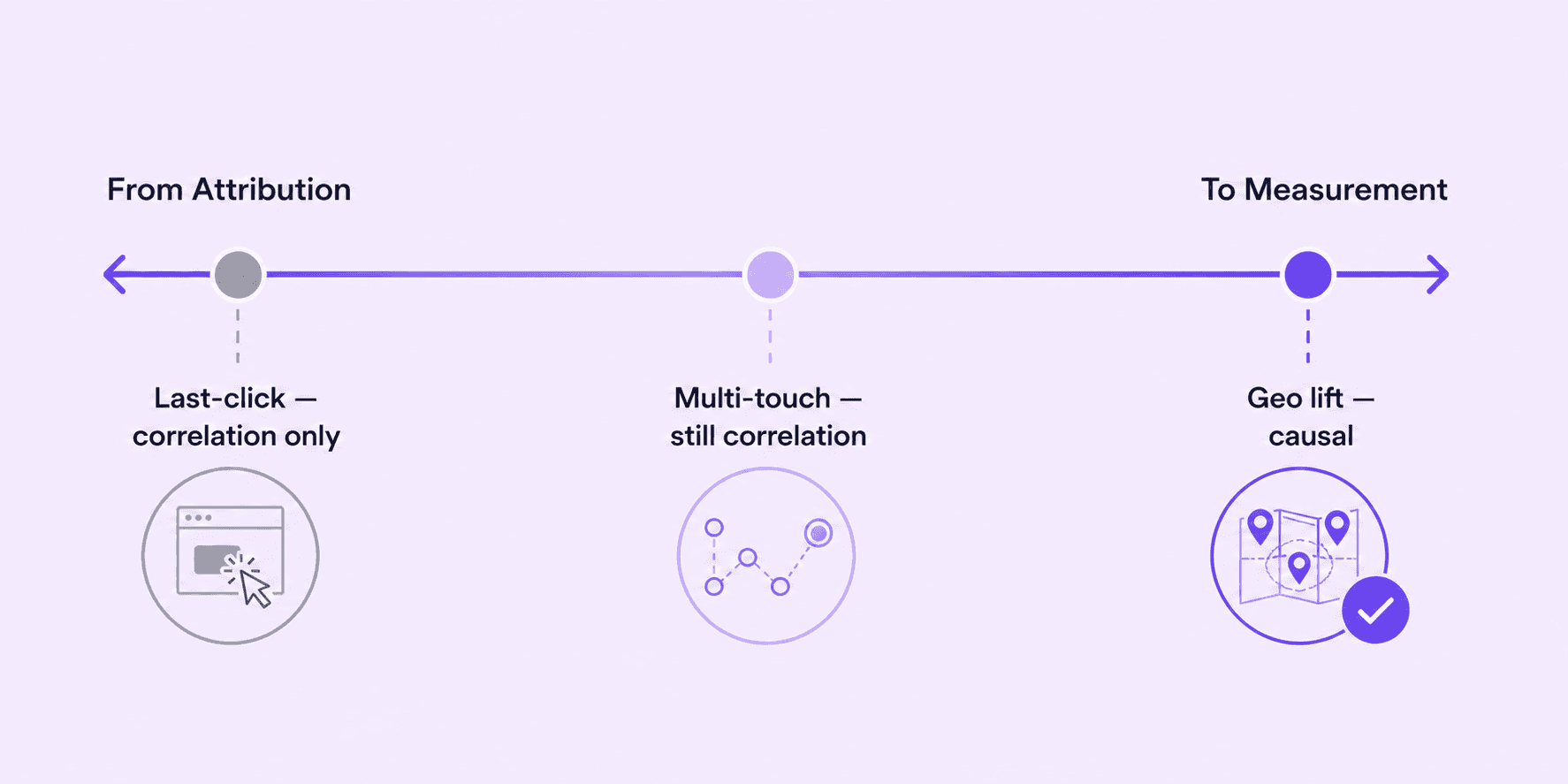
Attribution is not the goal. It is a tool, and treating it as the final word on marketing performance is one of the most common, and most expensive, mistakes brands make.
The goal is measurement: understanding what your marketing actually caused, not just what it happened to correlate with. Attribution assigns credit to touchpoints that appeared before a conversion. It cannot tell you whether those touchpoints caused the conversion, and it cannot see the conversions that happened on channels outside its ecosystem. Used in isolation, it produces a partial picture and frames it as a complete one.
This article explains what marketing attribution is, how the main models work, and, more importantly, where attribution stops being useful and measurement has to take over.
What is marketing attribution?
Marketing attribution is the process of assigning credit for a conversion to the marketing touchpoints that appeared in a customer's journey before it. When a customer clicks a Meta ad, sees a Google search ad, and then purchases, an attribution model determines how much credit each touchpoint receives for the sale.
Attribution models differ in how they distribute that credit. The most common:
Last-click gives 100% of the credit to the final touchpoint before conversion. Simple and widely used as a default, it systematically undervalues everything that happened earlier in the journey: brand awareness campaigns, social ads, top-of-funnel content.
First-click gives 100% of the credit to the first touchpoint. It highlights what introduced the customer but ignores everything that moved them toward purchase.
Linear distributes credit equally across all touchpoints in the journey. Fairer than single-touch models but still rule-based and still unable to distinguish which touchpoints actually influenced the decision.
Time-decay gives more credit to touchpoints closer to conversion, less to earlier ones. Useful for short sales cycles; less useful when brand awareness built weeks earlier matters.
Data-driven attribution (DDA) uses machine learning to distribute credit based on observed patterns across a large number of journeys. More sophisticated than the rule-based models above, but still bounded by what the platform can observe: only its own ecosystem.
Multi-touch attribution sits at the more sophisticated end of the attribution modeling spectrum and remains the dominant approach for day-to-day in-platform optimization. But even the most advanced attribution model shares the same fundamental constraint as the simplest: it assigns credit based on presence, not causation.
Each of these is a framework for distributing credit. None of them establishes whether the credit was earned.
What attribution theory actually says
For a practical breakdown of how last-click and other single-touch models fail DTC brands specifically, see our breakdown of last-click attribution.
Attribution theory, borrowed from psychology, describes how people assign causes to events. In marketing, the equivalent question is: which touchpoint caused the conversion?
The honest answer is that standard attribution models don't answer this question. They answer a different one: which touchpoints were present before the conversion occurred? Presence and causation are not the same. A customer who was already going to buy, saw a retargeting ad two hours before completing their purchase, and converted is counted as an attributed conversion in every model. The ad was present. It did not cause the purchase.
The only methodology that answers the causal question is incrementality testing: a holdout-based test that compares conversion rates between users or markets that received the ad against a matched group that did not. The difference is incremental impact. That is attribution theory applied: what would have happened without the touchpoint?
The three structural limits of marketing attribution
For a deeper look at how these challenges play out in practice, see our piece on the challenges of marketing attribution.
No matter which attribution model you use, three limitations remain:
1. Walled garden self-reporting.
Each platform calculates its own attributed revenue using its own logic, its own attribution windows, and without visibility into what other platforms reported. Meta attributes conversions within its 7-day click window. Google attributes conversions within its own window. When a customer interacts with both before purchasing, both claim credit. Total attributed revenue across platforms routinely exceeds actual revenue because each platform is reporting from a separate vantage point.
2.The organic baseline problem.
Attribution assigns credit to any ad touchpoint that preceded a conversion. It cannot filter out conversions that would have happened anyway. Loyal customers who repurchase on their natural cycle, customers already mid-research who would have found you through organic search: all of these appear as attributed conversions when they click an ad before buying. SimplyInked experienced this directly: moving Meta budget decisions to incrementality-grounded insights revealed a meaningful share of attributed conversions were non-incremental, and the reallocation produced 58% sales growth and a 26% reduction in CAC. Those were real purchases. They just didn't require the ad.
3. Cross-channel halo blindness.
Attribution can only count conversions that touch the platform's tracking infrastructure. When a customer sees a Meta ad and purchases on Amazon, Meta's pixel never fires. The conversion doesn't appear in Ads Manager. Signal-based measurement classifies it as organic demand.
Nordic Naturals ran a geo lift test on TikTok and found 99.6% of TikTok's incremental impact landed on Amazon, entirely outside TikTok's attribution view. For omnichannel DTC brands, this isn't an edge case. It is the defining measurement gap.
What attribution can still do well
Attribution isn't useless; it just shouldn't be the standalone answer. Within-platform attribution tools are valuable for:
Day-to-day campaign optimization: Real-time signals about which ad creative, audience, and placement is performing, relative to other options in the same campaign
Directional budget decisions: When you need to make a quick call about shifting budget within a channel, attributed ROAS provides a useful relative signal even if it's not a perfect causal one
Creative testing: Comparing two versions of an ad within the same platform and audience, where the organic baseline and attribution bias affect both equally
The appropriate frame is: attribution is a useful operational tool for in-platform decisions. It is not a reliable source of truth for how much each channel contributes to the business.
Moving from attribution to measurement
For a full comparison of how MMM and MTA differ and when to use each, see our guide on MMM vs. MTA. For Meta specifically, the Measuring Meta Performance one-pager covers how to layer incrementality on top of Meta's own attribution tooling.
The shift from attribution to measurement is a shift from asking "what got credit?" to asking "what caused this?"
Geo incrementality testing answers the causal question by design. It compares total revenue between matched geographies, one exposed to ads and one held out, across all channels simultaneously. The difference is what the ads actually caused, regardless of where the purchase was completed. It captures the Amazon halo. It captures the retail lift. It establishes the organic baseline and subtracts it automatically.
Once geo lift results exist, they can calibrate attribution: incrementality-adjusted attribution takes the lift results and uses them to correct day-to-day reporting so it reflects true causal contribution rather than platform-reported credit. Attribution becomes more accurate. The organic baseline is accounted for. The cross-channel halo is captured.
This is not a replacement of attribution with something else. It is attribution made meaningful by a causal foundation. The combination of causal measurement calibrating operational attribution is what a functional measurement stack looks like. The Triangulated Measurement playbook walks through how MTA, incrementality testing, and MMM work together as a unified system.
Frequently asked questions
What is the marketing attribution?
Marketing attribution is the process of assigning credit for a conversion to the marketing touchpoints that appeared in a customer's journey before it. Common models include last-click (all credit to the final touchpoint), first-click (all credit to the first touchpoint), linear (equal credit across all touchpoints), time-decay (more credit to recent touchpoints), and data-driven attribution (machine learning-based distribution). All attribution models measure correlation: the presence of a touchpoint before a conversion, not causation. They cannot determine whether the conversion would have happened without the ad.
What is an example of attribution in marketing?
A customer sees a TikTok ad on Monday, clicks a Google search ad on Wednesday, and purchases on Thursday. Under last-click attribution, Google receives 100% of the credit. Under linear attribution, TikTok and Google each receive 50%. Under time-decay, Google receives more credit than TikTok because it was closer to conversion. In all three cases, the attribution model assigns credit based on touchpoint presence, but none can determine whether either ad was necessary for the purchase to occur. If the customer had already decided to buy before seeing either ad, neither generated incremental revenue.
What are the 4 types of marketing analytics?
The four types of marketing analytics are descriptive (what happened, covering historical reporting and dashboards), diagnostic (why it happened, covering attribution modeling and funnel analysis), predictive (what will happen, covering forecasting and scenario modeling), and prescriptive (what to do, covering budget optimization and channel allocation recommendations). Most brands spend the majority of their measurement effort on descriptive analytics. The most valuable for budget decisions are prescriptive analytics grounded in causal measurement, which requires moving beyond attribution to incrementality testing and calibrated MMM.
What is an attribute in marketing?
In marketing, an attribute is a characteristic or property associated with a product, customer, or marketing touchpoint. In the context of marketing attribution, an attribute refers to the credit assigned to a specific touchpoint or channel for contributing to a conversion. Attribution models determine how this credit is distributed across the touchpoints in a customer's journey. The challenge is that assigning an attribute to a touchpoint does not establish that the touchpoint caused the conversion; it only records that the touchpoint was present before it occurred.