Last-Click Attribution: How It Works and Why It Fails DTC Brands

by
James Gerber, VP Strategy
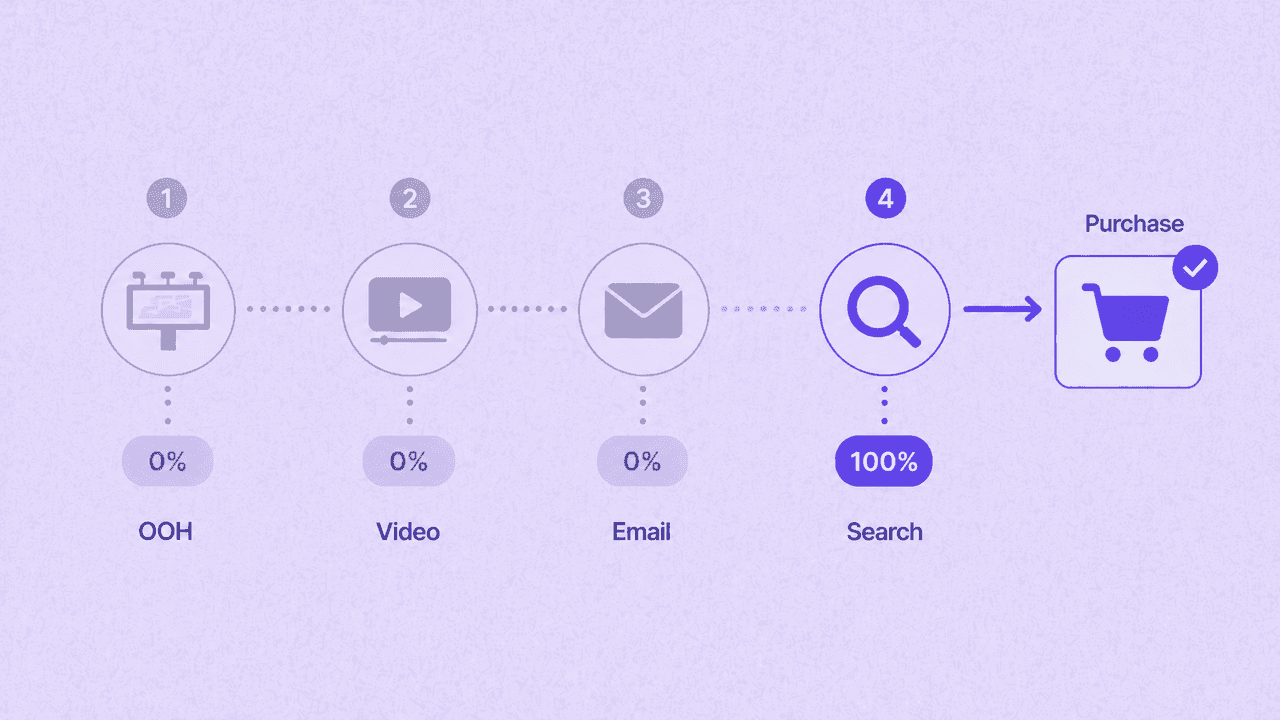
Last-click attribution is the marketing measurement model that assigns 100% of conversion credit to the final ad touchpoint a customer interacts with before purchasing. Most DTC brands are running it by default, often without choosing to. It's the logic under many ad platform reports, the default in older Google Analytics views, and what GA4 still falls back on as "last non-direct click." Its rule is simple: whichever ad the customer clicked just before purchase gets 100% of the credit. Every other touchpoint, including the discovery ad, the consideration impression, and the brand search, gets nothing.
That single rule is why brands relying on last-click attribution overspend on retargeting, underfund discovery channels, and miss most of the halo their ads create on Amazon, retail, and marketplaces. The structural design is the problem, not the tracking.
How last-click attribution works
Last-click attribution assigns 100% of conversion credit to the final ad touchpoint a customer clicked before purchasing. If a customer sees a Meta ad on Monday, watches a YouTube ad on Wednesday, then clicks a Google branded search ad and buys on Friday, the entire sale is credited to Google branded search. Meta and YouTube get zero.
The last-click attribution model became the default for a reason. It's simple to implement, deterministic to audit, and easy to explain to a finance team that wants a clean line connecting an ad click to a transaction. It also matches how most ad platforms report by default.
The cost of that simplicity is the assumption baked into the rule: that the last clicked ad caused the sale, and that everything before it can be ignored. For brands running multi-channel programs across awareness and conversion stages, that assumption is rarely true.
Why last-click attribution fails DTC brands
For DTC and omnichannel brands, the model breaks down in four predictable ways.
It overcredits the bottom of the funnel. Retargeting and branded search live closest to the purchase. They reliably appear as the final click before a conversion, even when the customer's decision was already made. Last-click rewards those channels, leading teams to scale them and starve the discovery channels (TikTok, Pinterest, CTV, YouTube) that brought the customer in. The result is a budget that grows efficient on paper while top-of-funnel demand erodes underneath it.
It can't see cross-channel halo. A Meta impression on Monday that triggers an Amazon purchase on Thursday never connects in any Facebook last-click attribution report. The ad platform never sees the Amazon order; the Amazon sale has no Meta touchpoint. For brands selling on Amazon, retail, or TikTok Shop alongside their DTC site, this isn't a small gap. It's where some of the highest-value impact disappears entirely. Geo lift tests routinely surface halos of 60% to 90% on these channels, none of which appear in last-click reporting.
It confuses presence with cause. Last-click cannot distinguish between an ad that triggered a purchase and an ad that happened to be present in a journey the customer was already on. A loyal customer searching the brand to reorder will click a branded search ad and complete a purchase that was going to happen regardless. Last-click credits the ad in full. The platform takes credit for revenue it didn't generate.
Signal degradation makes it shakier each year. iOS App Tracking Transparency, third-party cookie deprecation, and consent gating under GDPR and CCPA all reduce the share of conversions that last-click can observe in the first place. Server-side tracking recovers some of the lost signal, but it doesn't fix the structural problems above. It only makes a flawed model marginally more accurate inside its existing limits.
These aren't tracking problems that better pixels can solve. They're consequences of how last-click is designed. For the broader picture, see The Challenges of Marketing Attribution.
The channels last-click systematically undercounts
The pattern shows up most clearly in cross-channel halo data.
Branch Furniture's CTV test measured a 4.18% lift in Shopify orders attributable to CTV ads, 20× more than last-click reporting credited to the channel. Salt & Stone found 67% of YouTube's incremental orders landed on Amazon, not on the Shopify site the campaigns were directing traffic to. Comfrt's TikTok geo lift revealed that 68% of TikTok Shop ads' total impact was a halo effect on Shopify, fundamentally changing how the brand attributed TikTok performance. Semaine Health's Pinterest test measured an 87% halo, with the vast majority of Pinterest-driven revenue occurring off-platform. True Classic found TikTok's true impact was 74% higher than any-click attribution showed.
In each case, last-click reporting wasn't slightly off. It was structurally blind to the majority of what the channel was generating.
Better attribution models for DTC brands
Replacing last-click attribution doesn't mean abandoning attribution. The last-click vs multi-touch attribution debate is the most familiar comparison, but it isn't the only choice. The real question is choosing a model whose structure matches how DTC customers actually buy.
Multi-touch attribution (MTA) distributes credit across observed touchpoints rather than awarding it all to the last one. Linear, time-decay, and position-based MTA models address last-click's bottom-of-funnel bias, but they still depend on observing the full journey and share last-click's signal-loss and walled-garden limitations.
Data-driven attribution (DDA) uses algorithmic credit assignment based on observed conversion path patterns. It improves on rules-based MTA by weighting touchpoints empirically, but it still operates on observational signal and still cannot capture purchases on platforms it doesn't track.
Geo incrementality testing sits in a different category. It measures causal contribution by holding a portion of the addressable market dark while the rest continues to see ads, then comparing total revenue across all connected channels for test and control geographies. The output is true incremental revenue, regardless of where the purchase landed. The walled-garden problem disappears, the halo gets captured, and the organic baseline is controlled for.
Incrementality-adjusted attribution is the day-to-day operating layer. Lift test results calibrate the attribution model so that platform-reported credit reflects actual causal impact. Marketing and finance share a number they can both defend.
For a deeper methodology comparison, see MMM vs. MTA and Incremental Attribution on Meta.
How to transition off last-click
The fastest way to break the last-click default isn't to throw out the dashboard. It's to run incrementality tests on the channels where last-click and platform numbers disagree most loudly. Discovery and awareness channels with low last-click ROAS but high spend are the highest-yield place to start.
A single geo lift result on the largest channel produces enough signal to recalibrate attribution downstream. Once incrementality-adjusted numbers are in place, last-click reports become a secondary view rather than the source of truth.
Branch Furniture grew revenue from Meta ads by 113% after adopting incrementality-based attribution. The channels didn't change. The way they were being measured did.
Frequently asked questions
What is last-click attribution?
Last-click attribution is a marketing measurement model that assigns 100% of conversion credit to the final ad touchpoint a customer interacted with before purchasing. Every prior touchpoint in the journey, including the discovery ad, the consideration video, and the email, gets zero credit. The model is the default under many ad platform reports and in older Google Analytics views, which is why most DTC brands are running it without having explicitly chosen it.
What is an example of last-click attribution?
A typical last-click attribution example: a customer sees a TikTok ad on Sunday, opens a brand email on Tuesday, clicks a Google branded search ad on Friday, and completes a purchase. Under last-click attribution, Google branded search receives 100% of the credit for the sale. TikTok and email get zero, even though TikTok introduced the customer to the brand and the email kept the consideration alive. The same logic produces inflated retargeting ROAS, because retargeting ads are structurally most likely to be the final click before purchase.
What are the problems with last-click attribution?
The core problem with last-click attribution is that it treats correlation as causation while ignoring most of the customer journey. It overcredits bottom-of-funnel channels like retargeting and branded search, undercredits discovery and awareness channels, and misses cross-channel halo entirely (purchases on Amazon, retail, or other marketplaces never connect back to the upstream ad platform). It also confuses presence with cause: a customer who was going to buy anyway will trigger an attributed conversion on a retargeting ad, inflating reported ROAS without any underlying incremental impact.
What is better than last-click attribution?
For DTC and omnichannel brands, incrementality testing is the most accurate alternative to last-click attribution because it measures causal contribution rather than assigning credit based on observed touchpoints. Geo incrementality testing captures cross-channel halo automatically by comparing total revenue across all sales channels for test and control geographies. Incrementality-adjusted attribution then translates those test results into a day-to-day reporting layer, so that platform-reported credit reflects actual causal impact rather than last-click logic. Multi-touch attribution and data-driven attribution improve on last-click by distributing credit across more touchpoints, but they still inherit its observational limits.
What is the difference between first click and last click attribution models?
First-click attribution credits the very first touchpoint a customer interacted with on their journey to purchase; last-click credits the final one. Both share the same structural flaw: assigning all credit to a single point in the journey while ignoring everything in between. First-click overcredits discovery channels and underweights closers; last-click does the reverse. Neither captures cross-channel halo, and neither distinguishes touchpoints that actually drove the purchase from the ones that just happened to be present.
What's the difference between MTA and MMM?
Multi-touch attribution (MTA) distributes credit across observable digital touchpoints using rules-based or algorithmic weighting, giving granular per-campaign reporting. Marketing mix modeling (MMM) regresses aggregate sales against spend, seasonality, pricing, and external factors to estimate each channel's contribution. MTA is detailed but limited to tracked touchpoints; MMM captures offline, walled-garden, and brand-level effects but operates at a coarser, longer-cycle level. For the fuller comparison, see MMM vs. MTA.