MMM vs. MTA: What's the Difference?

by
Lauren Lauth, VP of Measurement
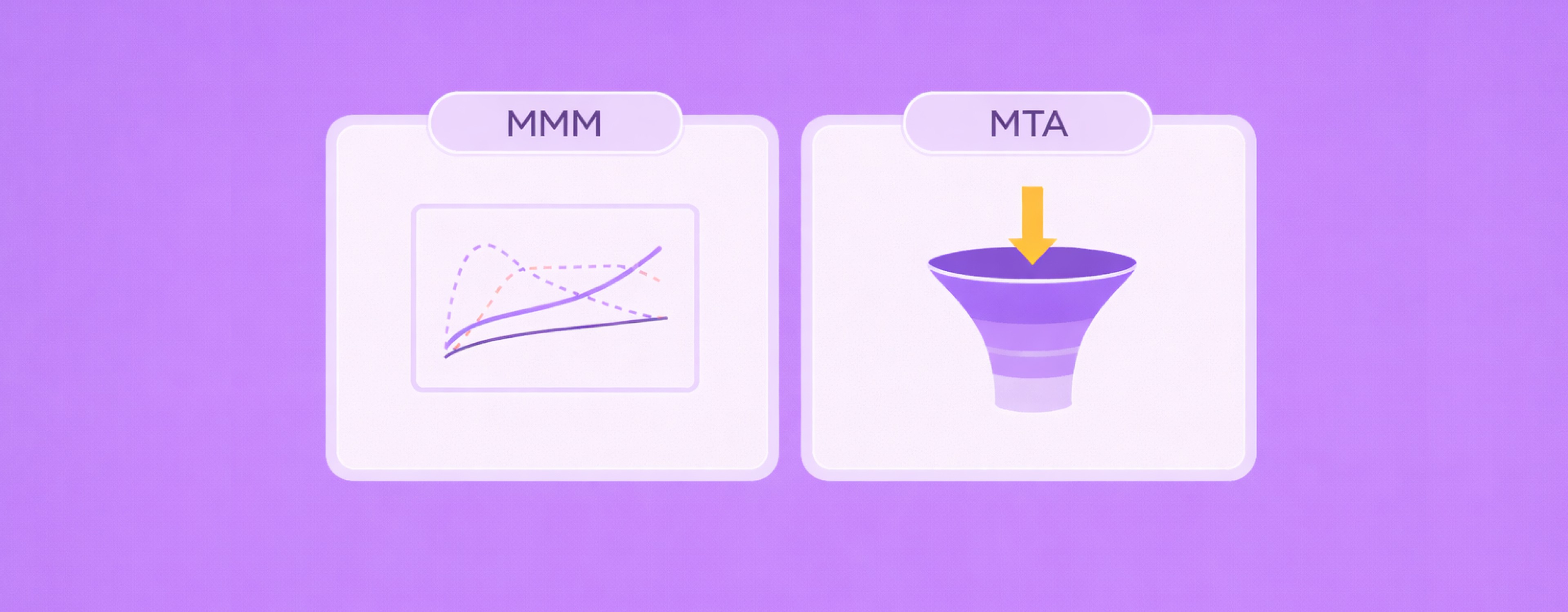
MMM vs MTA is one of the most common questions in marketing measurement. Marketing Mix Modeling and Multi-Touch Attribution look at the same performance question from opposite angles, operate on different data, and produce different kinds of decisions. Neither replaces the other. Here's what separates them, and where incrementality testing fits.
What is Marketing Mix Modeling (MMM)?
The short answer to what is MMM in marketing: a statistical technique that quantifies the contribution of each marketing channel to sales or revenue using aggregated historical data.
The MMM model works by pulling together months or years of spend data, sales figures, pricing, promotions, and external factors like seasonality and competitor activity. A statistical model identifies the relationships between those inputs and business outcomes, producing a channel-level view of what drove revenue and scenarios for how budget reallocation would affect future results.
MMM attribution operates at the macro level: How much does each channel contribute to sales? How should budget shift between paid social, CTV, and search next quarter? Because it uses aggregated data rather than individual user tracking, it is not affected by privacy restrictions or cookie deprecation, and can incorporate offline channels, in-store sales, and marketplace revenue. The tradeoff: it requires substantial historical data, is slow to update, and produces channel-level outputs rather than campaign-level ones.
What is Multi-Touch Attribution (MTA)?
Where MMM takes a macro view, MTA zooms in. Multi-Touch Attribution tracks individual customer journeys across digital touchpoints and distributes conversion credit across each interaction that contributed to a purchase. Rather than giving all credit to the last click before conversion, MTA attempts to reflect the full path.
There are several ways to assign that credit. First-touch models weight the initial interaction; last-touch models weight the final one; linear models split credit equally; time-decay models weight interactions closer to the conversion more heavily. Data-driven models use machine learning to assign credit based on observed patterns.
In terms of practical output, MTA vs MMM comes down to this: MTA produces granular, near real-time data suited to campaign-level decisions, showing which ads, emails, and search terms are working within a digital funnel.
Its structural limitations are significant. MTA is digital-only and cannot account for offline channels, in-store activity, or marketplace sales. It depends on user-level tracking, and iOS privacy changes and cookie deprecation have reduced that data considerably. Like MMM, it is also built on correlation: it identifies which touchpoints preceded conversions, not which ones caused them.
MMM vs. MTA: what separates them
The essential difference in multi touch attribution vs marketing mix modeling is the level at which each operates.
Media mix modeling vs attribution modeling covers similar ground: MMM produces aggregated, channel-level insight suited to long-term budget allocation. Attribution modeling (MTA included) produces granular, touchpoint-level insight suited to campaign optimization.
MMM | MTA | |
Data type | Aggregated, historical | Granular, user-level |
Channel coverage | Online and offline | Digital only |
Time horizon | Quarterly / annual | Near real-time |
Primary output | Budget allocation | Campaign optimization |
Privacy impact | Not affected | Significantly affected |
When it comes to comparing marketing mix modeling vs attribution, the answer is clear:
MMM is built for the CMO deciding where to invest next quarter; MTA is built for the performance team optimizing campaigns this week. Most mature brands use marketing mix modeling and multi touch attribution in tandem, with MMM anchoring strategic planning and MTA driving tactical execution.
What about incrementality? Isn't WorkMagic an incrementality testing brand?
Yes. It is worth addressing directly.
Incrementality testing is not a replacement for MMM or MTA. It is what makes both of them reliable.
The limitation that MMM and MTA models share is that both are built on correlation. MMM identifies statistical relationships between historical spend and outcomes. MTA tracks which touchpoints preceded conversions. Neither can answer the foundational question: would this revenue have happened anyway, without the ad?
That is what incrementality testing establishes. By running geo lift tests with randomized control groups, brands measure the causal impact of their advertising: the revenue that genuinely would not have occurred without the campaign. Incrementality testing also captures halo effects that neither MMM nor MTA can see: the lift on Amazon or TikTok Shop that a Meta or YouTube campaign drives but never receives credit for in standard reporting.
WorkMagic's approach is triangulation: run geo incrementality tests to establish causal baselines, use those results to calibrate data-driven attribution for daily decisions, then use both to calibrate incrementality-calibrated MMM for strategic planning. The stack runs: incrementality → DDA → MMM.
In practice: LifePro used incrementality-calibrated MMM to build a confident BFCM budget strategy grounded in causal outcomes. True Classic found TikTok's true impact was 74% higher than any-click attribution showed once halo effects on Amazon and organic search were included.
For a deeper look at how MTA compares to other measurement approaches including post-purchase surveys, this breakdown of incrementality vs MTA vs post-purchase survey covers the tradeoffs in detail.
Where to start
Early-stage DTC brands typically start with MTA for immediate campaign feedback, then run incrementality tests as budget scales. Brands with significant offline spend add marketing mix modeling for ecommerce once enough historical data exists. At that point, media mix modeling vs multi touch attribution is no longer an either/or question. Both are running, and incrementality testing is grounding both in causal reality.
The goal is not to pick the best model. It is to build a stack where each layer makes the others more accurate.
Frequently asked questions
What does MMM stand for in marketing?
MMM stands for Marketing Mix Modeling: a statistical technique that uses aggregated historical data to quantify each marketing channel's contribution to sales or revenue.
What does MTA mean in advertising?
MTA stands for Multi-Touch Attribution. It tracks individual customer journeys across digital touchpoints and distributes conversion credit across each interaction that preceded a purchase.
What's the difference between MMM and MTA?
MMM operates at the channel level using aggregated historical data, suited to long-term budget planning. MTA operates at the user level using granular digital data, suited to campaign optimization. Most mature brands use both.
Can you use MMM and MTA together?
Yes. MMM handles strategic planning; MTA handles day-to-day optimization. Both become more reliable when calibrated against incrementality test results, which provide the causal baselines neither model produces on its own.
Is it good to use MMM?
MMM is a strong tool for channel-level budget planning, particularly for brands with offline spend or complex media mixes. It works best as part of a broader measurement stack rather than in isolation.
What is incrementality testing and how does it relate to MMM and MTA?
Incrementality testing uses randomized control groups to measure the causal impact of advertising. It addresses the core limitation MMM and MTA share: both measure correlation, not causation. Calibrating both models against incrementality results produces attribution grounded in true causal performance.