Cross-Functional eCommerce Metrics That Benefit From Marketing Mix Modeling

by
Isaac Lee
The first blog in this series looked at how incrementality testing gives finance and marketing a shared foundation for measuring performance. This one goes a level up — into planning and forecasting. The decisions that shape how a business allocates resources, manages inventory, and sets growth targets touch every function. Marketing Mix Modeling, calibrated by incrementality testing, gives those decisions a common, reliable base.

Revenue Forecasting and New Customer Acquisition

The most direct output of MMM's saturation curve is a projected revenue figure at each spend level. For finance, that's the number that makes forward-looking planning possible: connecting a planned budget to an expected revenue outcome they can present to leadership with confidence.

But the saturation curve does more than project revenue. By modeling average ROAS and marginal ROAS at each spend level, it also gives finance and marketing a principled way to agree on new customer acquisition targets. As marginal ROAS declines with each additional dollar of spend, the implied CAC rises. That relationship, made visible through WorkMagic's MBO, allows both teams to identify the spend level at which new customer acquisition remains profitable — and set a CAC threshold they're both comfortable with.
What makes WorkMagic's approach particularly useful is that the same model can be oriented toward different goals. A fast-growing brand can optimize for total sales to capture market share. A mature brand can optimize for contribution margin to protect profitability.
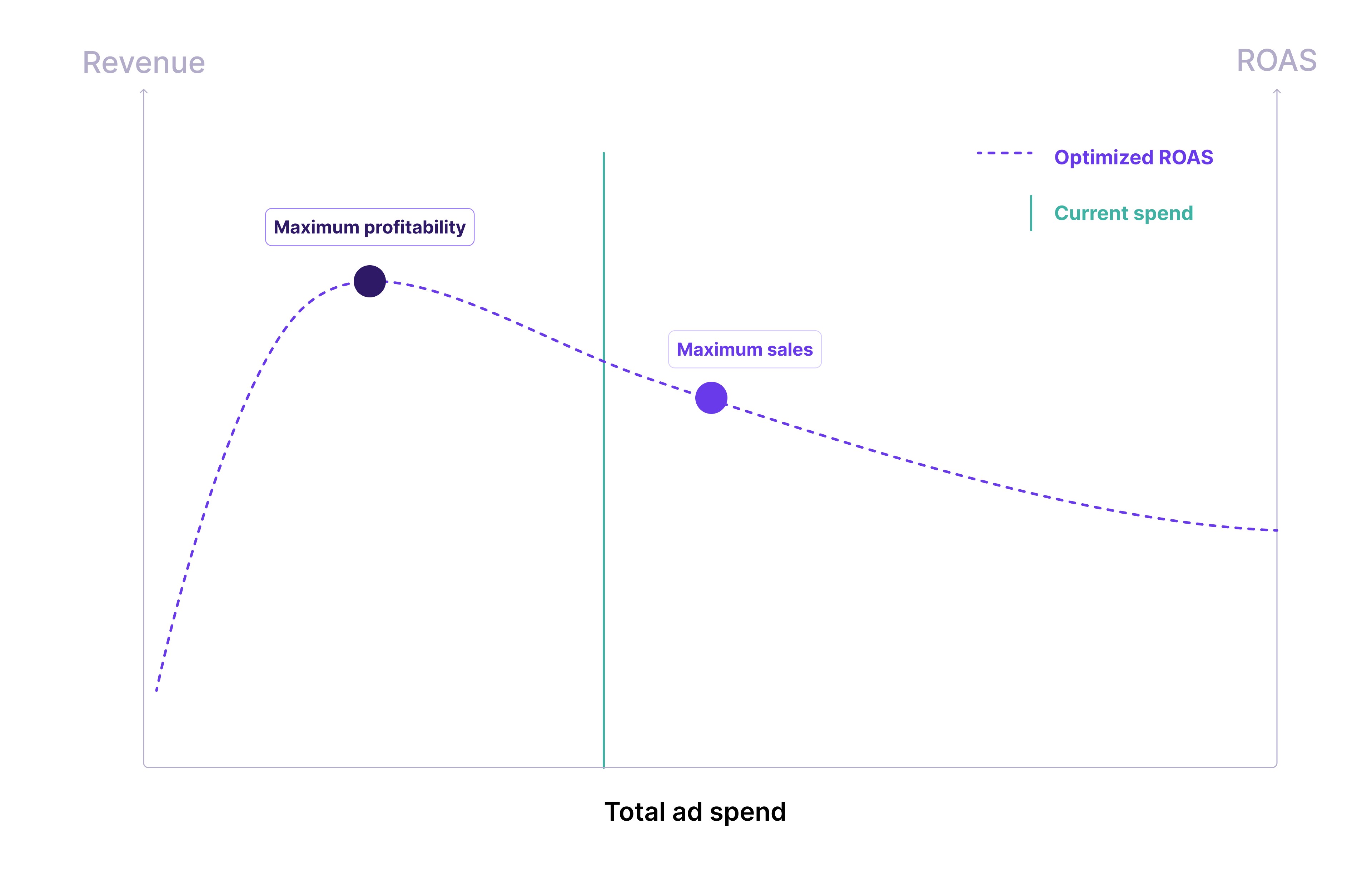
IndaCloud experienced this when leadership shifted their mandate mid-quarter from maximizing profitability to growing top-line sales while maintaining healthy margins. The Media Budget Optimizer let them model new scenarios in minutes, finding the optimal balance between the two objectives. Finance and marketing were planning from the same model — reoriented to a new goal, with projections both teams could build from.
"At the end of the day, you can have infinite amount of data, but what is it going to provide you when it comes to actionable insight? The reason we work with WorkMagic is because they take the guesswork out of it, we know where to spend along our revenue curves to hit profitability. That's a gamechanger for us." — Josh Bertini, CRO, IndaCloud
Demand Forecasting and Out-of-Stock Rate

Once revenue and order volume are projected from the saturation curve, the inventory calculation follows naturally. Ops teams can use the same revenue projection to size purchase orders and plan fulfillment capacity. A planned spend increase no longer just means more revenue on a finance spreadsheet — it means a projected number of orders that ops can prepare for in advance.

This is where cross-functional planning becomes genuinely collaborative. Marketing sets the spend plan. The saturation curve projects the order volume. Ops builds inventory and fulfillment capacity around that projection — before the campaign launches, not in response to a stockout after it. The lead time that ops needs to prepare is exactly what MMM provides, and helps keep OOS rates within acceptable limits.
David Protein experienced this as they scaled rapidly from DTC into Amazon and retail. With growth came the challenge of forecasting demand across an increasingly complex set of channels — and the need for a foundation that finance, ops, and marketing could all plan from. With WorkMagic's incrementality framework in place, the growth team could scale spend confidently during aggressive periods, while finance and ops could forecast and fulfill the resulting demand.
"Finance really appreciated the results and the accompanying analysis — it gave them far more confidence in lieu of our previous assumptions and estimates." — Gavin McManus, Growth Manager, David Protein
Budget Planning and Profitability

Budget planning happens at a different cadence from day-to-day forecasting — quarterly or annually, with higher stakes and longer time horizons. It's the conversation where finance and marketing need to agree not just on what spend will produce this week, but on the channel mix and allocation that will drive the business forward over the next quarter or year.
This is where the MBO is most powerful as a cross-functional tool. Rather than stopping at insight, it translates MMM outputs into specific, actionable budget recommendations — showing exactly where to allocate across channels to hit a business goal, down to the dollar. The recommendations account for seasonality, demand spikes, promotions, and the proven causal impact of each channel. Finance can approve a budget that's grounded in evidence. Marketing can execute a plan they helped build.

For IndaCloud, facing a mandate to maximize profitability on a constrained budget, the MBO identified the optimal channel allocation and produced a 150% increase in marketing profitability in January 2026. Allocations were no longer being made on instinct or lagging reports — they were grounded in causal analysis of where returns were at their peak and where diminishing returns were beginning to set in.
"It's such a time saver at the end of the day, and time is so precious. We can try and analyze and predict through our own models to how we should spend, but to just plug that into the Media Budget Optimizer, get our outputs, and witness the results, it's invaluable. That's where the power is." — Josh Bertini, CRO, IndaCloud
The Common Thread
When planning and forecasting are grounded in the same model, the whole organization moves more confidently. Finance approves budgets with evidence rather than assumption. Ops plans inventory around a demand signal it can trust. Marketing scales spend knowing the projections it's working from are ones the rest of the business believes in too.
MMM provides that shared foundation. But its accuracy depends on what it's built from. Incrementality testing is what ensures the saturation curves, budget recommendations, and revenue forecasts reflect true causal impact rather than historical correlation — and that's what makes the difference between a forecast that gets challenged in a planning meeting and one that the whole team can action on.