Seam-less Success: Key Metrics and Insights for the Fashion and Apparel Space

by
Isaac Lee
In this article, we take a closer look at the metrics and methodology driving advertising in the Fashion and Apparel industry.
In fitting with the theme, we're calling it WorkMagic's Spring/Summer 2025 Collection!
We take a look at how ROAS and CPAs fluctuate over time, as well as how different measurement methodologies impact those numbers, to give brands a baseline from which they can understand their own metrics.
Methodology
To gather this data, we looked at over 8-figures in ad spend to discern the impact that seasonality and measurement methodology has on 2 key metrics: cost per acquisition (CPA), and return on ad spend (ROAS).
We aimed to elucidate how commonly-used measurement methodologies, such as last-click attribution and platform-reported metrics, differed from the ground truth, and to see if that gap fluctuated over time.
Here's how we did it:
We used incrementality tests to determine a ground truth for each metric, then measured how the gap between ground truth and the tested method's result fluctuated over the months.
For example, we measured the difference between ad platform-reported ROAS and incrementality-calculated ROAS each month, then repeated that process using last-click attribution versus incrementality.
This allowed us to answer these, and other, questions:
What is the average gap between platform-reported CPA/ROAS and incrementality-calculated CPA/ROAS, and how does that gap change over time?
What is the average gap between last click-reported CPA/ROAS and incrementality-calculated CPA/ROAS, and how does that gap change over time?
Which method gets brands closer to the truth? Platform-reported metrics, or last-click attribution?
If a brand cannot currently run incrementality tests, what are some industry benchmarks they should be aiming for?
Our findings
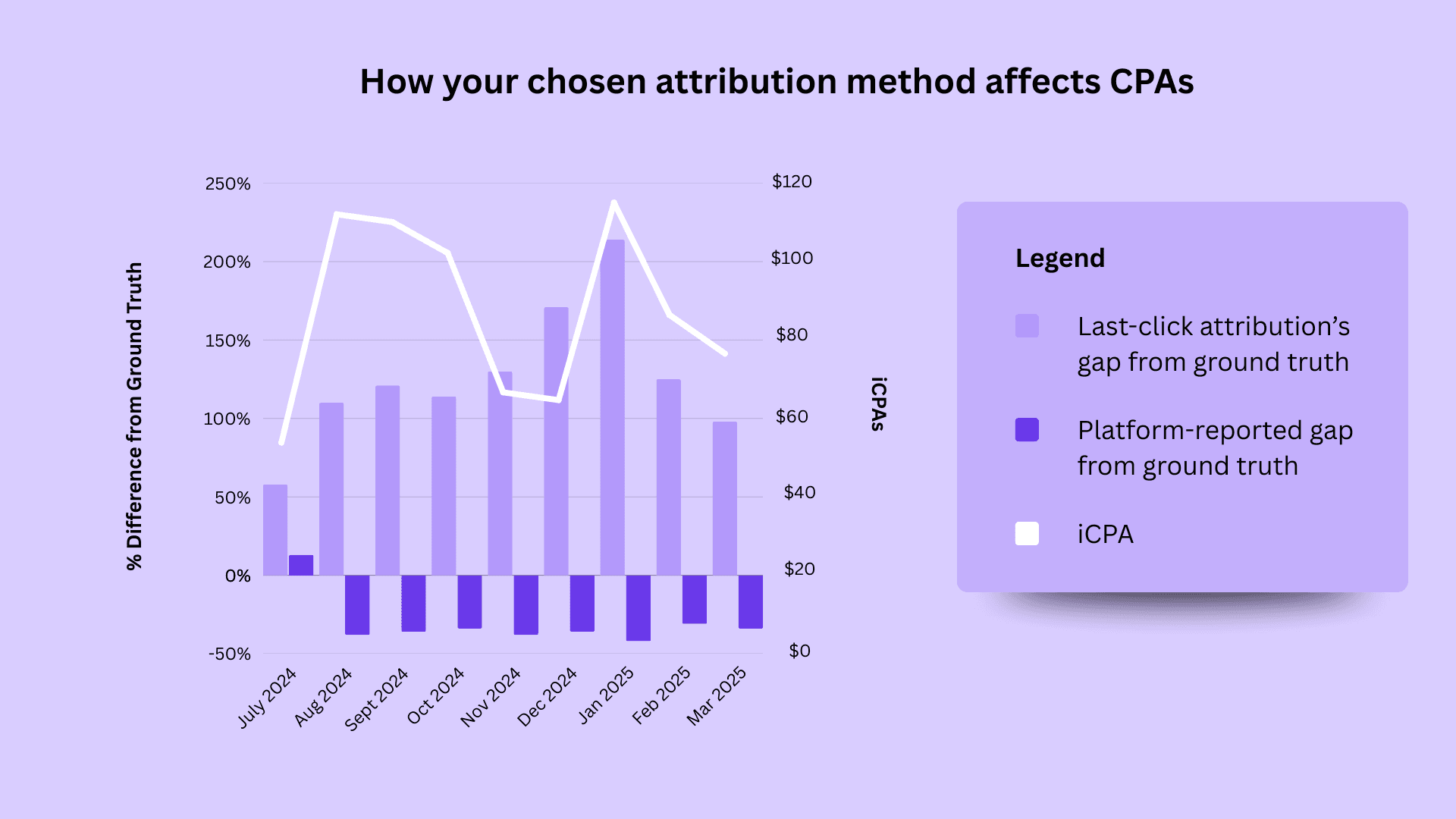
Average Gap between Platform CPA and the Ground Truth
First up: we see an average of -31% under-reporting of CPA costs from platforms. Flipping that statement on its head might make it easier to understand: you might be underestimating your cost per acquisition by up to 31%!
For brands that are not yet ready to run their own incrementality tests, this benchmark is pretty important information. Here's what else you need to know to make sense of this:
Understand ad platform attribution windows
These include: view-through: 1 day, and click-through: 1-7 days. Any interaction that meets those rules that ends up in a sale will be counted as a conversion in platform metrics, generally leading to higher reported conversions compared to an incrementality test, and thus a lower CPA.
Know that platforms are trying their best here
Rules-based attribution is limited by the amount of data that you can try to delineate and extrapolate from awareness to purchase. In publishing these trends, we're hoping to show a consistent delta (-31%) from ground truth as measured by multiple incrementality tests, and across a large sample size.
Average Gap between Last-click CPA and the Ground Truth
On average, last-click CPAs are higher than incremental CPAS (iCPAs) by 127%.
What to make of this:
View-based platforms are always going to be underrepresented in last-click attribution models, which is the complete opposite to platform-reported metrics, where the platform tries to use signals like ad views to extrapolate out to a conversion.
Imagine the typical customer journey: discovering a brand on Instagram, researching more on Google, clicking through to purchase... Platform conversions drop (those clicks went to Google) and their CPA increases.
That's why WorkMagic recommends a data-driven attribution (DDA) model incorporating signals from ad platforms and first-party data at the minimum.
In summary, the data reaffirms what we've known: if you're looking at CPAs, platforms will generally underreport CPAs, while a last-click attribution model will overreport CPAs‚ purely due to the nature of each methodology.
Average Gap between Platform-reported ROAS and the Ground Truth
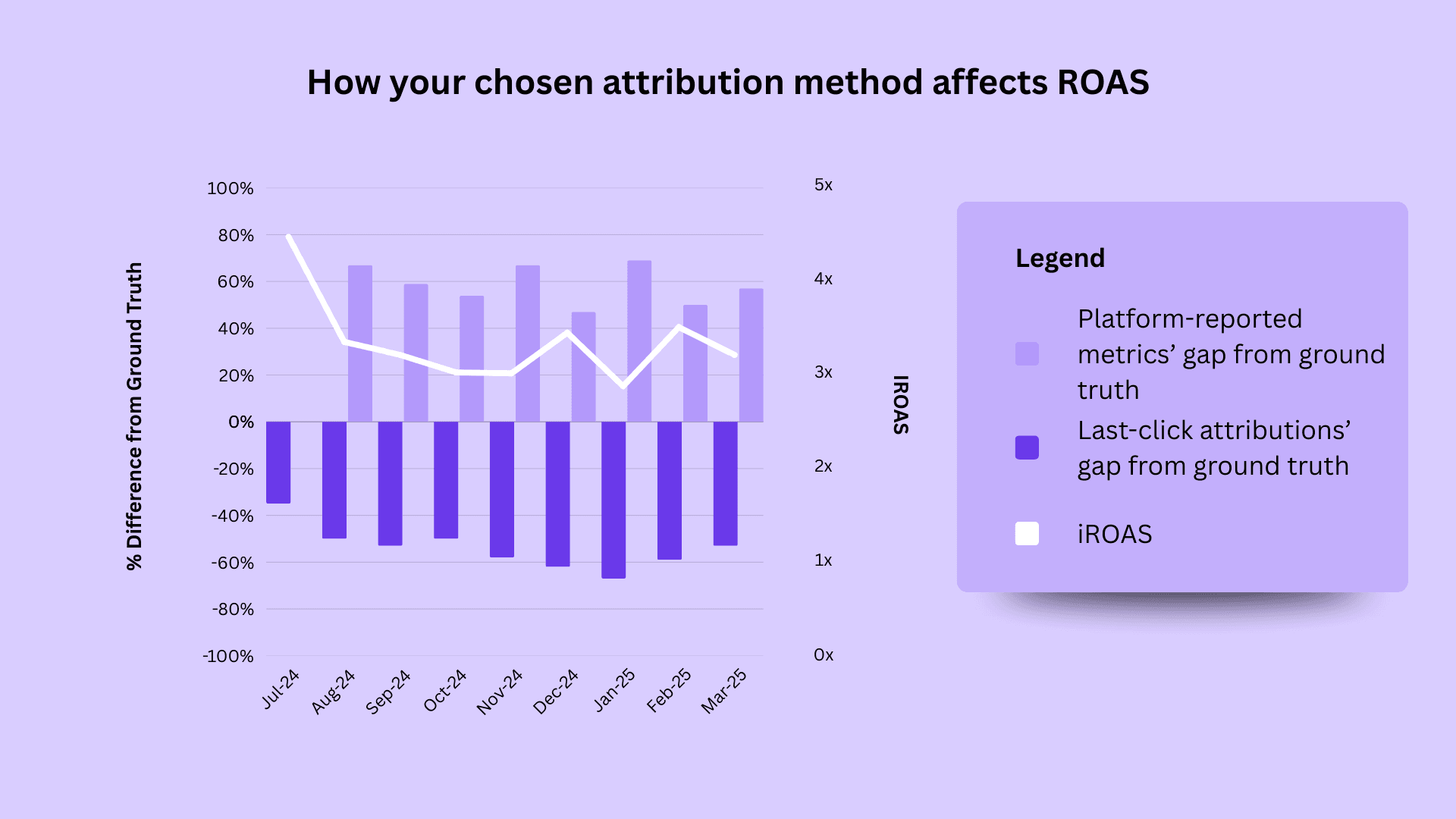
Next up, ROAS.
Similar conclusions as the CPA chart can be made here.
Using incrementality test results as a ground truth for ROAS numbers, we see that last-click attribution undercounts the return on Meta ad spend by about 54%, while the platform itself typically overcounts its ROAS, to the tune of around 52%.
Fashion and apparel brands that aren't able to run their own incrementality tests should use these benchmarks to adjust their own platform-reported and last-click ROAS numbers to hone in on the true return on spend.
Average ROAS for Fashion and Apparel Brands
The average incrementality-calculated ROAS for this industry stood at 3.34x during our study, which represents a healthy return on investment for brands in the space.
Falling CPAs during BFCM
Lastly, across the board, CPAs actually drop during the holiday season. While the average CPA sits around $110, that dips to $60 during the BFCM and holiday months of November and December.
Customers are primed and ready to buy during this season, so it's no wonder that conversions come in at a lower cost during this time.
With this in mind, brands should make clear distinctions between targeting them, and other net new customers.
Giving ad platforms different objectives (e.g. Retargeting and re-engaging existing customers vs. Maximizing conversions on a lookalike campaign) helps your brand to optimize towards the lowest CPAs during this time of year.
What brands can do
It's hard to make one-size-fits-all recommendations, so we typically suggest a ladder of recommendations tailored to the size of each brand:
Start with Benchmarks and Data-driven Attribution
For brands under the suggested threshold of 3,000 monthly orders for incrementality tests, their volume might not give the platform enough data to accurately calculate the incremental lift of each channel, and its associated metrics. We typically recommend starting with data-driven attribution, where a combination of first-party pixel data and signal from the platform helps us form a much better picture of where your conversions are occurring. Separately, we'll regularly publish reports (such as this one!) to give brands benchmarks to which they can adjust the results of their attribution model of choice.
Layer on incrementality testing
Brands that are ready for incrementality testing should run regular incrementality tests through the WorkMagic platform, across their various advertising channels.
In case you're unfamiliar, incrementality testing is a marketing measurement method that utilizes a controlled experiment to determine the impact of marketing on key customer actions, such as purchases, by comparing results between a group exposed to the marketing and a control group that is not.
These results are then used as a ground truth to calibrate their various other measurement methodologies, such as MMM and MTA.
Ready to get started? Book a demo of the WorkMagic platform today.