What Are Incremental Sales? Definition, Formula, and How to Measure Them Accurately

by
Isaac Lee
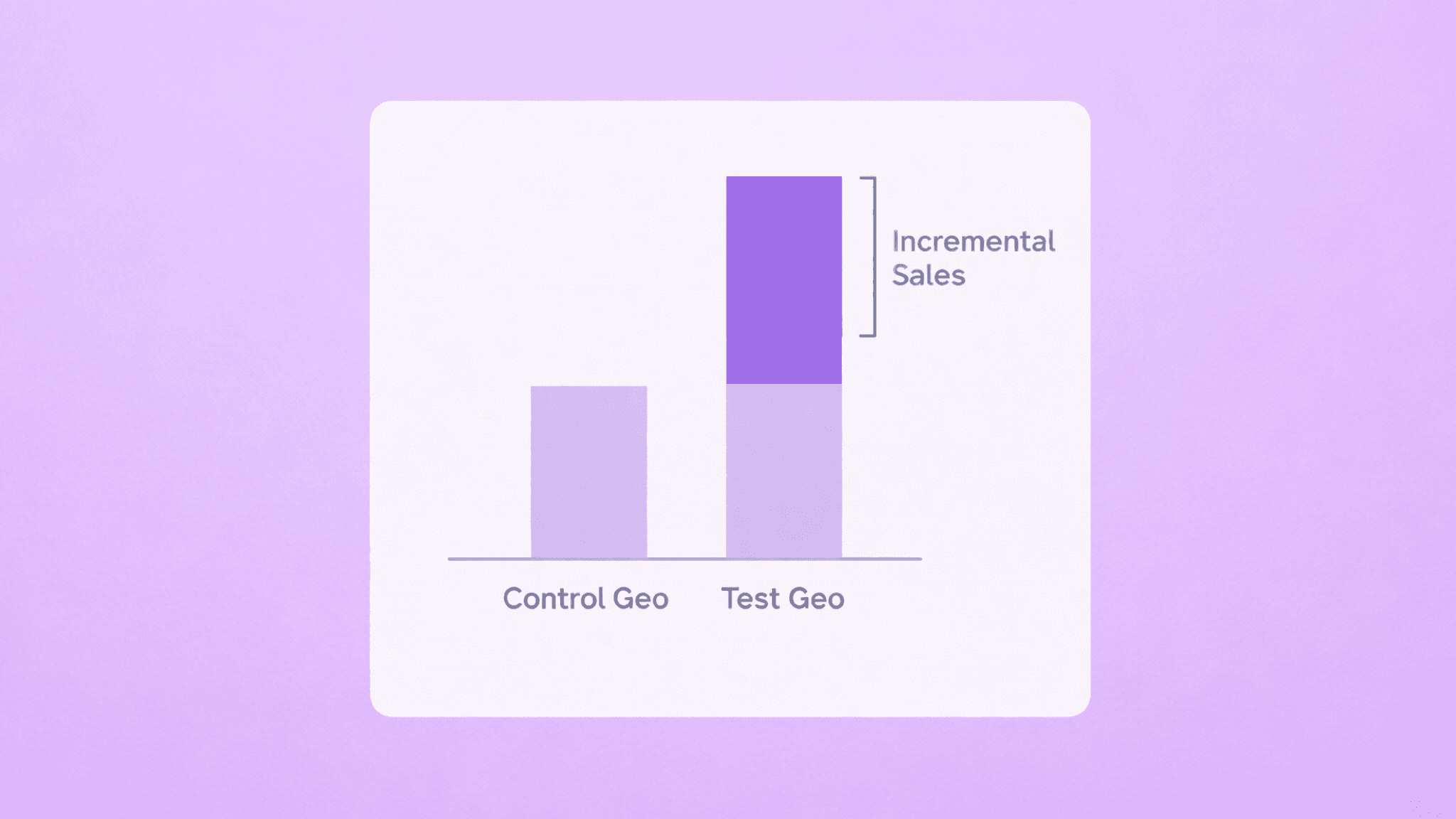
Incremental sales are the revenue generated specifically by a marketing activity: the sales that would not have occurred without it. Calculated as total sales minus baseline sales, this metric captures what your advertising, promotions, or campaigns actually caused, rather than what they happened to coincide with. For DTC brands measuring ad performance across Shopify, Amazon, and retail, it is the number that matters most and the hardest one to measure accurately.
What is the meaning of incremental sales?
Incremental sales refers to revenue attributable to a specific marketing activity, above what would have occurred without it.
The word "incremental" is the operative one. Total sales include everything: purchases driven by ads, organic demand, seasonality, word of mouth, and prior brand awareness. Incremental sales strip out everything that would have happened anyway and isolate only the revenue your activity caused.
What are incremental sales in practice? They are the answer to the question: if we hadn't run this campaign, would this customer still have bought? If yes, that sale isn't incremental. If no, and the campaign is what brought them in, it is.
Incremental value can only be measured against a counterfactual: what would have happened in the absence of the activity. That counterfactual is the baseline.
What is the difference between total sales and incremental sales?
Total sales is the full revenue your business generates across all channels during a given period. Incremental sales is the portion of that revenue directly caused by a specific marketing activity.
The gap between the two is baseline sales: purchases that would have happened regardless. Organic search traffic, repeat customers buying on habit, and demand built by prior campaigns all contribute to the baseline. A brand with strong awareness and high retention will have a large baseline; a new brand acquiring customers for the first time will have a smaller one.
This distinction matters because optimising for total sales can lead you to pour budget into channels that are capturing demand you already created, rather than generating new demand. Incremental sales measurement forces the question: is this spend actually working, or is it just present when purchases happen?
How do you calculate incremental sales?
The incremental lift formula is:
Incremental sales = Total sales (test group) − Baseline sales (control group)
The formula is simple. Establishing the baseline is not.
The baseline is not your average sales from last month, or your sales on days when you don't run ads. Both approaches are confounded by seasonality, trend, and changes in other spend. A reliable baseline requires a controlled measurement: a group of customers or markets that experienced the same conditions as your test group, except for the marketing activity you're evaluating.
Why ad platform reporting doesn't give you incremental sales
Ad platforms like Meta, TikTok, and Google each report their own version of the sales they drove. These numbers are not incremental sales figures. They are multi-touch attribution models, built around each platform's own data ecosystem, which means they can only measure what happens within their own channel.
Meta's pixel looks for purchases that followed an ad exposure. Google's last-click model takes credit for conversions where its ad was the final touchpoint. TikTok's reporting counts purchases within its attribution window. None of these platforms can see what would have happened without their ads, which is exactly what you need to calculate incrementality, and none of them can see purchases happening on channels outside their own ecosystem.
The result is that platform-reported numbers tend to overstate the causal contribution of ad spend. Each platform attributes credit to purchases that occurred within its measurement window, but cannot distinguish between purchases it caused and purchases that would have happened regardless.
The baseline for incremental sales measurement has to come from the sales channel side: Shopify, Amazon, and retail point-of-sale data, not from the ad platform. It has to be measured against a control: a geography that didn't receive the ads, so you can observe what your sales channels generate on their own, without advertising driving demand.
How geo incrementality testing measures true incremental sales
Geo incrementality testing is the method purpose-built for this problem. A geo lift test divides your addressable market into matched geographic regions. The test group receives your ads; the control group is held dark. Both groups are tracked across every sales channel (Shopify, Amazon, TikTok Shop, retail) for the duration of the test.
Incremental sales equals the difference in revenue between the test and control geographies, scaled to the full market.
This gives you a causal number. Not correlation or attribution, but causation. The only variable that differs between test and control is the ad exposure. Everything else, from seasonality to organic demand to competitor activity, affects both groups equally and cancels out.
Critically, this measurement captures sales across every channel where your customers buy, not just the one the ad was pointing at. Brands consistently find that a significant share of incremental sales land somewhere other than the campaign's intended destination: on Amazon when the ad pointed to DTC, or in retail when the campaign was running on TikTok.
Graza's geo lift test on Meta showed a 2.7× higher true incremental impact than last-click had reported. Nordic Naturals found that 99.6% of TikTok's incremental sales occurred on Amazon, not on the DTC site the campaign was driving to, a result entirely invisible to standard attribution. True Classic's TikTok incrementality test showed real incremental impact 74% higher than any-click attribution had suggested.
In each case, the finding wasn't just a different number. It was a different understanding of where incremental sales were actually happening, which changed where to invest next. Once established, geo lift results can be used to calibrate an incrementality-adjusted attribution model, so that day-to-day reporting reflects the true causal contribution of each channel, not just platform self-reported numbers.
Frequently asked questions
What do you mean by incremental sales? Incremental sales are the revenue generated specifically by a marketing activity: the sales that would not have occurred without it. The term contrasts with baseline sales, which are the purchases that happen regardless of advertising. Measuring incremental sales requires a controlled comparison: a group or geography that did not receive the marketing activity, so you can isolate its causal contribution.
What is the difference between total sales and incremental sales? Total sales is all revenue your business generates in a period. Incremental sales is the portion of that revenue directly caused by a specific marketing activity. The difference between the two is baseline sales: purchases driven by organic demand, prior brand awareness, and factors unrelated to the campaign being measured.
How do you calculate incremental sales? Incremental sales equals total sales in the test group minus baseline sales in the control group. In practice, the most reliable method is a geo lift test: run ads in a test geography, hold a matched control geography dark, and measure sales across all channels in both groups. The difference is incremental sales. This approach controls for seasonality, organic demand, and other variables that simple before/after comparisons cannot.
What does incremental mean in business? In business, incremental refers to what is added above an existing baseline: the additional output, revenue, or value generated by a specific activity, beyond what would have existed without it. Incremental sales, incremental revenue, and incremental spend all use this framing: what changed because of this decision, compared to what would have happened anyway.
What are incremental sales in marketing? In marketing, incremental sales are the purchases directly caused by a campaign or ad spend, as opposed to sales that would have happened organically. Measuring incremental sales accurately requires a controlled test that establishes what baseline demand looked like without the marketing activity. Ad platform reporting (Meta, TikTok, Google) provides attribution, which assigns credit but cannot establish causation.