What Is Incremental Revenue? Why the Definition Matters for Ad Measurement

by
Isaac Lee
Every ad platform will tell you how much revenue it generated. What none of them will tell you is how much of that revenue would have happened anyway. Incremental revenue answers that question, and for DTC brands trying to make confident budget decisions, it is the only number that actually matters.
What is incremental revenue?
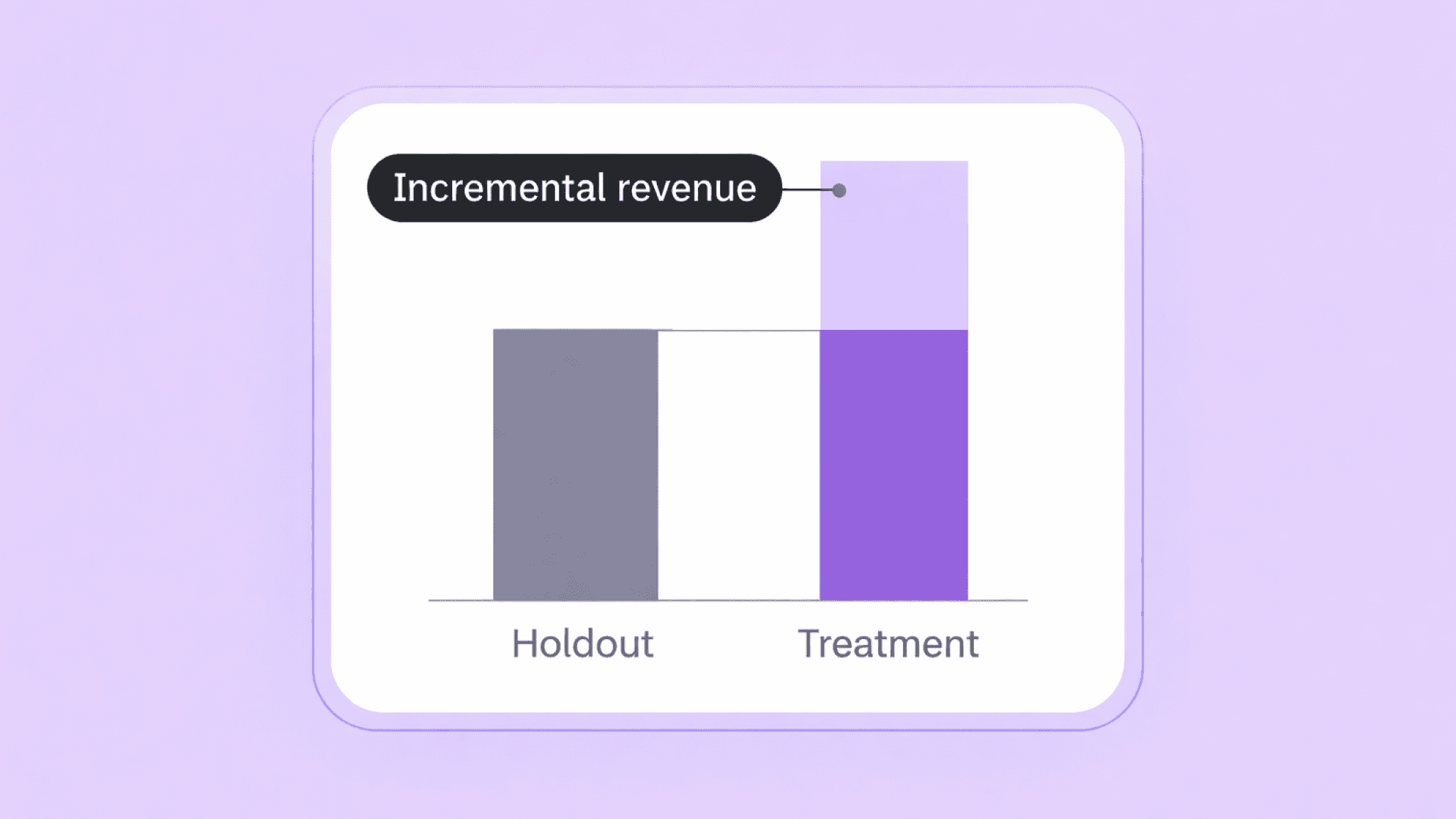
Incremental revenue is the revenue your business earned specifically because of your advertising: the sales that would not have occurred without your ads running.
To understand the incremental revenue meaning, you need to separate two types of sales. The first are sales your ads caused. The second are sales that would have happened regardless, from customers who found you through organic search, word of mouth, or existing brand loyalty. Incremental revenue only counts the first type.
Every business has a baseline level of sales that occurs without paid advertising. Incrementality testing isolates what sits above that line. It is the pure causal impact of your ad spend, stripped of the background noise.
What is the difference between total revenue and incremental revenue?
Most brands measure attributed revenue: the revenue their platforms report as driven by ads. Incremental revenue and attributed revenue are not the same number, and the gap between them is often significant.
Attributed Revenue | Incremental Revenue | |
|---|---|---|
What it measures | Revenue correlated with an ad touchpoint | Revenue caused by the ad |
How it's calculated | Credit assigned to clicks or views | Test group minus control group |
Organic sales included? | Yes — any sale after an ad interaction | No — baseline is subtracted out |
Halo effects captured? | No — only tracks within-platform | Yes — measures across all channels |
Reliability for budget decisions | Low | High |
Attributed revenue can be 2x, 3x, or even 10x higher than incremental revenue, because it counts sales that would have happened anyway. A returning customer who clicks a retargeting ad before repurchasing is not an incremental customer — they were already going to buy.
Attribution also misses halo effects entirely. When a customer sees a TikTok ad but purchases on Amazon, last-click attributes the sale to Amazon search. Incrementality testing captures that TikTok drove the sale, regardless of where it completed.
What is the incremental revenue formula?
The incremental revenue formula is built on a test-and-control comparison:
Incremental Revenue = (Test Group Revenue − Control Group Revenue) × (Full Population / Test Population)
The test group receives your ads. The control group is matched on geography, customer behavior, or both, and receives no ads for the duration of the test. The revenue difference between the two groups, scaled up to represent the full business, is incremental revenue.
This is the core of geo incrementality testing. The formula assumes both groups are identical except for ad exposure. When that condition holds, the revenue difference is causally attributable to your advertising alone, not seasonality, not brand awareness, not organic demand.
How to calculate incremental revenue in practice
The most common approach is geo lift testing: ads are run or paused in different geographic regions, and revenue is compared between test and control geos over the same period.
A D2C footwear brand ran this exact test on Meta. The test group received Meta ads; the control group did not. Incremental revenue came in meaningfully lower than platform-reported attributed revenue, but iROAS was solidly positive. The brand reallocated budget based on the causal data and grew revenue 34% while boosting net profit by 37%.
To calculate incremental revenue accurately, you need three things: a clearly defined test period (typically 3–6 weeks), test and control groups matched on historical revenue behavior, and revenue measurement across all channels, not just the one being tested.
That last point matters. Incremental revenue is not just what happens on Shopify. It includes the halo effect on Amazon, TikTok Shop, and retail. Measuring only one platform understates the true incremental impact, sometimes dramatically.
What is iROAS, and how does incremental revenue connect to ad spend?
Incremental ROAS (iROAS) is incremental revenue divided by the ad spend that generated it:
iROAS = Incremental Revenue / Ad Spend
If you spent $100,000 on Meta ads and incrementality testing shows $400,000 in incremental revenue, your iROAS is 4.0x. Every dollar of spend generated four dollars in revenue that would not have existed without the campaign.
iROAS is the version of ROAS that finance teams can act on. Platform-reported ROAS includes the organic baseline. iROAS strips it out, leaving only the causal return, which maps directly to profitability.
Why does incremental revenue matter to finance teams?
Finance operates on P&L reality. Attributed revenue figures do not. The gap between them is the source of most budget disputes between marketing and finance, and it is often larger than either team expects.
David Protein found that traditional attribution was overestimating DTC orders by 36%. That is not a rounding error. It means the financial case for those channels was being built on revenue that was going to arrive regardless of the ad spend.
Once both teams agreed to measure incremental revenue and build budgets around iROAS, budget alignment followed naturally. Finance had causal data they could defend. Marketing had a number they could stand behind. The question "is this channel profitable?" stops being a debate when incremental revenue is the answer. Once incrementality baselines are established, they can be used to calibrate an incrementality-adjusted attribution model so that day-to-day reporting stays grounded in causal reality.
Frequently asked questions
What is the meaning of incremental revenue?
Incremental revenue is the additional revenue generated specifically by a marketing activity or business action, above what would have occurred without it. In ad measurement, it refers to the sales caused by a campaign, as opposed to sales that would have happened through organic demand, brand awareness, or prior customer loyalty. It is calculated by comparing revenue in a group that received the marketing activity against a matched control group that did not.
What is the difference between total revenue and incremental revenue?
Total revenue is all revenue your business generates in a period, regardless of cause. Incremental revenue is only the portion of that revenue directly caused by a specific action or campaign. The difference between the two is baseline revenue: the sales that would have happened anyway, with no marketing intervention. For DTC brands running incrementality tests, the gap between attributed and incremental revenue is often 2x to 5x.
How do I calculate incremental revenue?
Incremental revenue equals test group revenue minus control group revenue, scaled to the full population. In practice, the most reliable method is a geo lift test: run ads in a test geography, hold a matched control geography dark, and measure revenue across all channels in both groups. The difference, scaled to your full addressable market, is your incremental revenue for that campaign.
What is the difference between marginal revenue and incremental revenue?
Marginal revenue is an economics concept referring to the additional revenue from selling one more unit of a product. Incremental revenue in marketing refers to the additional revenue generated by a specific campaign or initiative, above the baseline. The two terms are related but used in different contexts: marginal revenue is about pricing and production decisions, while incremental revenue is about measuring the causal impact of marketing spend.