
Elaine Wei
VP of Marketing at WorkMagic
Why marketers mistake correlation for causation, and how you can understand avoid the common pitfalls of marketing measurement.
"Correlation is not causation" is probably one of the best-known but least understood maxims about statistics out there. The proof? The most common measurement tools used by marketers are (still) mostly click-based, with GA4 alone claiming up to an 88% market share.
While two marketing variables that move in tandem might indicate a correlation (for example, a visitor clicked on your ad, and then clicked to complete checkout), this doesn't necessarily mean that one is causing the other. Let's take a look at other examples where correlation and causation are commonly confused in marketing.

Examples Showing Highly Correlated Variables That Aren't Causally Linked
In marketing, we often observe correlations that might seem like causal relationships at first glance. Here are a few examples:
Increased Ad Spend and Higher Sales During Seasonal Peaks:
A brand might increase its ad spending during the holiday season and simultaneously see a significant rise in sales. While these two are correlated, the increased sales are likely driven by overall consumer demand during the holidays, not solely by the increased ad spend. The ad spend might contribute to the increase, but it's not the sole cause.
A rise in conversions coming from Organic Search:
Customer journeys are non-linear, and customers often seek the easiest path to purchase once they've made their minds up. Often, this looks like an increase in conversions coming from Organic Search channels, or perhaps even Direct Traffic. In actuality, these customers might have been influenced by a campaign on TikTok, and were just beating the quickest path to checkout.
Higher Conversion Rates and Increased Website Speed:
A company invests in improving its website loading speed and observes a rise in conversion rates. While correlated, other factors, such as improved user experience or updated product information implemented concurrently, could also be contributing to the higher conversion rates. The website speed improvement might be a contributing factor, but establishing a direct causal link requires further investigation.
It's easy to understand (and therefore accept) that a rise in ad spend would lead to higher sales, and that a faster-loading website will lead to higher conversion rates, but correlation is only half of the road to causation—you have to run controlled experiments to truly prove causality.
Some casual causal palate cleansers
A good way to cleanse our correlation-heavy palate is to look at common ways correlated factors might actually relate to each other. This helps a marketer question if A truly caused B, or if there are other forces at play.
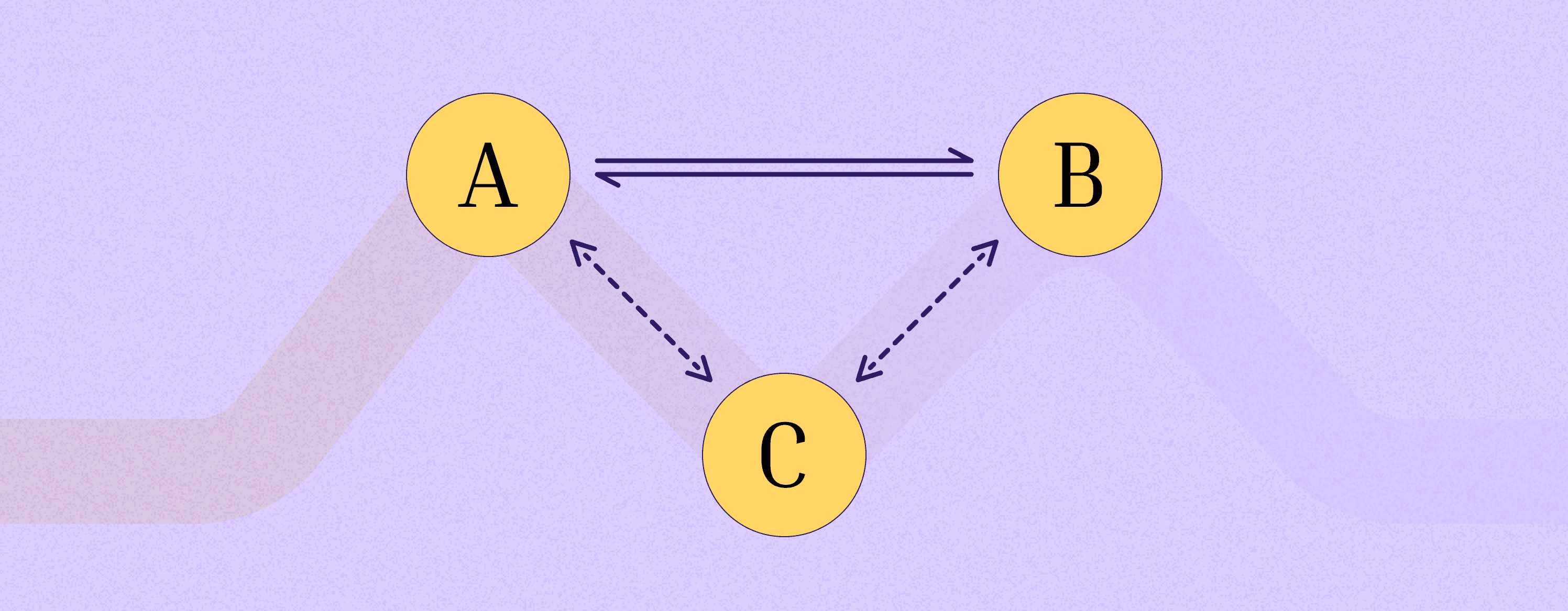
The third-cause fallacy (C causes B ... and also A)
Our first example above illustrates this fallacy well. Brands keep a lot of their powder dry for BFCM, and customers tend to hold out spending with the expectation of a good bargain. So did the rise in ad spend cause the rise in sales, or did the expectation of the largest sales in retail cause both?
Reverse causality (B causes A)
In our second example, a rise in Google Search traffic looks like it has caused a rise in overall sales, when it is actually a rise in demand that has led to customers using Google Search to navigate to the page(and that's causing the rise in organic traffic).
The spurious relationship (A and B are coincidental)
Imagine a brand that's running an Amazon Ads campaign. The duration of the campaign coincides with a rise in sales on Amazon, and the analytics seem to agree—a large share of buyers were influenced by the ads. It'd be easy (and also fallacious) to conclude that the Amazon Ads campaign caused that rise—especially when the brand had also launched a widespread CTV campaign at the same time. Scratching your head at some of these? So did we. A lot of this confusion can be attributed (haha...) to click-based attribution.
Double-clicking into Click-based Attribution
John Wanamaker's famous quote "Half the money I spend on advertising is wasted; the trouble is I don’t know which half" perfectly characterized the sentiment of the era right before the digital age and the advent of click-based attribution.
Marketers sought out click-based attribution as a panacea for their pains—they finally had a solution to measure every touchpoint, or so it seemed. But that system came with inherent shortcomings that a new generation of marketers has either readily accepted, or are blissfully unaware of. Let's break it down through the lens of causality and correlation:
It Focuses on Touchpoints, Not True Influence:
Click-based attribution assumes that a click signifies a causal link to the subsequent conversion. However, a user might click on numerous ads or engage with various marketing materials before finally purchasing, and the last click might not be the most influential factor in their decision. The initial exposure or a compelling view-through might have played a more significant role, yet these are often undervalued or entirely ignored in click-based models.
Correlation Mistaken for Causation:
Click-based systems inherently equate a click (a correlation) with a direct cause of the conversion. They fail to account for the possibility that the user was already inclined to purchase and the click was merely a step in a pre-determined journey. This can lead to over-crediting channels that are effective at capturing late-stage buyers who were already close to converting.
Limited View of the Customer Journey:
By focusing solely on clicks, these systems often miss the impact of other crucial marketing activities like view-through conversions, brand awareness campaigns, and offline touchpoints. Upper-funnel channels, which play a vital role in creating awareness and interest, are often underreported because they don't always generate immediate clicks.
Incrementality Testing—The Science-based Approach to Proving Causality
To overcome the limitations of click-based attribution and gain a true understanding of marketing causality, incrementality testing has emerged as a crucial methodology. Incrementality testing provides a ground truth by directly measuring the causal impact of specific marketing efforts on key metrics like purchases or leads.
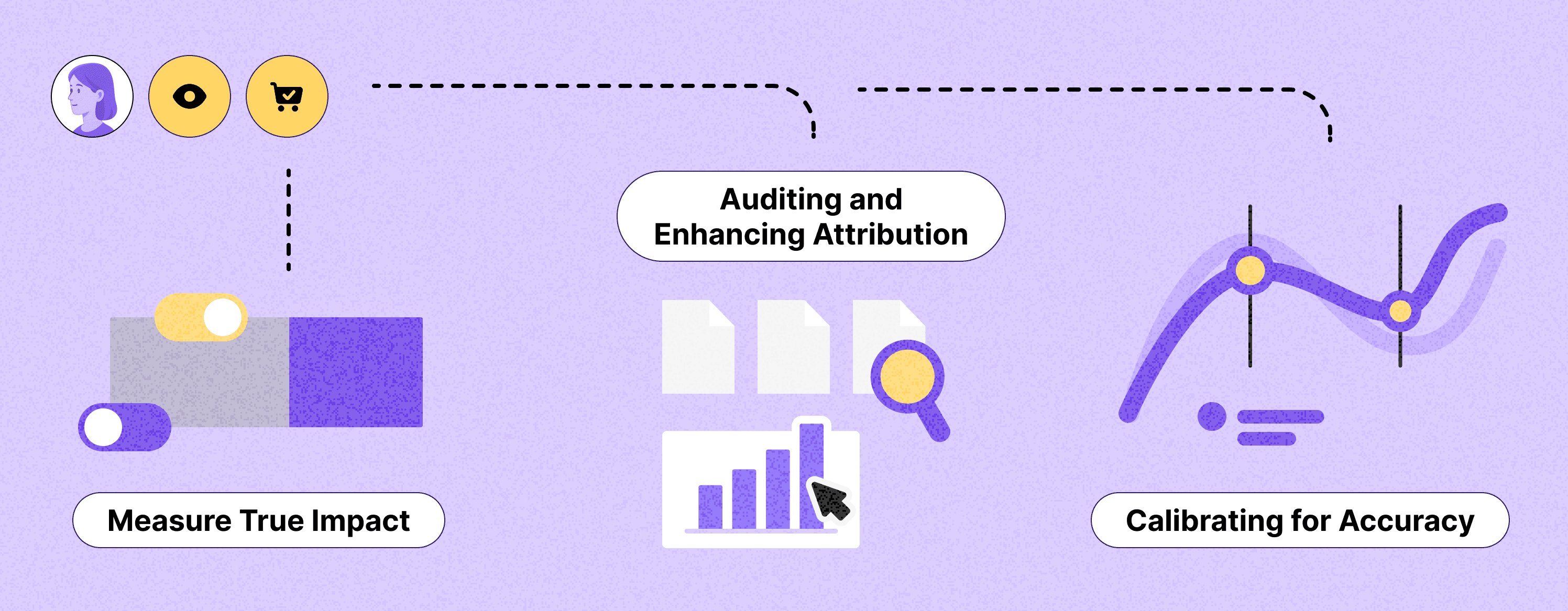
Measuring True Impact:
Unlike attribution, which observes correlations, incrementality tests employ controlled experiments (similar to scientific trials) to isolate the impact of a particular marketing channel or tactic. By comparing an experimental group (exposed to the marketing) with a control group (not exposed), marketers can determine the incremental lift—the sales or conversions that would not have occurred without the marketing intervention.
Auditing and Enhancing Attribution:
Incrementality tests also serve as a powerful tool to audit the accuracy of existing attribution models. By comparing the incremental impact measured through testing with the credit assigned by attribution models, marketers can identify discrepancies and understand which channels are being over- or under-reported.
Calibrating for Accuracy:
The results of incrementality tests can be used to calibrate and enhance data-driven attribution models, creating what is known as incrementality-based attribution. This approach combines the granular insights of multi-touch attribution with the causal measurement of incrementality testing, providing a more accurate and comprehensive understanding of marketing performance at every level.
Conclusion
By embracing incrementality testing, marketers can move beyond the limitations of correlation-based measurement and establish a data-driven ground truth for their marketing efforts.
This enables more informed decision-making, optimized budget allocation, and ultimately, a more effective and efficient marketing strategy focused on driving real, incremental growth.
Ready to move beyond correlation and embrace a science-based approach to causality? Schedule a demo with WorkMagic today.