MMM examples: What DTC brands actually get out of it

by
Lauren Lauth, VP of Measurement
You're probably overstating channel contribution by 30 to 40%
Your attribution dashboard says Meta drove $500k in revenue last month, and your finance lead asks whether you should double spend there. You freeze, because you have no way to tell whether that $500k is real.
Last-click attribution rewards whichever channel sat closest to the purchase. Correlation gets recorded as causation. A good share of those customers would have bought anyway, just through a different path.
That's the gap media mix modeling fills. Instead of guessing which conversions your ads caused, you measure them.
What DTC brands actually find when they run MMM
Most find they've been crediting their channels with more than those channels earned.
David Protein found their Meta attribution inflated by 36%. Once they moved to incrementality-based measurement, real Meta ROAS came in well below what the dashboard had been reporting. The same analysis surfaced budget opportunity they'd been sitting on elsewhere. After reallocating against true incremental impact, revenue grew 34% and profit grew 37%.
That's the useful part of a proper MMM. It takes away confidence you hadn't earned, then tells you where the money should have gone.

Most brands also surface:
Cross-channel halo they'd been ignoring. Someone sees your TikTok ad, doesn't click, searches your brand on Google later that week and converts. Last-click hands the whole sale to Google. MMM catches the TikTok contribution.
A saturation curve for each channel. Meta might be genuinely incremental at $10k a month and well into diminishing returns above $50k. Your optimizer has to know where that bend is.
Seasonal patterns the dashboard smoothed over. If summer traffic runs 40% above baseline, a model that ignores seasonality will read that as channel performance and push you toward the wrong quarter.
Budget recommendations tied to profit, not just ROAS. A channel driving $1M at $400k of cost is worse than one driving $500k at $100k. A profit-aware optimizer picks the second one.
How budget reallocation actually works
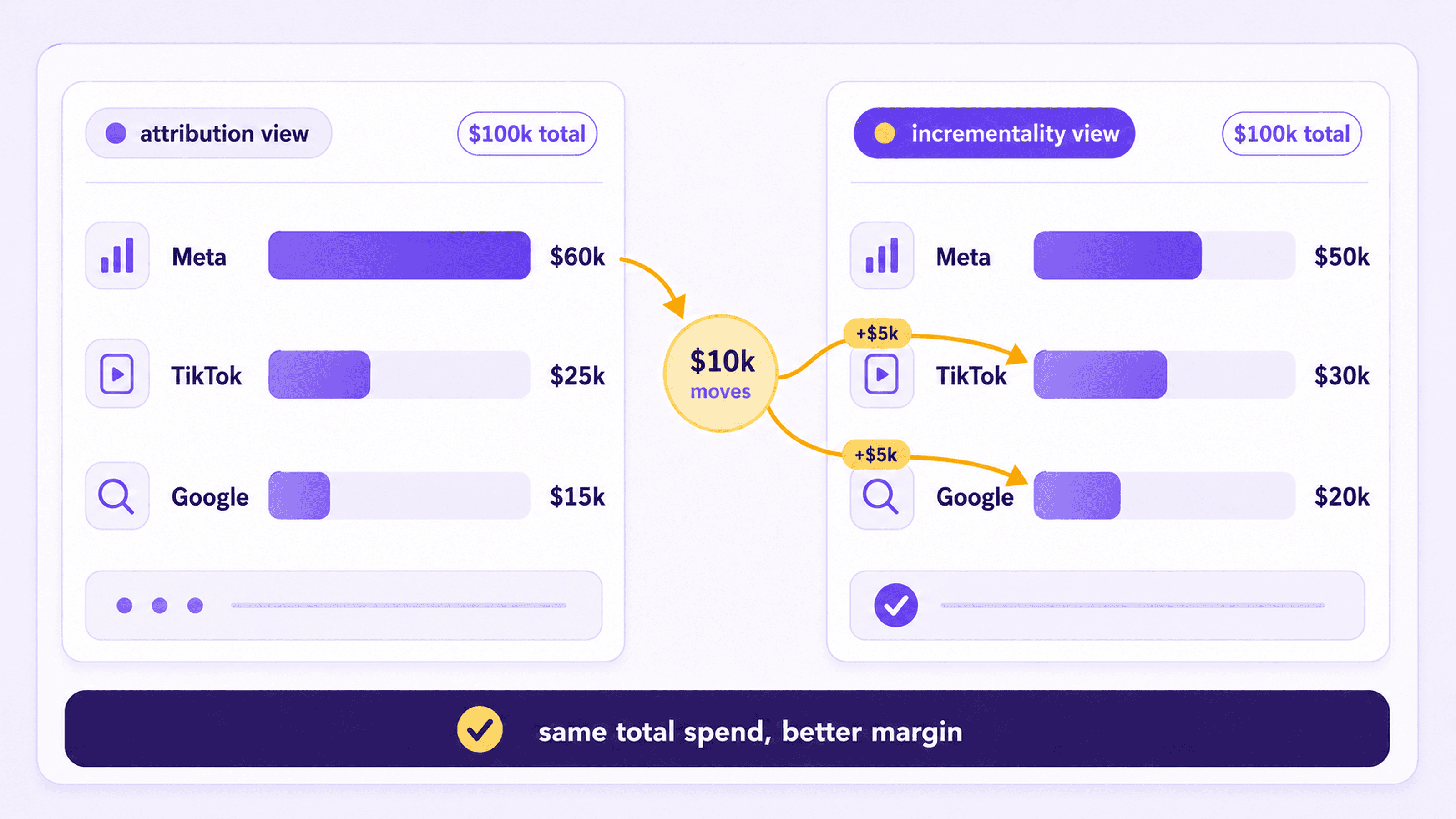
Say you're running $100k a month across Meta, TikTok and Google Ads. Attribution tells you Meta drives 60%, TikTok 25% and Google 15%, so the obvious read is to double Meta and cut TikTok.
Run the same data through a model built on causal relationships and the picture shifts: Meta at 45% incrementality, TikTok at 35%, Google at 20%. More useful than the split itself is what sits underneath it, which is that Meta is already into diminishing returns at your current spend while TikTok still has runway.
The optimizer then models a scenario:
Meta: $60k → $50k
TikTok: $25k → $30k
Google: $15k → $20k
Same total spend, roughly the same revenue, better margin.
None of that works unless you trust the model, and a model built on last-click assumptions hasn't earned that trust.
MMM vs. attribution: what's the difference
Aspect | Attribution - Last Click | Marketing Mix Modeling |
|---|---|---|
What it measures | Which channel the customer clicked last | Which channels actually drove the sale |
Handles multiple touchpoints | No. Only credits the final click | Yes. Models all exposures |
Works with non-clickable media | No. Misses TV, OOH, awareness | Yes. Uses sales data to infer impact |
Accounts for seasonality | No | Yes. Builds a seasonal baseline |
Tells you where to shift budget | Suggests more spend on high-conversion channels | Models saturation and recommends profit-optimal allocation |
Handles multi-channel sales | Breaks down completely | Yes. Consolidates Amazon, TikTok Shop, retail, DTC |
Why DTC brands specifically need this
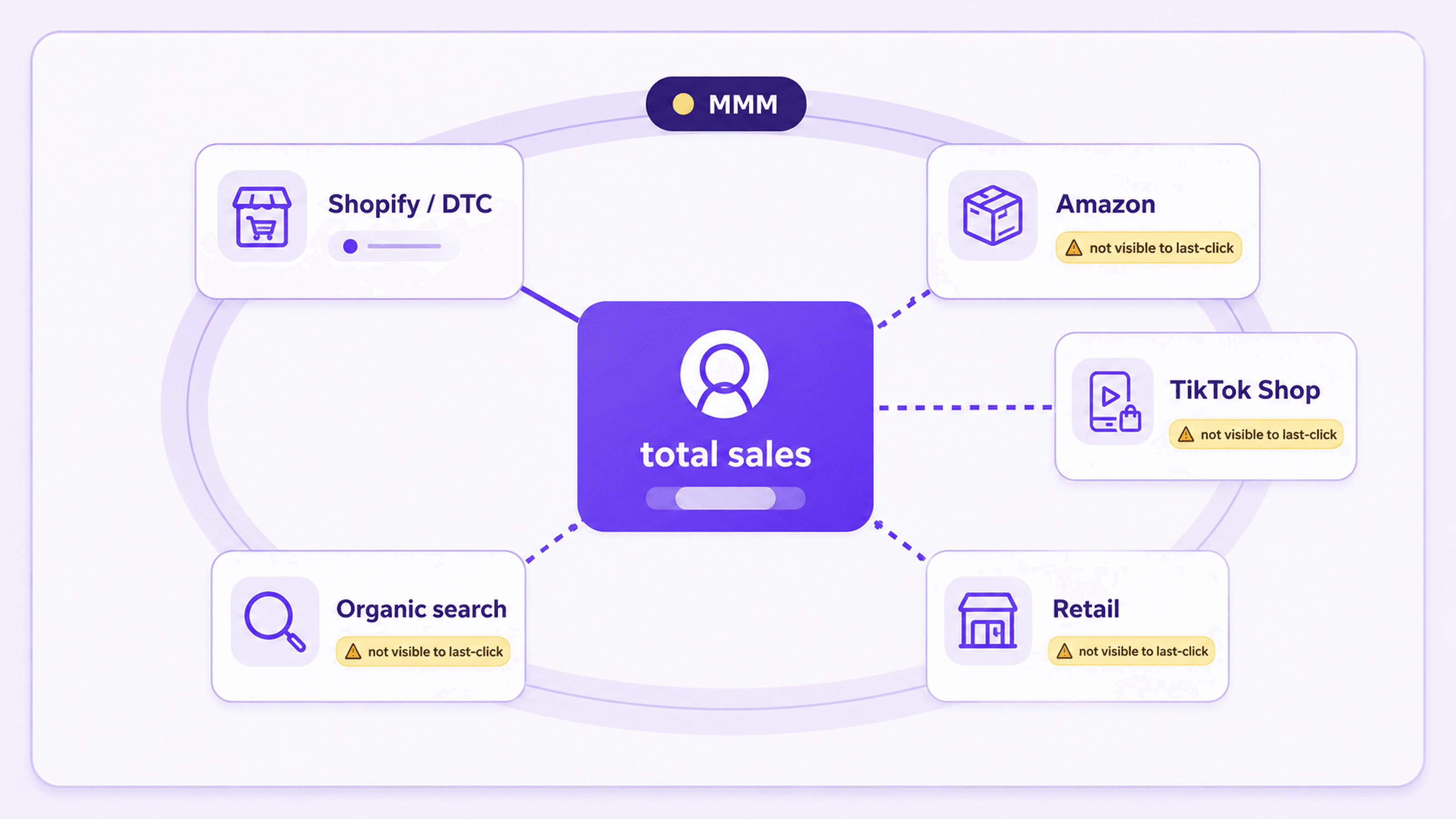
If you sell almost entirely on Shopify with 80%+ of revenue coming from paid ads, last-click attribution more or less holds. Everyone knows the limitations and works around them.
Add Amazon, TikTok Shop, retail partners or organic search halo and it stops holding at all.
Incrementality-calibrated MMM handles that by combining sales data across every channel, ad spend and impressions, and incrementality tests that validate the model. What comes out is one number you can actually defend: true channel contribution.
Brands use it for three things.
Monthly budget reallocation. The optimizer shows where to shift spend based on saturation and profit curves.
Channel investment decisions. Double down on YouTube or launch Pmax? The model projects halo and incrementality for each.
Vendor negotiations. When a partner claims a ROAS number, you can put it next to your modeled incrementality and push back with something concrete.
How to get started without breaking the bank
You don't need a $500k annual analytics contract. You need three things:
12 to 24 months of clean spend and sales data
Willingness to run a two- to four-week incrementality test, usually a geo lift, to calibrate the model
A platform that can explain what it's doing rather than handing you a black box
Ask vendors these questions to separate the ones who understand their own methodology from the ones reselling one.
WorkMagic's MMM ingests Shopify, Amazon and retail data, then layers on causal relationships validated by your own incrementality tests. You get monthly budget recommendations with confidence intervals, so you can see where the model is sure and where it's estimating.
Most DTC brands run this monthly. Setup takes two to three hours. Review takes about 15 minutes.
Frequently asked questions
Does MMM work for small DTC brands with under $100k/month ad spend?
Yes, with caveats. The model needs 12 to 24 months of history to train on. If you're newer than that, a simple geo incrementality test will tell you more for less. Once you've built up history, MMM becomes worth running monthly.
How do I know if my MMM model is actually correct?
Check it against incrementality tests you've already run. If the model predicted 20% lift on a channel and the geo test came back at 22%, it's calibrated. If the two diverge by 50% or more, the problem is either your inputs or the vendor's methodology.
Can MMM work if I sell on multiple channels like Shopify, Amazon, TikTok Shop?
Yes, and that's where it earns its keep. Last-click attribution falls apart across channels; MMM works from total sales data and models each channel's contribution at the same time. The tradeoff is that you need clean data from every source.
Will MMM tell me to cut spend on a channel I rely on?
Sometimes. If a channel shows negative incrementality at your current spend level, that's what the model will say. It will also show you where to redeploy the budget for more profit. The goal isn't spending less. It's spending where the return is real.
Learn more about marketing mix modeling for DTC and how to set up incrementality-calibrated measurement across your channels. Schedule a demo to see how MMM works with your data.