Causal MMM: How It Differs from Regression MMM

by
Lauren Lauth, VP of Measurement
Why your MMM predictions might be wrong
You're using Marketing Mix Modeling to forecast what a 20% increase in TikTok spend does to revenue. Your vendor hands you a lift prediction. You scale spend exactly as the model suggested, and three months later the real lift comes in at half the forecast.
That gap usually isn't a vendor failure. It's a methodology difference. One kind of MMM is calibrated to ground truth. The other is built on historical correlation.
What is regression MMM?
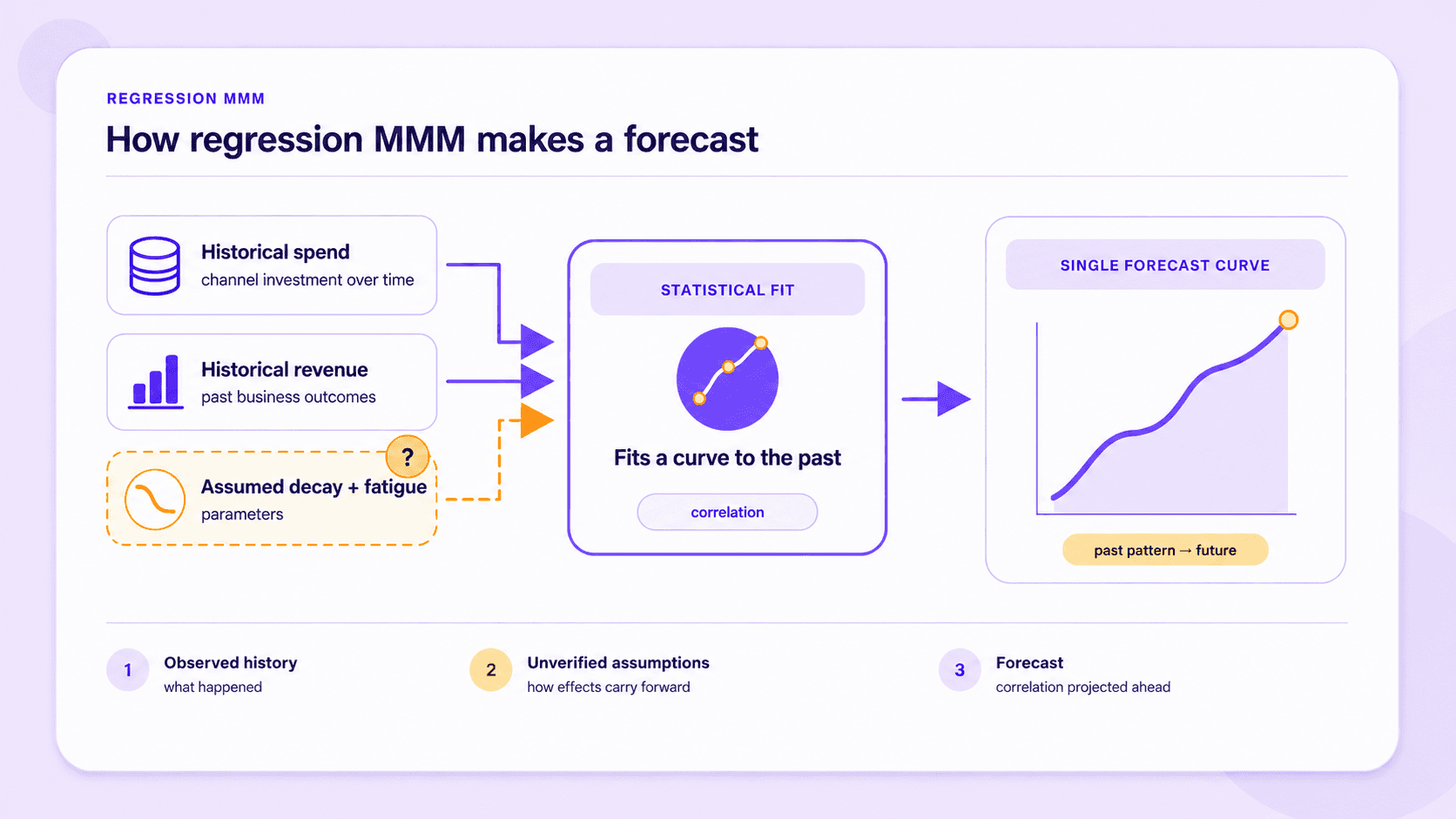
Regression MMM is the traditional approach, and it still powers most vendors on the market.
You feed historical spend and revenue data into a statistical model. The model fits a curve to the past and assumes the same spend-to-revenue relationship holds going forward. It's fast, it's legible, and it looks rigorous because it reports p-values and coefficient significance.
What it measures is correlation, not causation.
Your TikTok spend might track revenue spikes without having caused them. Maybe you pushed spend up because a product drop was coming. Maybe revenue climbed over the summer for seasonal reasons and your spend happened to climb alongside it. A regression model can't separate those cases. It treats the historical pattern as a forecast.
Regression MMM also leans on modeling assumptions that are close to arbitrary. How far should last-click attribution be discounted? When does ad fatigue set in? What's the decay curve on brand awareness? Every vendor picks different values, and none of those values have test data behind them. They're educated guesses buried inside a black box.
What is causal MMM?

Causal MMM starts from a different input: incrementality test results.
Rather than assuming correlation predicts the future, causal MMM uses live test data, including geolift experiments, holdout tests and other incrementality testing approaches, to measure what each channel actually causes. The model is then built around those observed effects.
In practice, it looks like this. You run a geolift test on Meta and observe 3.2% revenue lift per 1% spend increase. That's ground truth for Meta. A second test on TikTok returns 2.1% lift per 1% spend. You then constrain the model so the Meta and TikTok coefficients match those results, training on two years of history but anchoring to what the tests proved.
As new data lands, you recalibrate against fresh tests. If the model predicts 2.8% lift for Meta next month and a new test comes back at 1.9%, the model gets adjusted. That loop is what catches correlation drift, the point where the spend-to-revenue relationship changes because the market moved, seasonality shifted or the channel saturated.
Causal MMM also produces outputs regression MMM can't support: saturation curves showing where diminishing returns begin, budget allocation across channels, and forecasts grounded in measured effects rather than assumed ones.
How causal and regression MMM actually differ
Aspect | Regression MMM | Causal MMM |
|---|---|---|
Ground truth source | Historical correlation | Incrementality test results |
Assumption risk | High. Assumes past relationships continue | Low. Validated by live tests |
Calibration | None, or against arbitrary parameters | Continuous, against geolift and holdout tests |
Actionability | Directional insights, hard to trust | Saturation curves, budget optimization, forecasts tied to causality |
Typical prediction error | 40–60% of models miss their targets | 15–30% average MER lift when switching from regression |
Cost of being wrong | $500K–$5M annual budget misallocation | Significantly lower |
Time to value | 4–8 weeks | 8–12 weeks, including incrementality test cycles |
When causal MMM wins, and when regression is good enough
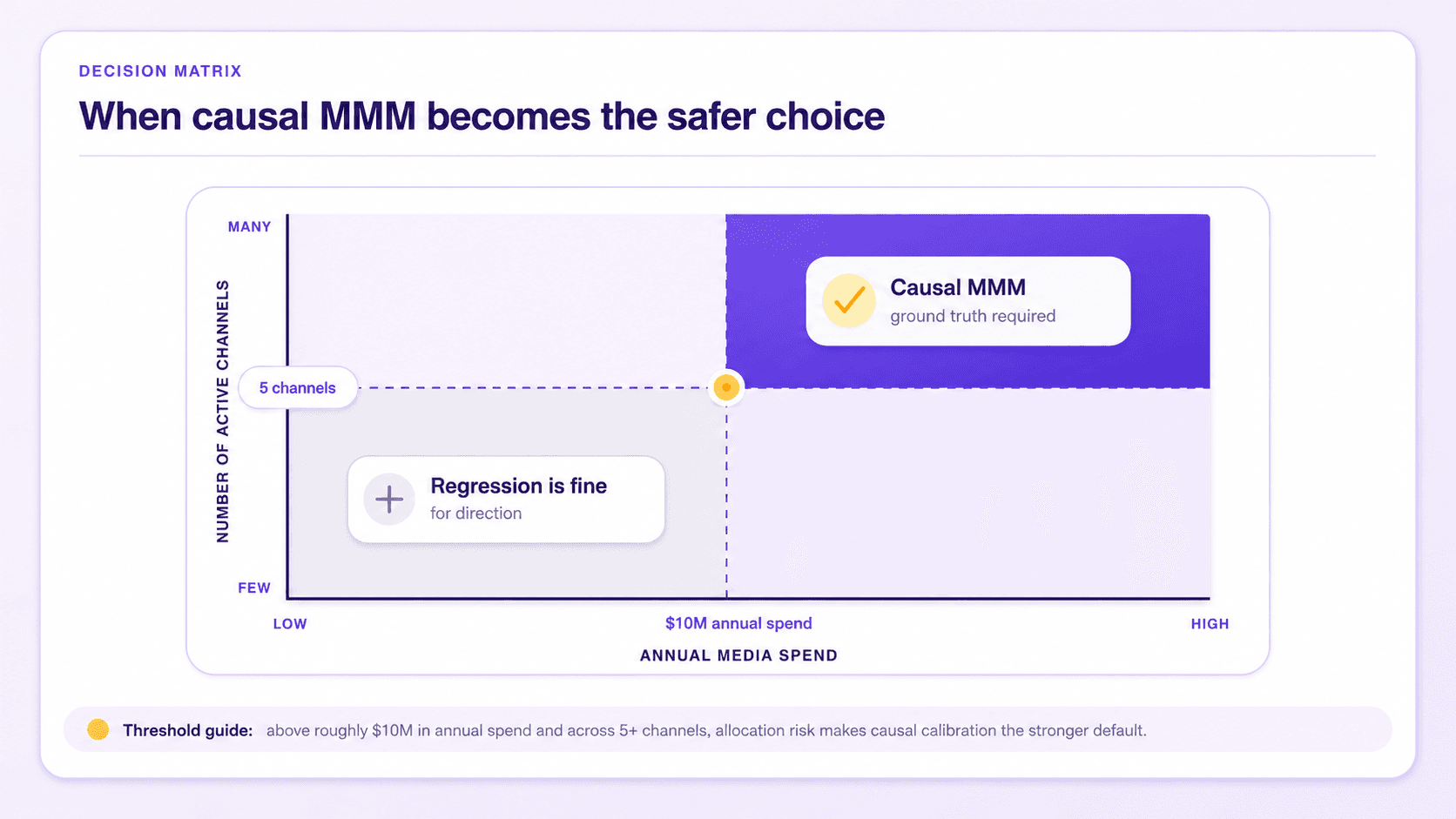
If you're making million-dollar allocation decisions, causal MMM is the right tool. Across five or more channels, or above roughly $10M in annual spend, regression carries too much risk. You need ground truth.
Regression MMM is fine for direction. "TikTok tends to outperform Pinterest" is a claim it can support. Magnitude is where it breaks down, and magnitude is what budgets actually run on.
The trap is that regression MMM looks confident. The output is polished. The coefficients are statistically significant. But significance isn't accuracy. A model can clear every diagnostic and still miss real lift by 50%.
Causal MMM costs more, because you have to run the tests, and it takes longer to stand up: 8 to 12 weeks against 4 to 8. One avoided allocation mistake usually covers the difference. So when you're choosing an MMM vendor, start with the question that separates the two approaches: is the model grounded in incrementality test results?
A real example: why David Protein switched
David Protein was running regression-based attribution that showed strong Meta performance. After moving to causal measurement anchored to incrementality tests, they found Meta attribution had been overstated by 36%.
Budget had been allocated against inflated numbers. Once the MMM was recalibrated to the causal lift the Meta tests measured, they redistributed spend across channels and grew revenue 34% with a 37% lift in profit.
For them, the gap between regression and causal wasn't a methodology debate. It was millions in recaptured margin.
Frequently asked questions
How do I know if my current MMM is regression-based or causal?
Ask your vendor two questions: is your model calibrated to incrementality test results, and do you run geolift tests? If the answer is no, or if testing is sold as an optional add-on, the model is regression-based. A causal MMM needs test data to function at all.
Can I run both at the same time to compare?
Yes, and it's worth doing. Run your current MMM alongside a causal MMM for two to three months, then use the same holdout tests to see which one predicted better. If the causal model doesn't win, something is wrong with the setup.
How much do I need to spend on incrementality tests to calibrate an MMM?
Budget 5–10% of media spend for testing across geolift, holdout and switchback designs. On $1M in annual spend that's $50–100K, which pays for itself the first time it catches a major misallocation.
Does causal MMM work for small brands?
It's harder to justify below $2–3M in annual spend, since incrementality tests need volume to return reliable results. High-margin products or a short channel list change that math in your favor. Walk a vendor through your specific setup before ruling it out.
Book a demo to see how causal MMM with live incrementality calibration works.