What is cross-channel marketing measurement?

by
Faizi Zahari, Growth Marketing & Product Lead
You're running paid ads across Meta, TikTok, and Google. You log in to your attribution dashboard which says:
Meta is your star performer.
Google is secondary.
TikTok barely registers.
But what if Meta isn't actually driving as much incremental revenue as your dashboard claims? What if Meta is mostly capturing traffic that would have landed on Google anyway? And what if TikTok is driving awareness higher up the funnel that both Meta and Google are converting lower down the funnel?
What would happen if you decide to scale down one of these channels? If you're looking at your attribution dashboard, it's very hard to divine an answer from what the last-click model is telling you.
That gap between what attribution tells you and what's actually causal is where cross-channel marketing measurement comes in.
What is cross-channel marketing measurement?
Cross-channel marketing measurement shows how spending on one channel drives incremental lift across others.
It answers a specific question: if you shut off Meta tomorrow, how many orders attributed to Google or TikTok would you lose? Those lost orders are the cross-channel impact, and understanding that is key to understanding how your entire marketing funnel works.
This is different from last-touch or multi-touch attribution, which simply allocate credit across touchpoints you already recorded. Cross-channel measurement uses incrementality testing to isolate the causal effect: hold one channel back in a test group, measure the sales lift (or loss) in other channels, and quantify the real incremental value.
Why does cross-channel impact matter for DTC and enterprise brands?
Your media mix doesn't operate in siloes. When you increase Meta spend, you don't just get Meta conversions. You also get awareness spillover, search volume lift, and often incremental sales on lower-funnel channels like Google Shopping and email. Last-click attribution ignores this entirely.
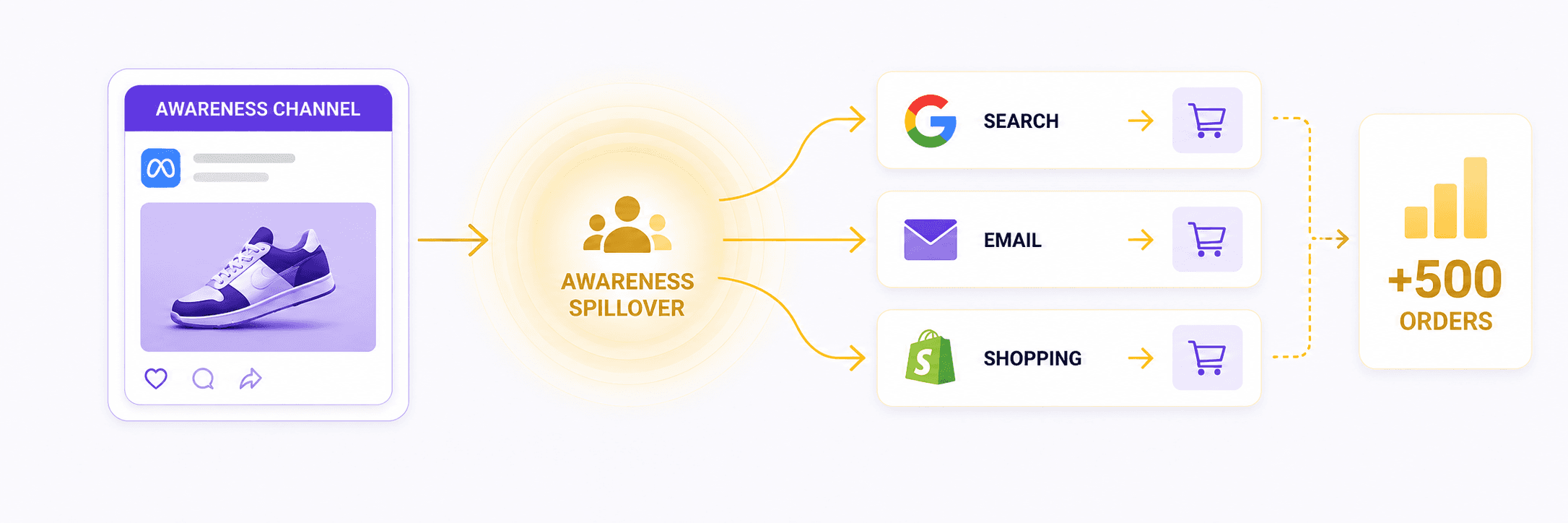
Top-of-funnel channels are systematically undervalued by last-touch models. Channel incrementality testing solves this by measuring the cross-channel impact, or the incremental orders your awareness channels create on your performance channels.
For DTC brands, this means you stop over-investing in bottom-funnel channels and under-investing in top of funnel. For enterprise MMM buyers, it means your marketing mix model is calibrated on causal truth, not correlation.
The formula for cross-channel impact is straightforward:
Cross-Channel Lift = (Orders in Other Channels with Channel On) − (Orders in Other Channels with Channel Off)
If Meta drives 500 incremental orders across Google, TikTok, and email combined, that's 500 orders last-click attribution was assigning to those channels instead of Meta.
How does cross-channel measurement actually work?
Cross-channel measurement starts with incrementality testing. You run a geo-level test: reduce (or hold out) spend in one channel across a test region for 2-4 weeks, keep a control region at normal spend, and measure the incremental impact on sales in every region.
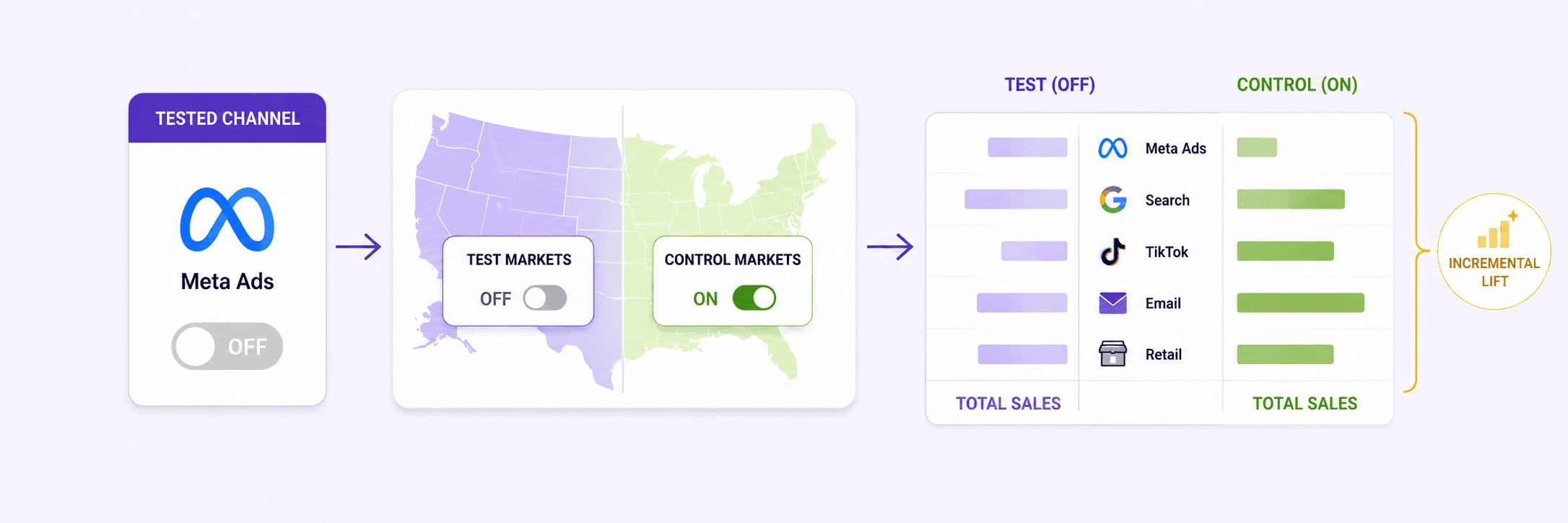
The key is measuring impact across all downstream channels, not just the one you're testing. This is why incremental attribution on Meta has limits. You'll only see Meta's own incremental performance, not the cross-channel lift Meta creates on your other channels.
For example, if you reduce Meta spend in 10 markets and measure direct orders from Meta along with:
incremental orders attributed to Google and TikTok
incremental orders on email
incremental retail sales (if you have offline data)
You'll get a complete picture of what that channel actually contributes across your entire customer acquisition funnel.
This approach works because it doesn't rely on the same signals that deterministic attribution does. You're not tracking individual users across channels (which is increasingly impossible post-iOS 14 and privacy changes). Instead, you're measuring aggregate incremental lift using statistical inference.
Cross-channel measurement vs. multi-touch attribution
Aspect | Multi-Touch Attribution | Cross-Channel Measurement |
|---|---|---|
What it measures | Credit allocation across recorded touchpoints | Causal incremental impact on all channels |
Data requirement | Customer journeys (cookies, first-party data) | Sales data by channel + test/control groups |
What it answers | "Which touchpoints led to this conversion?" | "If we change spend on X, what happens to sales on Y?" |
Accuracy | Limited by attribution rules and data availability | Causal, validated by experimental design |
Top-of-funnel value | Often undervalued | Properly quantified via halo effect |
Multi-touch attribution is useful for understanding customer journeys. Cross-channel measurement tells you how much incremental revenue each channel actually drives, and that's what budget allocation decisions should be based on.
Real-world example: the cost of ignoring cross-channel impact
David Protein discovered they were overestimating Meta's attribution by 36% using standard attribution models. The overestimation came from Meta capturing orders that were actually driven by awareness channels and organic search—cross-channel impact that attribution models couldn't quantify.
When they switched to incrementality-adjusted attribution using cross-channel testing, they reallocated budget more accurately and achieved 34% revenue lift and 37% profit lift. The shift wasn't because Meta got better—it was because they finally understood what was actually incremental.
How to measure cross-channel impact on your channels
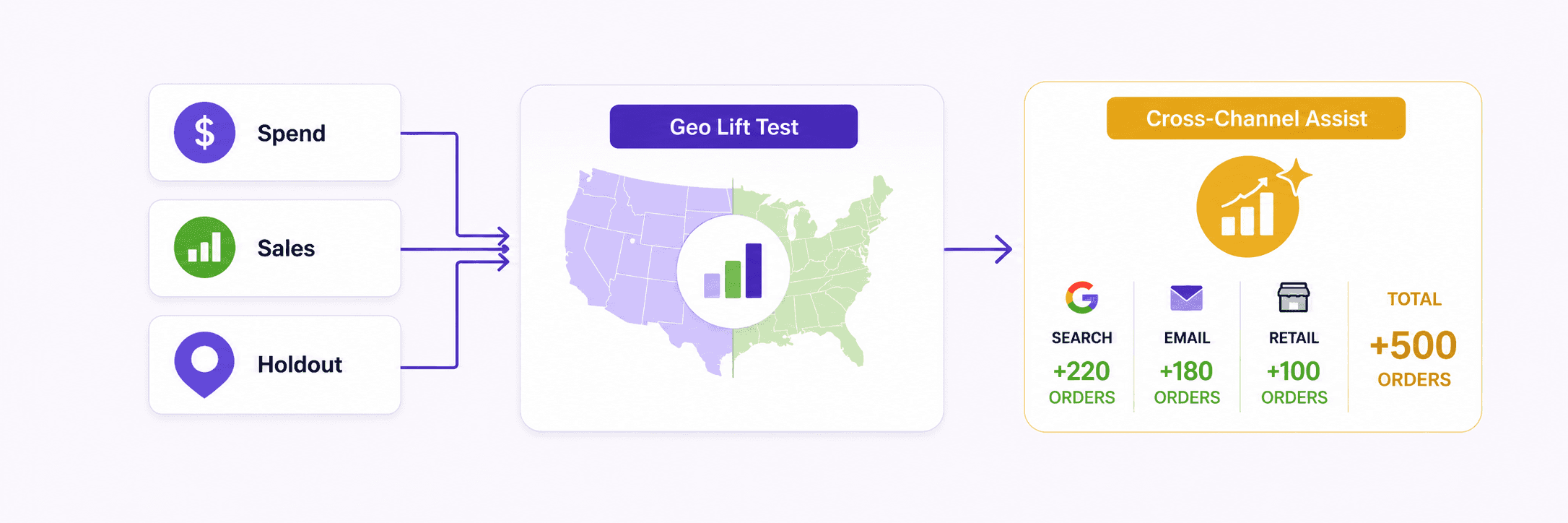
Start with geo incrementality testing. Pick one channel you want to test, which is likely a top-of-funnel channel where you suspect last-click is undervaluing impact.
Run a 2-4 week test holding spend at zero in a subset of geographic markets, keep other markets at normal spend, and measure incremental impact not just on that channel's direct orders, but on all downstream channels (Google, TikTok, email, organic, retail, or whatever you have clean data for).
The data sources required: channel spend by geography and date, revenue or orders by channel and geography, and the ability to toggle spend off in test markets for 2-4 weeks.
If you have geo-level sales data (from Shopify, your data warehouse, or retail integrations), you can measure cross-channel impact.
The output: a clear number for cross-channel assist. "When we shut off Meta in test markets, we lost $X in orders across Google, TikTok, and email combined."
Frequently asked questions
How is cross-channel impact different from attribution modeling?
Attribution models allocate credit across recorded touchpoints using rules (first-touch, last-touch, linear, time-decay). Cross-channel measurement measures causal incremental impact using experiments. Attribution answers "where did this conversion come from?" Incrementality answers "what would we lose if we removed this channel?"
Can you measure cross-channel impact for new channels like AppLovin or Pinterest?
Yes. Use a reverse holdout test design—spend aggressively in test markets and measure lift across all other channels. This works especially well for validating whether new channels efficiently absorb incremental spend and create or cannibalize lift on existing channels.
Do you need first-party data or cookies to measure cross-channel impact?
No. Cross-channel measurement uses geo-level data and statistical inference, not individual user tracking. As long as you have channel spend by geography and sales data by geography, you can measure cross-channel impact—even in a post-cookie world.
Can cross-channel measurement include offline data like retail or wholesale?
Yes. If you have geo-level retail sales data (from Walmart, Target, or your own stores), it can be incorporated into cross-channel tests. The platform shows adjusted incremental lift for every sales channel—online and offline.
Ready to measure cross-channel impact on your full media mix? Get a demo to see how incrementality-adjusted measurement calibrates your entire marketing system.