Channel incrementality 101 - Why granularity matters for ad spend?

by
Faizi Zahari, Growth Marketing & Product Lead
You're running incrementality tests on your top channels. The results come back: Meta shows 40% lift, TikTok shows 55%, Google shows 25%. You feel like you finally have causal truth.
Then reality hits the floor.
You apply the 40% multiplier to your Meta budget and realize you've been overpaying for some campaigns while underspending on others. Your incrementality number was right—but it was right for the channel. It wasn't right for the campaign.
That's the channel incrementality trap, and it's costing brands millions.
What is channel incrementality?
Channel incrementality measures how much incremental revenue a marketing channel truly drives—revenue that wouldn't have happened if you'd turned off all ads on that channel. It separates real lift from the baseline demand that shows up whether you advertise or not.
It's a causal number, not a correlation. It's the answer to: "If I spend 1 dollar on Meta, how much of that dollar actually moves the needle on incremental sales, rather than just capturing demand that would've converted anyway?"
When you run an incrementality test—typically a geo test where you hold out some regions from ads while running ads normally in others—you're measuring the incremental lift. The difference in revenue per capita between the test region (with ads) and the holdout region (without) is your incremental lift for that channel.
Why channel incrementality matters more than channel attribution
Attribution gives you a history of what happened. Incrementality tells you what was caused by your ads.
A customer in Chicago saw your Meta ad on Tuesday, clicked to your site, browsed for 10 minutes, and came back on Thursday to buy. Your attribution tool credits Meta with the conversion. But did Meta cause the purchase, or did the customer want your product anyway and use your Meta ad as a faster path to the site?
Incrementality answers that by comparing regions where you ran ads to regions where you didn't. If Chicago buys at the same rate as Denver (where you paused all ads), then Meta wasn't incremental—it was just skimming demand.
Attribution is inventory. Incrementality is impact.
This matters because incrementality testing is the foundation of accurate measurement. Everything downstream—whether you use MMM, multi-touch attribution, or rules-based models—is only as honest as the incrementality signals you feed into it.
The granularity problem: why one channel number lies
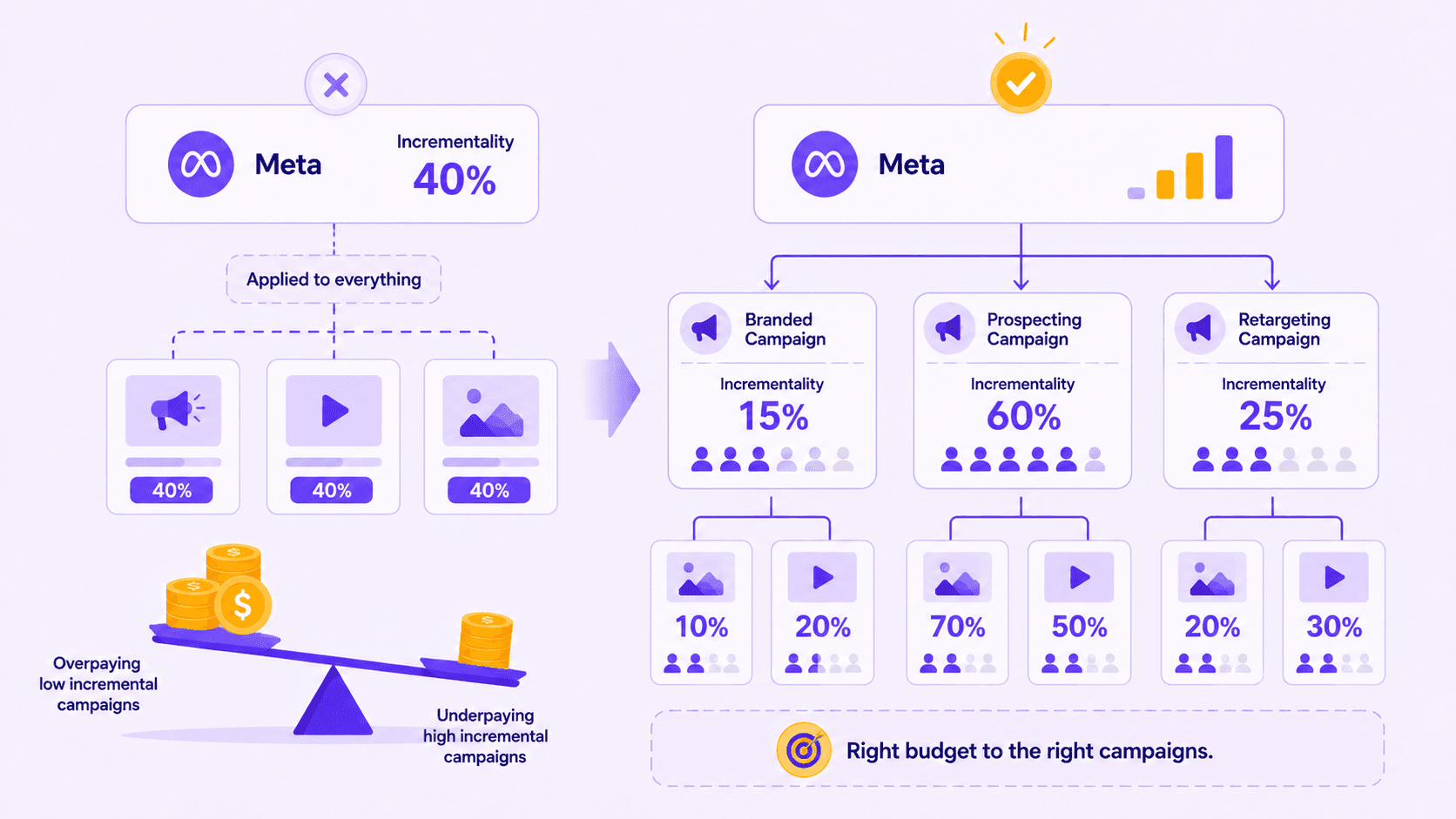
Here's what most brands get wrong: they run a geo test at the channel level (e.g., "Meta incrementality is 40%") and then apply that number to every campaign, ad set, and creative in that channel.
This breaks in practice because not all campaigns on a channel are equally incremental.
Your branded campaign on Meta might be 15% incremental—most of those clicks are people who already knew your brand and would've searched for you anyway. But your prospecting campaign might be 60% incremental—those are new-to-brand users you're genuinely moving into your funnel.
One channel number hides that truth.
If you apply "Meta is 40% incremental" uniformly, you're overpaying for the branded campaign and underpaying for prospecting. Your budget allocation is wrong, even though your channel incrementality test was technically correct.
To actually optimize, you need incrementality at the campaign, ad set, or even ad level. This is where most incrementality testing vendors stop—they say, "Run more tests." But running a separate geo test for every campaign is expensive and slow.
That's where the incrementality-adjusted attribution approach makes sense. You run the channel test once, then use an MMM-like model to calibrate those results down to campaign and ad level, so you get granular, actionable insights without running a hundred different tests.
How to test channel incrementality the right way
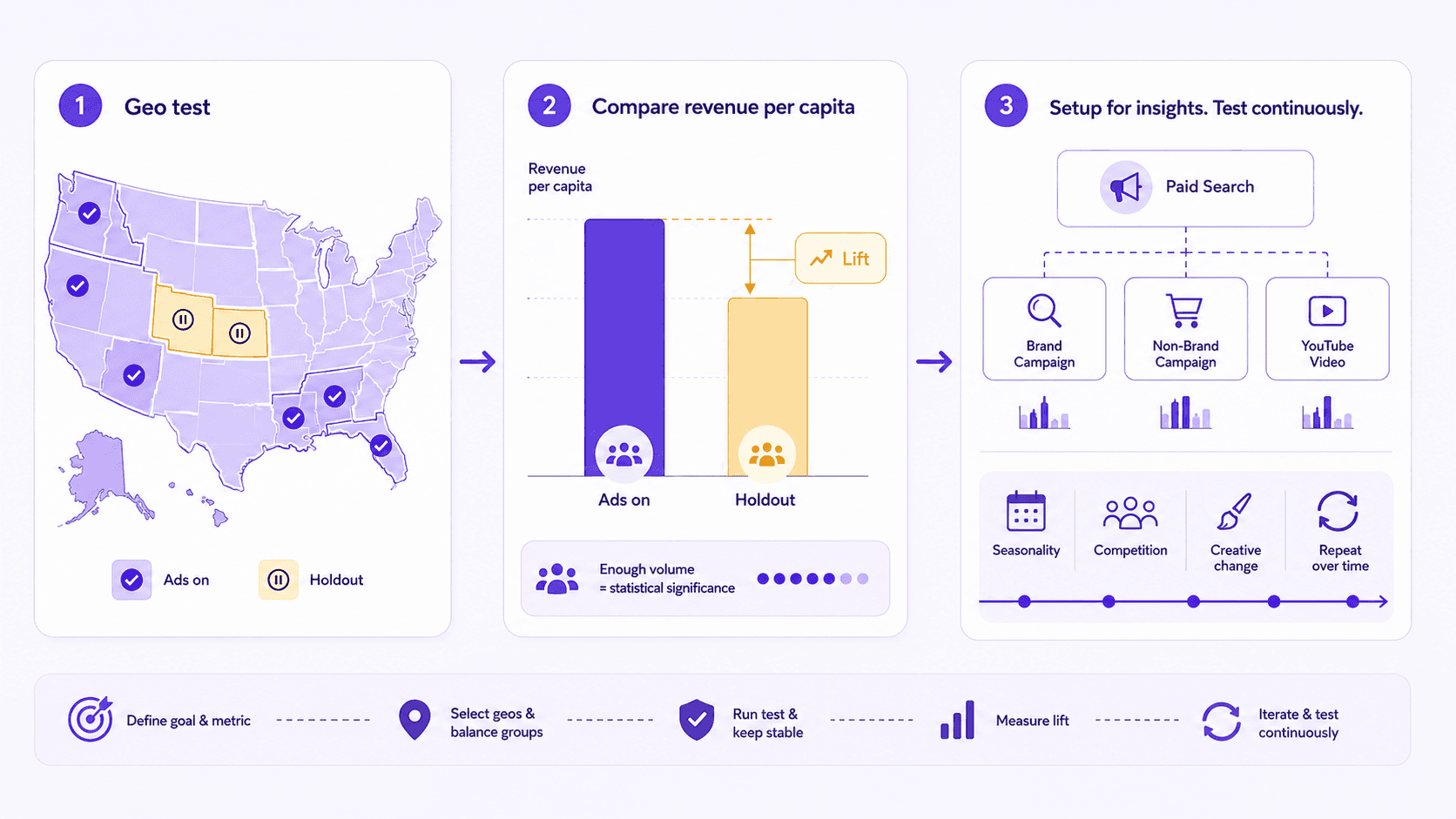
A geo test is the standard: pick a subset of geographic regions to hold out from ads while running normally elsewhere, measure revenue per capita in both groups, and the difference is your lift.
The tricky parts: you need enough volume in holdout regions that the result is statistically significant. Startups running $10k/month might not have enough data; brands at scale usually do. Seasonality, competition, and creative all change incrementality—a single test is a snapshot, not a guarantee. Plan your test to measure at channel level but design your holdout regions strategically so you can slice by campaign or tactic later. Better to capture granular data upfront than run secondary tests.
Ongoing testing matters too. Incrementality should be a long-term roadmap, not a one-time audit. Consumer behavior shifts, seasonal patterns change, and new channels emerge.
A real example: how granularity caught a budget leak
David Protein ran an incrementality test on Meta and found channel lift of 36%—strong signal. But when they drilled down to campaign level, the picture changed. Some campaigns showed 50%+ incremental lift, others showed 15% or even negative incrementality (meaning the ads were displacing organic demand rather than adding to it).
By applying a single 36% multiplier, they would've over-attributed to low-incremental campaigns and made budget allocation mistakes. Instead, they used granular, incrementality-calibrated reporting to reallocate: cutting back on low-incremental campaigns and doubling down on true winners. This strategy, documented in the David Protein case study, drove 34% revenue growth and 37% profit lift after switching to incrementality-driven allocation.
That's not just better measurement. That's math-driven budget discipline.
How channel incrementality fits into your measurement stack
Channel incrementality is foundational. Once you know the true lift by channel (and ideally by campaign), everything else snaps into focus.
Attribution becomes honest. You can adjust multi-touch models to account for incrementality so your last-click or time-decay numbers aren't lying about channel value. Budget allocation gets harder and better—you can't just optimize by ROAS anymore; you have to optimize by incremental ROAS. Forecasting becomes possible: MMM with incrementality calibration lets you model what happens if you shift budget between channels and know causality, not just correlation.
Channel incrementality also matters across channels. Digital channels aren't the only ones that drive incremental lift. CTV advertising, YouTube, retail halo effects—these all have incrementality and they interact with each other. That's where cross-channel testing gets complex, but it's where the real optimization lives.
What makes channel incrementality hard to measure right
The biggest headache: holdout regions complain. You're intentionally not showing them ads. If they notice, they might tweet about being left out, or your competitors might run ads in those holdout regions, or the natural distribution of demand shifts. Holdout bias is real.
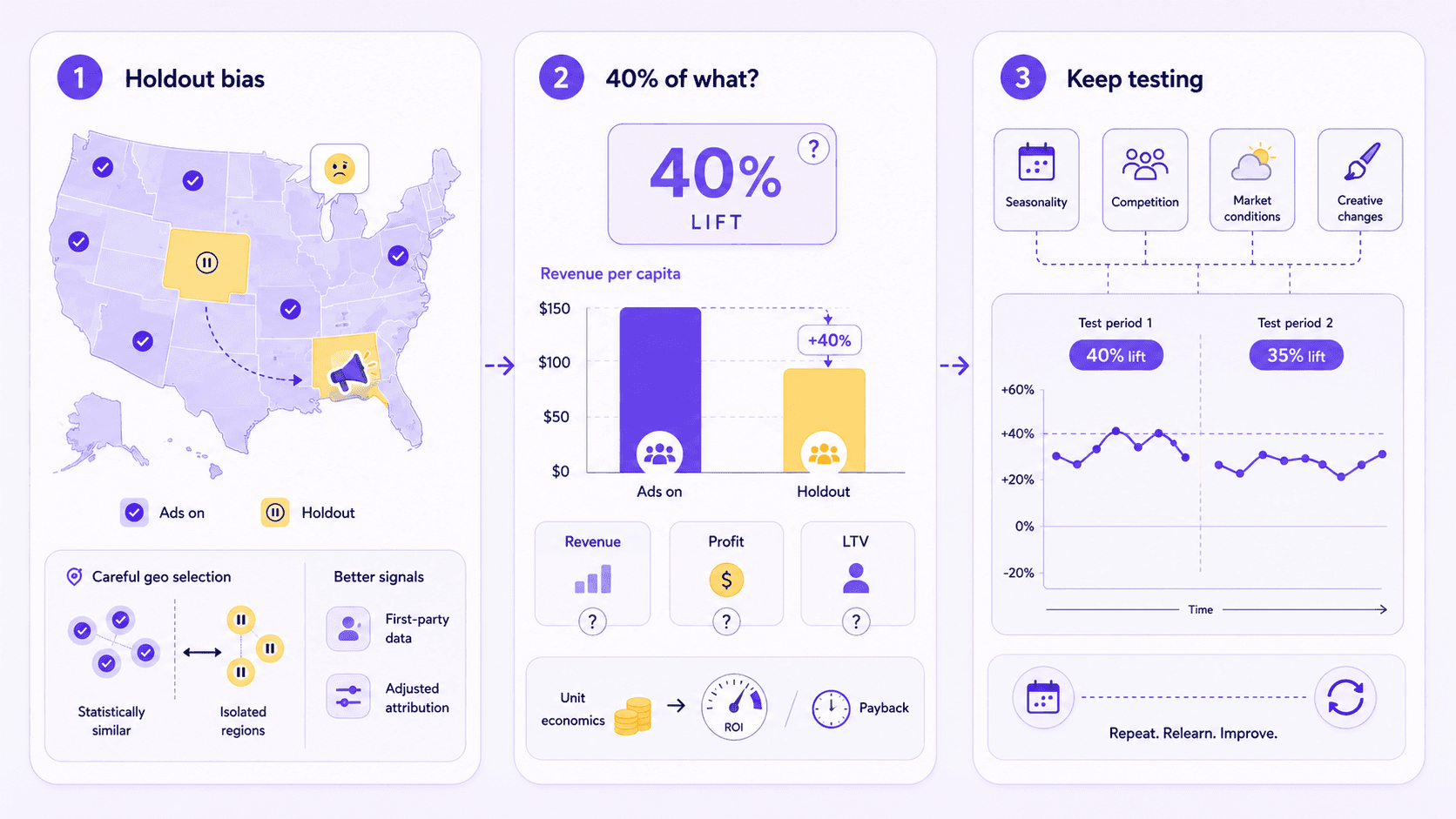
That's why geo selection matters. The best incrementality tests use regions that are statistically similar but geographically isolated enough that spillover is minimal. Smaller brands often lack the scale to get clean regions, which is why some companies turn to first-party data approaches and incrementality-adjusted attribution instead of—or alongside—geo tests.
The second hard thing: interpreting the result. A 40% lift is good, but 40% of what? Revenue? Profit? Customer LTV? A test that measures incremental revenue per capita is clean, but it doesn't tell you anything about unit economics or payback period.
And the third: keeping it current. One test is a snapshot. Incrementality moves with seasonality, competition, and market conditions. The 40% Meta lift you measured in Q3 might be 35% in Q4. You need an ongoing testing rhythm, not a one-time audit.
Frequently asked questions
How is channel incrementality different from channel attribution?
Attribution assigns credit to channels based on which touchpoint appears last or uses some other rule. Incrementality measures causality—how much revenue the channel actually caused, separate from baseline demand. Attribution answers "which channel did this customer touch?". Incrementality answers "would this customer have converted without the channel?"
Can you measure incrementality at campaign level, not just channel level?
Yes, but it requires more sophistication. You can run geo tests at campaign level (holding out regions just for certain campaigns), or you can run a channel-level test and calibrate the results down to campaign and ad level using MMM-style modeling. The latter is faster and cheaper—it's how brands get ad-level incrementality without running hundreds of separate tests.
What if I don't have the scale to run a geo incrementality test?
Geo tests require volume and geographic diversity to be statistically valid. Smaller brands often use first-party data approaches combined with multi-touch models and whatever incrementality signals you do have: cohort analysis, previous test results, or external benchmarks.
How often should I re-test channel incrementality?
At least quarterly, ideally monthly if you have the budget and scale. Incrementality shifts with seasonality, competition, and creative performance. A test from January won't tell you much about July. Treating it as an ongoing roadmap—not a one-time project—is how you stay calibrated to reality.
Ready to measure incrementality across all your channels? Book a demo to see how WorkMagic calibrates channel tests down to the ad level.