Incrementality Fundamental - Why it matters for accurate attribution?

by
Faizi Zahari, Growth Marketing & Product Lead
Your attribution dashboard is giving you the wrong number.
Of course, it's not intentional. Most attribution models are just running off of pattern recognition and correlative analysis to calculate the value of your ads. They usually operate on rules-based frameworks like last-touch, first-touch, linear, etc.
But pattern recognition isn't hard proof. Just because a customer clicked on an ad 48 hours before purchase doesn't prove that the ad was responsible for driving the purchase. There's definitely influence, but how much? What was this ad actually worth in terms of its actual ROI?
When you're evaluating where to spend your next ad dollar and your budget is already under enough scrutiny as it is, acting off how your ads are correlated with conversions isn't enough. You need to know if your ads actually caused them.
That's where incrementality comes in.
What is incrementality?
Incrementality measures the true causal impact of your marketing spend. It isolates the revenue, sales, or conversions you would never have captured without that specific ad, channel, or campaign.
Or in layman's, it proves the return on marketing spend and definitively answers: what did my marketing dollars actually drive?
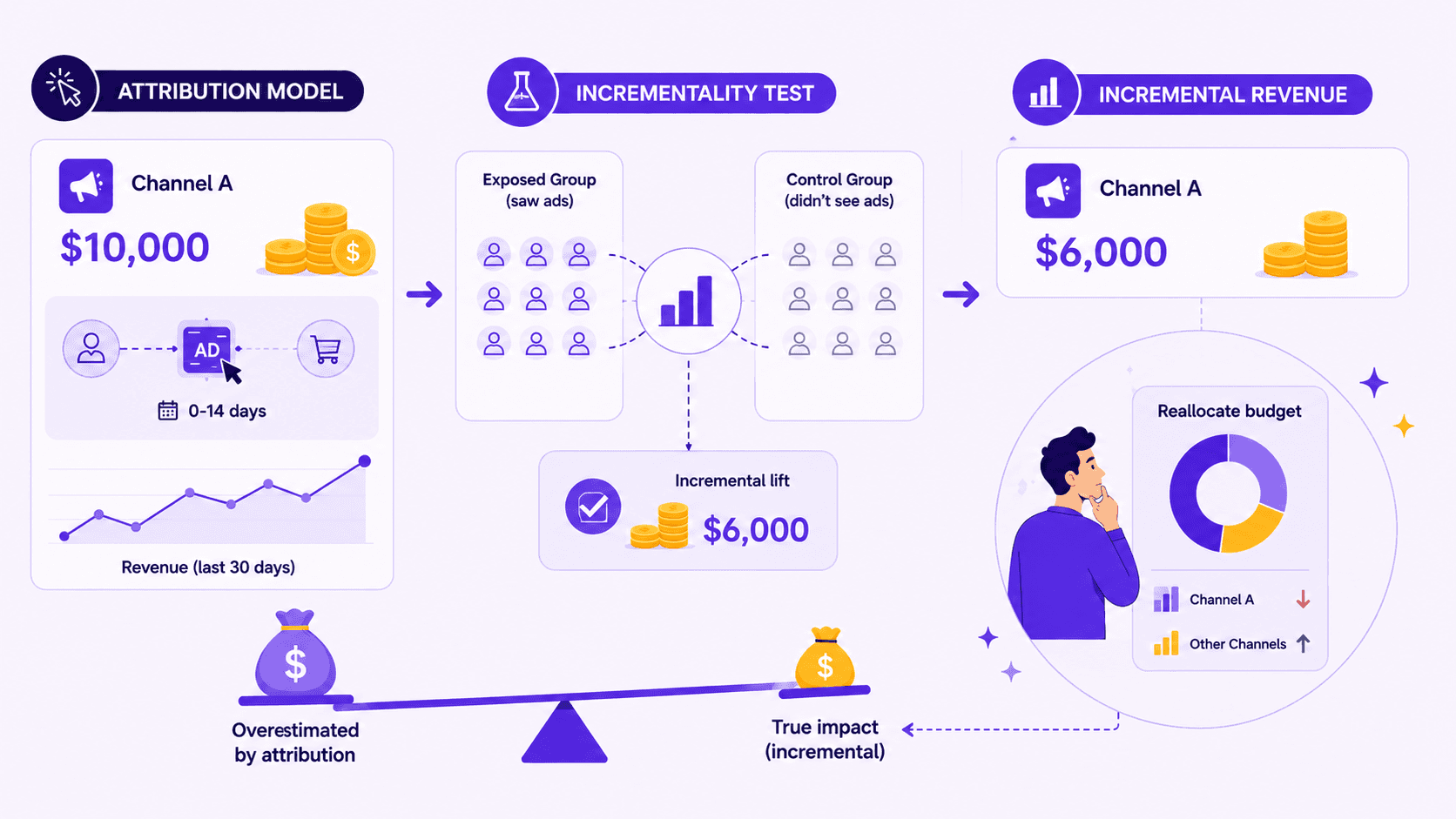
Here's the practical difference: your attribution model might claim that Channel A generated $10,000 in revenue in the last 30 days. Depending on which attribution model you're looking at and how it's set up, this can be because the customer purchased right after clicking or purchased within 14 days of that ad click.
Incrementality testing tells you whether that customer would have converted without that ads from Channel A. This is usually calculated by running a statistically rigorous test that proves the lift in conversions Channel A is actually responsible for.
Let's say your incrementality test proved out that Channel A was actually responsible for only $6,000 in revenue. How would that change your perspective on allocating resources towards it?
How does incrementality testing work?
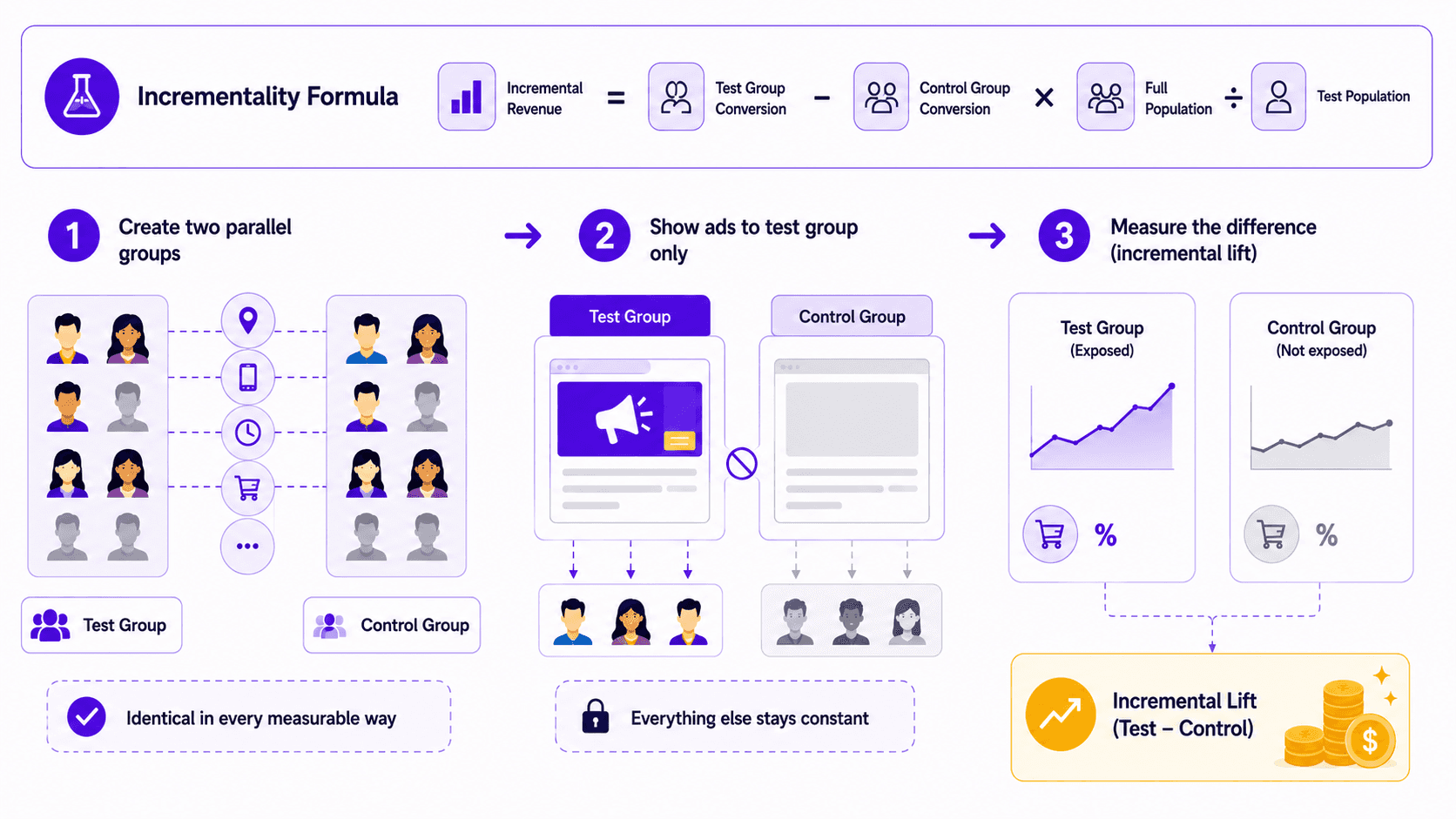
Incrementality testing uses a randomized controlled experiment, the gold standard for causal inference. The formula is straightforward: Incremental Revenue = (Test Group Conversion − Control Group Conversion) × (Full Population / Test Population)
The most popular way to test for incrementality is through a pause-to-measure test (otherwise known as a holdout test). The way it works is:
Step 1 - you identify two parallel groups of users who behave identically in every measurable way: geography, device, browsing history, purchase history, and whole lot of other factors.
Step 2 - Then you show ads to one group (the test group) and prevent the other group from seeing them (the control group). Everything else stays constant.
Step 3 - The difference in conversion rate or revenue between test and control is your incremental lift. That's pure causation, not correlation.
Think of it like A/B testing on steroids. In A/B testing, you change something and measure the effect. In incrementality testing, you silence a channel entirely and measure what goes missing.
Why incrementality matters for attribution
Marketing attribution is built to assign credit based on user journeys, and most of them work off of last-click, first-touch, multi-touch, or data-driven models. All of these are useful for understanding journey shape, but without considering incrementality, none of them tell you causation.
A customer who sees your Meta ad five times before converting might have been genuinely moved to action by that creative. Or that customer was already in-market, and they would have found you through a Google search after their paycheck hits.
Traditional attribution wouldn't be able to tell the difference, but incrementality testing can.
That's why the most sophisticated brands now use incrementality to calibrate their attribution models. Instead of trusting the algorithm's credit assignment at face value, they run incrementality tests to detect where attribution is overstating or understating true causal impact, then adjust accordingly.
Incrementality at different levels of granularity
Most brands run incrementality tests at the channel level: "What's the lift on Channel A?" But that's just scratching the surface.

A channel may reflect a certain incrementality factor, but individual campaigns, ad sets, and even ads within that channel have wildly different degrees of incrementality. Your high-volume, low-intent awareness campaigns might be highly incremental, but your low-volume, high-intent retargeting campaigns might be cannibalizing sales from organic search.
If you apply a single channel-level incrementality multiplier across all Channel A campaigns, you're solving the wrong problem. You're just guessing with a different number.
The answer is to drill down. Modern incrementality platforms take geo incrementality testing results and triangulate them down to campaign, ad set, and even ad-level insights without needing secondary tests. That granularity is what transforms incrementality from a diagnostic tool into a resource allocation tool.
Incrementality vs. Traditional attribution: the critical difference
Attribute | Traditional Attribution | Incrementality |
|---|---|---|
How it works | Estimates outcome by analyzing patterns in historical data | Proves outcome through controlled experiments |
What it measures | Did my ads connect to my sales? | Did my ads actually drive my sales? |
Sample size needed | Small (fast, cheap) | Large (slower, more expensive) |
Resiliency to bias | Very low (confounding, selection bias) | Very high (test controls for all variables like promos, seasonality, etc.) |
Best use | Journey understanding, ad spend accounting | Budget allocation, ROI validation |
Real example: why David Protein switched measurement approaches
David Protein, a DTC nutrition brand, discovered their standard multi-touch attribution model was overstating Meta's impact by 36%. They were allocating budget to Meta based on inflated numbers, then wondering why incremental ROAS lagged their dashboard.
After switching to incrementality-adjusted attribution, they recalibrated their entire spend mix based on true causal impact. The result: 34% revenue lift and 37% profit lift.
That gap - 36% overestimation to 34% revenue growth - is what happens when you stop trusting correlation and start trusting causation.
Incrementality as a measurement system
A single test at one point in time can validate how incremental your marketing efforts are, but those results don't last forever. There are so many factors that determine ad performance like market conditions, creative cycles, new viral trends, and so much more. As they shift, so does your ad's incremental impact.
Winning brands run incrementality as a continuous practice, not a one-time audit. They test quarterly or continuously at smaller scale and use the results to calibrate their measurement framework month to month. That means their attribution is always grounded in current causal reality, not last year's test results.
This is where marketing measurement matures from static reporting to dynamic optimization. You're no longer asking "did this work?" once and moving on. You're asking "is this still working the same way?" continuously.
Incrementality in context: how it fits your stack
Incrementality is the causal layer of your measurement stack. By itself, it's powerful. Combined with marketing mix modeling for long-term trend analysis and integrated with your attribution model for day-to-day campaign optimization, it becomes your complete measurement framework.
Learn more about the complete incrementality testing approach to see how these pieces fit together.
Frequently asked questions
Can I run incrementality tests at the ad level, or only at the campaign or channel level?
You can drill down to the ad level. Modern incrementality platforms take channel-level incrementality factors and translate them down to campaign, ad set, and ad level using data triangulation similar to MMM, so you don't need secondary tests. This gives you ad-level halo effects and ad-level iROAS for more precise budget allocation.
Is incrementality a fixed number I calculate once and use forever?
No. The incrementality scalar is recomputed as new lift tests calibrate the model and it refreshes over time. Treat it as a continuously updated causal estimate that drifts with market conditions, creative changes, and audience behaviour, not as a static conversion factor.
How much larger does my test sample need to be compared to a regular A/B test?
Incrementality tests typically require 2x to 4x larger sample sizes than A/B tests because the lift you're measuring (true causal impact, not conversion rate delta) is often smaller. Larger samples reduce noise and improve statistical confidence. The exact requirement depends on your baseline conversion rate and expected lift.
Should I run incrementality tests across all my channels or focus on one?
Start with your highest-spend channel, where the ROI impact of an accurate number is largest. After that, prioritise channels where your attribution model shows the biggest variance (likely candidates for overestimation). Eventually, run it across all major channels, but testing all simultaneously is neither practical nor necessary.
Ready to ground your measurement in causation, not correlation? Schedule a demo to see how incrementality testing works in practice.