Marketing Measurement: What It Is, Why It Fails, How to Fix It

by
Lauren Lauth, VP of Measurement
Most brands have a measurement stack. They have attribution dashboards, platform reports, pixel data, and weekly ROAS summaries. What they rarely have is confidence in the numbers, because most marketing measurement tools track what happened alongside your ads, not what your ads actually caused.
That gap is the core problem with how marketing measurement is practiced today, and it has real consequences. Brands cut channels that were driving demand invisibly. They double down on channels that were capturing demand they already created. And they build budgets on metrics that platforms have every incentive to inflate.
Fixing measurement requires understanding what it is, why the dominant approaches fall short, and what a causal measurement framework actually looks like in practice.
What is marketing measurement?
Marketing measurement is the process of evaluating the effectiveness of marketing activities by connecting spend to business outcomes: revenue, new customers, profit. A functional measurement framework answers two questions: what is working, and what would happen if you spent more or less?
The challenge is that "working" can mean different things depending on the method you use to define it. Three measurement approaches dominate the field today, and they produce meaningfully different answers. For a deeper look at how to structure a measurement program from scratch, see marketing measurement plan.
Multi-touch attribution (MTA) assigns credit to ad touchpoints that appeared before a conversion. It measures correlation: the ad was present, and a purchase followed. It cannot determine whether the purchase required the ad, and it only sees conversions that touch the platform's own tracking infrastructure.
Marketing mix modeling (MMM) uses historical data to estimate the contribution of each channel to sales over time. It operates at the aggregate level and doesn't rely on individual tracking, making it privacy-safe. But a standard MMM built on historical attributed data inherits the same biases as attribution; the saturation curves it produces reflect what platforms reported, not what they caused.
Incrementality testing compares outcomes between an exposed group and a holdout group to establish causality. It answers the specific question attribution and standard MMM cannot: would this sale have happened without the ad? It is the only method that produces a true counterfactual.
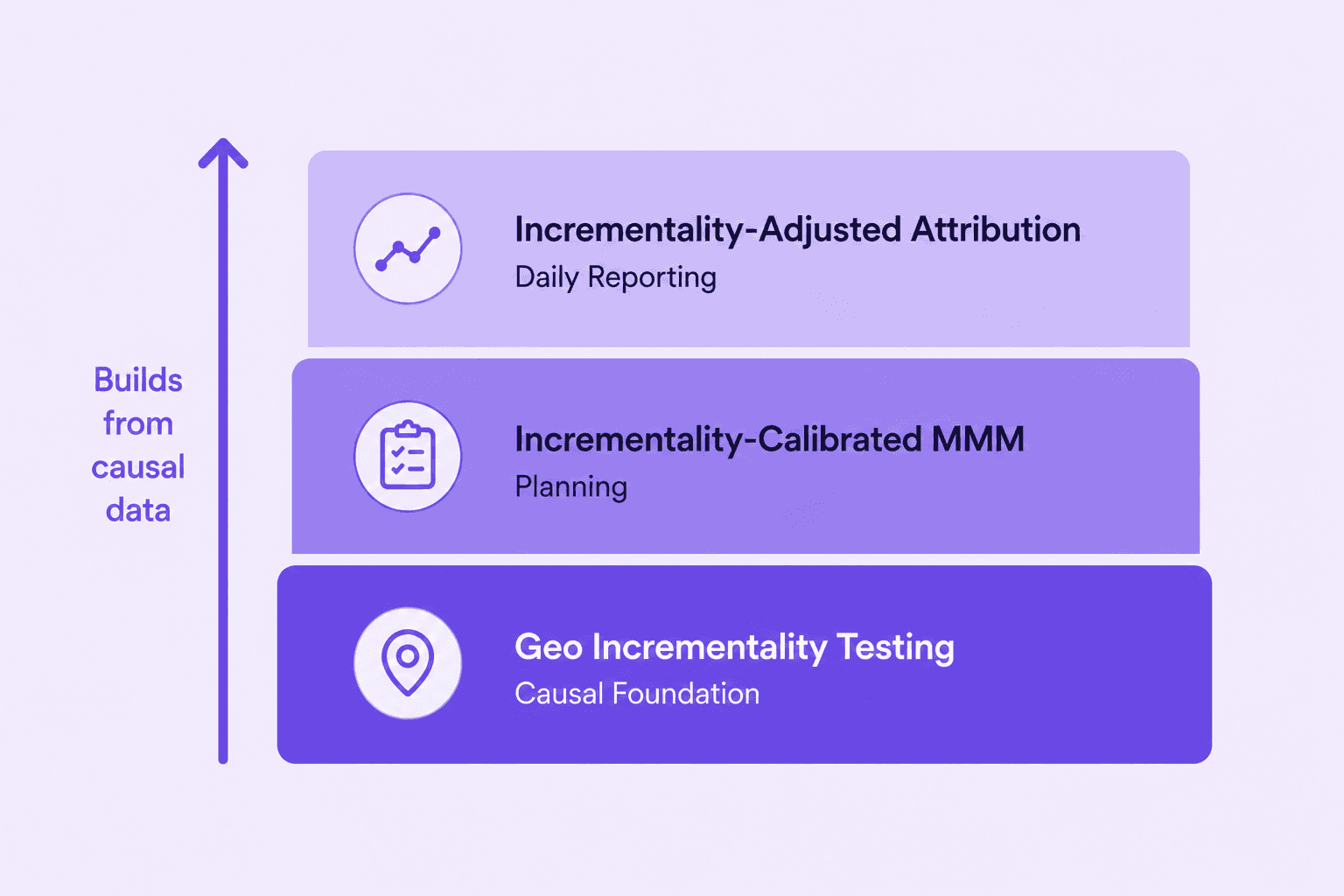
These aren't three equal alternatives. Incrementality is the measurement layer that validates the other two. It produces causal baselines. Those baselines calibrate MMM so its saturation curves reflect true causal returns. And they calibrate attribution so day-to-day reporting reflects what channels actually drive, not just what they claim credit for. WorkMagic's Triangulated Measurement playbook explains how each layer connects in practice.
Why marketing measurement is harder for omnichannel DTC brands
The standard marketing measurement challenges (cookie deprecation, signal loss from iOS ATT, walled garden self-reporting) apply to every brand. For a detailed breakdown of each, see challenges of marketing attribution. For omnichannel DTC brands, there is an additional layer: the halo effect.
When a customer sees a TikTok ad and purchases on Amazon three days later, no signal is captured by TikTok. The pixel never fires on Amazon. The conversion doesn't appear in platform reporting. Signal-based measurement classifies that purchase as organic. It wasn't.
This isn't an edge case. For brands selling across Shopify, Amazon, retail, and TikTok Shop, a significant share of the incremental impact from any given campaign lands somewhere other than the channel it was pointed at. Nordic Naturals found that 99.6% of TikTok's incremental impact landed on Amazon, entirely invisible to TikTok's own reporting. Salt & Stone found that 67% of YouTube's incremental orders occurred on Amazon.
A measurement framework that only measures the channel it can see is not measuring marketing. It is measuring a partial view of marketing.
Why most marketing measurement frameworks fall short
Platform self-reporting inflates results. Every major ad platform reports attributed revenue based on its own logic and its own attribution windows. Meta, Google, and TikTok each count the same conversion from their own vantage point. Total attributed revenue across all platforms routinely exceeds actual revenue. No single platform can see what the others reported.
Standard MMM inherits attribution bias. MMM built on platform-reported data produces saturation curves that reflect attributed returns, not causal ones. A channel that appears to drive strong results in attribution will appear to drive strong results in a biased MMM, even if a significant portion of that revenue was organic baseline that would have arrived regardless.
Attribution cannot establish causality. SimplyInked found the same dynamic: shifting Meta budget decisions to incrementality-grounded insights, rather than attributed results, revealed that a significant share of attributed conversions were non-incremental, enabling a 58% sales growth and 26% CAC reduction once spend was reallocated accordingly. Those weren't miscounted purchases; they were real purchases from customers who would have bought anyway. Attribution records proximity between ad and purchase; it cannot determine whether the ad was necessary.
Signal loss is accelerating. Since App Tracking Transparency, a significant share of iOS users opt out of cross-app tracking. Cookie deprecation is narrowing the observable signal further. Attribution models built on declining signal quality produce declining accuracy.
What a modern marketing measurement framework looks like
Measuring marketing performance accurately, and using it to drive decisions about spend, channels, and forecasts, requires a framework built for causal accuracy. That framework has three layers:
Geo incrementality testing as the causal foundation. Geo incrementality testing compares total revenue between matched geographies, one exposed to ads and one held out, across all channels simultaneously. The difference is causal revenue, not platform-reported credit. It captures halo effects on Amazon and retail because both are measured in the same comparison. It isn't affected by signal loss because it measures total revenue, not tracked events.
Incrementality-calibrated MMM for planning and forecasting. Once geo lift results are established, they calibrate the MMM so its saturation curves reflect causal returns rather than historical correlation. The result is a model finance and marketing can both plan from, with revenue forecasts grounded in what each channel actually drives.
Incrementality-adjusted attribution for day-to-day reporting. Lift test results, used to calibrate attribution, produce incrementality-adjusted attribution: reporting that reflects causal contribution on an ongoing basis without requiring a new lift test for every budget decision.
This isn't three separate tools. It is one measurement stack where each layer informs the others, and the foundation is always causal. For cross-channel benchmark data on how this plays out across DTC and omnichannel brands, see the Media Performance Index 2026.
The marketing metrics that actually matter
Most marketing metrics measure activity. Measuring marketing success requires a different set: metrics that connect spend to causal business outcomes rather than platform-reported activity.
iROAS (Incremental ROAS): Revenue caused by the ad divided by the spend that generated it. Unlike platform ROAS, which includes organic baseline, iROAS measures only what the campaign actually produced.
iCPA / iCPO (Incremental Cost Per Acquisition / Order): The true cost of acquiring a customer who would not have purchased without the ad. A channel with a low reported CPA can have a high iCPA if most of its conversions were organic.
MER (Marketing Efficiency Ratio): Total revenue divided by total ad spend, measured at the business level. The cleanest measure of marketing effectiveness and efficiency at the blended level; no platform can inflate it.
Halo contribution: The share of a channel's total incremental impact that landed on channels outside the one being measured. For omnichannel brands, this is often the majority of the real impact.
Marginal ROAS: The return the next dollar will generate at the current spend level, derived from the saturation curve. The signal for when to increase or decrease spend in a channel.
Frequently asked questions
What is a marketing measurement?
Marketing measurement is the process of evaluating the effectiveness of marketing activities by connecting spend to business outcomes such as revenue, new customers, and profit. A complete marketing measurement framework combines data from all channels, uses controlled methods to establish causality rather than correlation, and produces metrics that marketing, finance, and operations can all plan from. The most important question in marketing measurement is not "what happened?" but rather "what would have happened without the ad?"
What are the 5 marketing metrics?
The five marketing metrics that most directly connect to business outcomes are iROAS (incremental return on ad spend), iCPA (incremental cost per acquisition), MER (marketing efficiency ratio, total revenue divided by total spend), halo contribution (incremental impact on channels outside the one being measured), and marginal ROAS (the return the next dollar will generate at the current spend level). Platform-reported metrics like ROAS and attributed conversions measure activity and correlation; these five measure causal impact and business performance.
What is the 70 20 10 rule in marketing?
The 70/20/10 rule is a budget allocation framework: 70% to proven channels, 20% to emerging channels, and 10% to experimental investments. It is a useful starting point for managing risk across a media mix but is not a measurement framework and should not be used as one. It doesn't account for where each channel sits on its saturation curve, what each channel's marginal return is at the current spend level, or what share of each channel's attributed revenue is actually incremental. Budget allocation decisions grounded in incrementality baselines and saturation curves will consistently outperform those made from fixed percentage rules.
What is a marketing measurement framework?
A marketing measurement framework is the combination of methods, metrics, and processes a brand uses to evaluate the causal impact of its marketing spend. A modern framework for omnichannel DTC brands includes geo incrementality testing as the causal foundation, incrementality-calibrated MMM for planning and budget allocation, and incrementality-adjusted attribution for day-to-day reporting. The framework should measure across all channels where customers buy, not just the channels where ads run, so that halo effects on Amazon, retail, and other platforms are captured rather than classified as organic demand.