How to Build a Marketing Measurement Plan That Actually Works

by
Isaac Lee
A marketing measurement plan is a structured framework that defines how a brand tracks, attributes, and evaluates the impact of its advertising spend — and uses that data to make better budget decisions. A rigorous plan goes beyond platform dashboards and attribution reports; it establishes a causal baseline through incrementality testing, then calibrates every downstream signal against it.
Most marketing measurement plans are built backwards. They start with attribution dashboards, graduate to platform-reported ROAS, and end with a number the finance team doesn't trust and the marketing team can't defend. The plan feels rigorous until someone asks a simple question: is our advertising actually working?
The problem isn't effort — it's the foundation. Platform attribution measures correlation. It tells you which ads were present when a conversion happened, not which ads caused it. Build your measurement plan on top of that, and every budget decision you make is directionally plausible but causally uncertain.
This article lays out a different approach: a three-layer measurement stack built on causal evidence, where each subsequent layer is calibrated using incrementality as its foundation.
Why most marketing measurement plans fail before they start
Attribution models — last-click, linear, time-decay, even data-driven — share a fundamental limitation: they distribute credit across touchpoints using statistical correlations, not experiments. A brand search that closes a sale gets credited. The YouTube ad that drove the brand search gets a fraction, or nothing.
The result is systematic misattribution. Upper-funnel channels are consistently undervalued. Lower-funnel channels are consistently overvalued. Halo effects — the revenue your TikTok ads drive on Amazon, or your CTV ads drive across retail — are invisible entirely.
Last-click attribution compounds this further. It assigns all credit to the final touchpoint before conversion, which typically means brand search, direct, or the lowest-funnel paid channel. Scaling based on last-click data doesn't optimize your marketing — it optimizes for the appearance of performance.
A measurement plan that starts here will produce confident-looking reports that are wrong in ways that compound over time.
The three-layer measurement stack
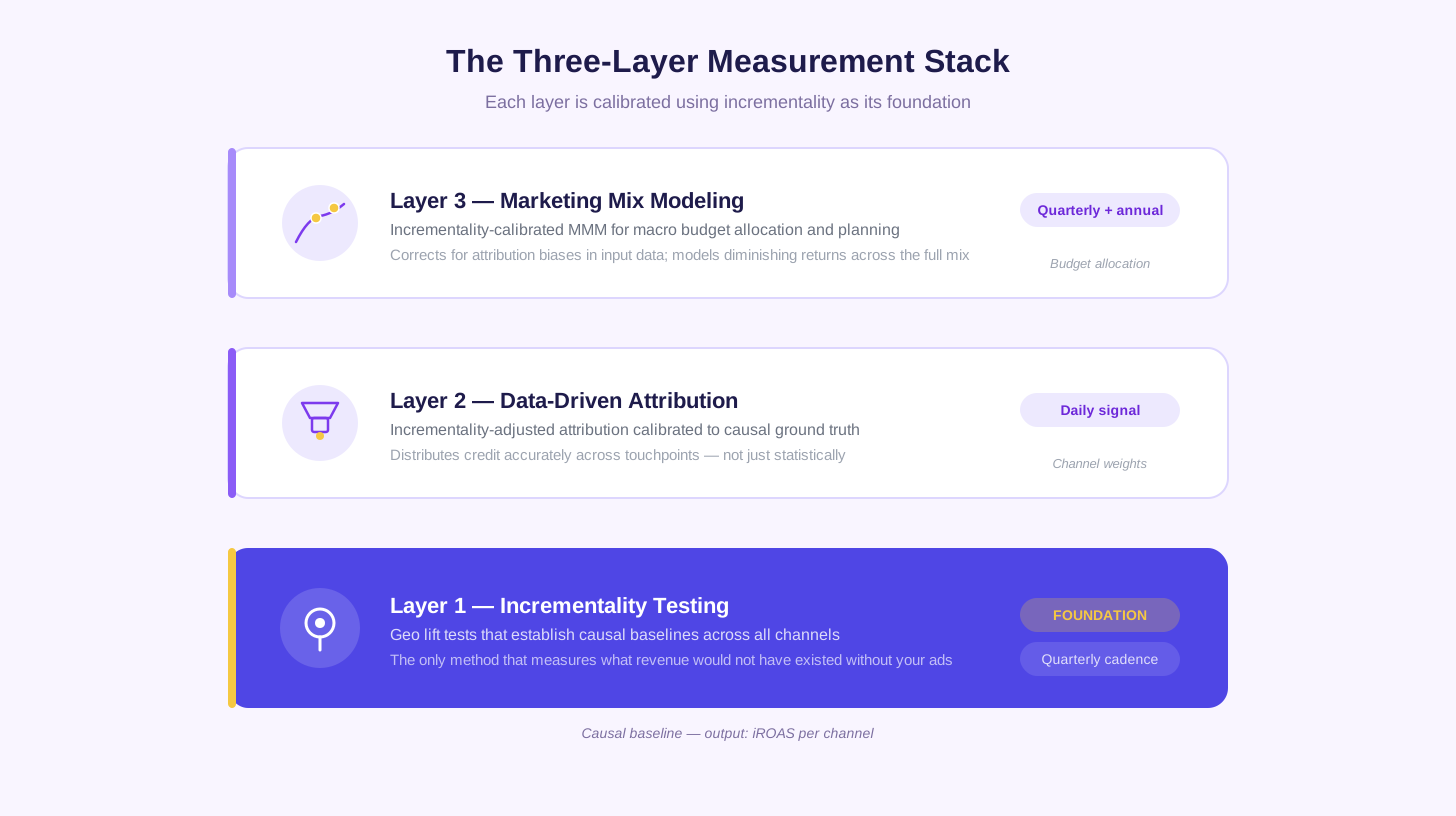
A measurement plan that actually works is built in three layers:
Layer 1 — Incrementality testing: the causal foundation. Tells you what revenue would not have happened without your ads.
Layer 2 — Data-driven attribution: your daily signal. Calibrated against incrementality data, it becomes reliable for channel-level optimization.
Layer 3 — Marketing Mix Modeling: your planning tool. Calibrated against incrementality, it tells you where to allocate budget at a macro level with confidence rather than guesswork.
Each layer serves a different time horizon. Incrementality tests run quarterly or per major channel decision. Data-driven attribution operates daily. MMM informs quarterly and annual planning. These are not competing methods — they are complementary ones, each made more accurate when calibrated against the incrementality foundation beneath it.
Layer 1: Incrementality testing — establishing your causal baseline
Geo incrementality testing works by dividing your market into matched geographic regions. One group sees your ads (test); one doesn't (control). The difference in sales between the two groups — scaled to your full market — is your incremental lift.
This is the only method that establishes causation. Every other measurement approach infers it.
The results brands find when they run their first proper incrementality test are almost always surprising — in both directions. Branch ran a 3-cell geo lift test during Black Friday 2024 and found that running Meta and Google PMax together drove 2× more total sales than Meta alone. Acting on WorkMagic's MMM-based budget recommendations, they achieved 225% higher Meta ROAS, 187% higher PMax ROAS, and an 18% MER improvement. Lifepro used incrementality-calibrated measurement to correct for attribution bias ahead of their most important sales period, giving their team a confident budget strategy grounded in causal data.
The causal baseline this establishes is the number every other layer in your measurement plan needs to anchor to.
Layer 2: Data-driven attribution — calibrated by incrementality
Multi-touch attribution improves on rules-based models by using machine learning to assign fractional credit across touchpoints. But without a causal baseline, it still systematically undervalues upper-funnel channels and overvalues the bottom of the funnel.
Incrementality-adjusted attribution is what data-driven attribution becomes once you calibrate it against your geo lift test results. Your incrementality test tells you the true contribution of each channel. You adjust your attribution model so its outputs align with that ground truth. Now your day-to-day data reflects causal reality — and it can be used to optimize bids, creative, and budget allocation with confidence.
This is the difference between a model that distributes credit with the data it has and one that distributes it accurately — with incrementality as its baseline.
Layer 3: Marketing Mix Modeling — calibrated by incrementality
Incrementality-calibrated MMM gives you the macro view: across your full media mix, where should budget go to maximize efficiency?
MMM models the relationship between media spend and revenue over time, accounting for external factors like seasonality, pricing, and promotions. Its outputs — response curves and saturation curves — tell you where you're approaching diminishing returns and where you have room to scale.
Without calibration, an MMM inherits the biases of its priors — the historical spend data and attribution inputs it's trained on are already distorted by the same measurement problems the model is meant to solve. Calibrated against incrementality results, it corrects for those biases and produces budget recommendations you can defend to a CFO.
The results compound. IndaCloud used incrementality-calibrated budget optimization across their full channel mix and achieved a 150% increase in marketing profitability. True Classic used incrementality data alongside marketing mix modeling for ecommerce to determine optimal TikTok spend — the model showed scaling to optimal levels could drive a 64% increase in sales.
The metrics that belong in your measurement plan
If you're building on the three-layer stack, the right north-star metrics are:
iROAS (incremental ROAS): incremental revenue divided by ad spend. The only ROAS metric that reflects true causality.
iCPA (incremental cost per acquisition): ad spend divided by incrementally driven new customers.
MER (marketing efficiency ratio): total revenue divided by total ad spend. A blended efficiency signal that captures the full system, not individual channels.
POAS (profit on ad spend): ROAS calculated against gross profit rather than revenue. Essential for brands with variable margins across SKUs or channels.
Platform ROAS belongs in your reporting dashboard. It does not belong as the primary metric in your measurement plan.
How to build your measurement plan by growth stage
The right starting point depends on where you are:
Early stage (under $1M annual ad spend): MER is your north-star metric. Platform-based reporting is fine to use at this stage — with a clear understanding of its shortfalls and biases. Most early-stage spend is genuinely incremental, so the distortion is smaller. Run your first geo lift test on your highest-spend channel when you're ready to validate that assumption and establish a causal baseline.
Mid stage ($1M–$10M): run geo lift tests quarterly on each major channel. Calibrate your attribution model against results. Once you're running spend across multiple platforms with consistent history, you'll need MMM alongside marginal ROAS analysis to properly allocate each ad dollar across your mix.
Scale stage ($10M+): maintain a continuous testing calendar. Incrementality-calibrated MMM drives quarterly planning. Channel decisions are made on iROAS, not platform metrics. Every significant budget reallocation is validated by a test before it's scaled.
The common thread: incrementality testing is the foundation. Every other layer of measurement becomes more accurate when it's anchored to causal evidence — and every budget decision becomes more defensible as a result.
Frequently asked questions
What is a marketing measurement framework? A marketing measurement framework is the methodology a brand uses to evaluate whether its advertising is working. The most rigorous frameworks are built on three layers: incrementality testing to establish causation, data-driven attribution for day-to-day optimization, and MMM for macro budget planning — each calibrated against the layer below.
What are the main models of marketing measurement? The three primary models are multi-touch attribution (MTA), Marketing Mix Modeling (MMM), and incrementality testing. MTA and MMM are widely used but rely on correlation rather than causation. Incrementality testing — specifically geo lift tests — is the only approach that measures true causal impact. Best-practice measurement combines all three, with incrementality as the calibrating foundation.
How do you measure digital marketing performance? Digital marketing performance should be measured at two levels: channel-level (using incrementality-adjusted attribution to track daily performance) and portfolio-level (using MER and incrementality-calibrated MMM to evaluate the full media mix). Platform-reported metrics like ROAS are useful as directional signals but should not serve as the primary measure of performance.
What metrics belong in a marketing measurement plan? The core metrics are iROAS (incremental revenue divided by ad spend), iCPA (ad spend divided by incrementally acquired customers), MER (total revenue divided by total ad spend), and POAS (profit on ad spend). These reflect causal performance rather than correlation-based attribution and are the metrics most likely to align marketing and finance on a common view of efficiency.