How Understanding Marginal ROAS Allows Brands to Optimize Every Ad Dollar

by
Isaac Lee
What is marginal ROAS?
Every marketer knows what return on ad spend (ROAS) is.
For operators in e-commerce, ROAS is one of the easiest ways of understanding whether you are getting that bang for your advertising buck.

But looking at ROAS in aggregate tends to muddy the waters. When results are combined, optimal and sub-optimal spending levels get averaged out, and hidden.
That's where marginal ROAS (mROAS) comes in. In practice, marginal ROAS is not directly observable from platform-reported metrics alone. True mROAS must be estimated using causal measurement methods, such as incrementality experiments (e.g. geo-based lift tests) or incrementality-calibrated media mix models, which isolate the true incremental impact of additional ad spend.

If performance marketing is a game of chess, looking at ROAS is like evaluating your performance at the end of a game. mROAS, by contrast, would be equivalent to assessing after every move and asking yourself: "Now that that's happened, what should my next move be?".
If you were to draw a graph of revenue against ad spend, ROAS would take the total revenue at a single point, and divide it by the total ad spend. mROAS, on the other hand, would be the slope of the curve at that point.
ROAS | Marginal ROAS |
Your total sales divided by total ad spend for a channel | The return you'll receive for spending this next $1 in ad spend |
Looking at mROAS allows marketers to make surgical adjustments to their ad budgets and achieve more optimal outcomes.
Marginal ROAS vs ROAS
Another way to think about this is through the Law of Diminishing Marginal Returns. As the curve below shows, not every incremental ad dollar (the X-axis), gets you the same results.
Most ad campaigns start out strong, with every incremental dollar delivering a large step up in revenue. Over time, returns taper off as latent demand converts and it becomes harder to reach the next, slightly less ready-to-buy customer.
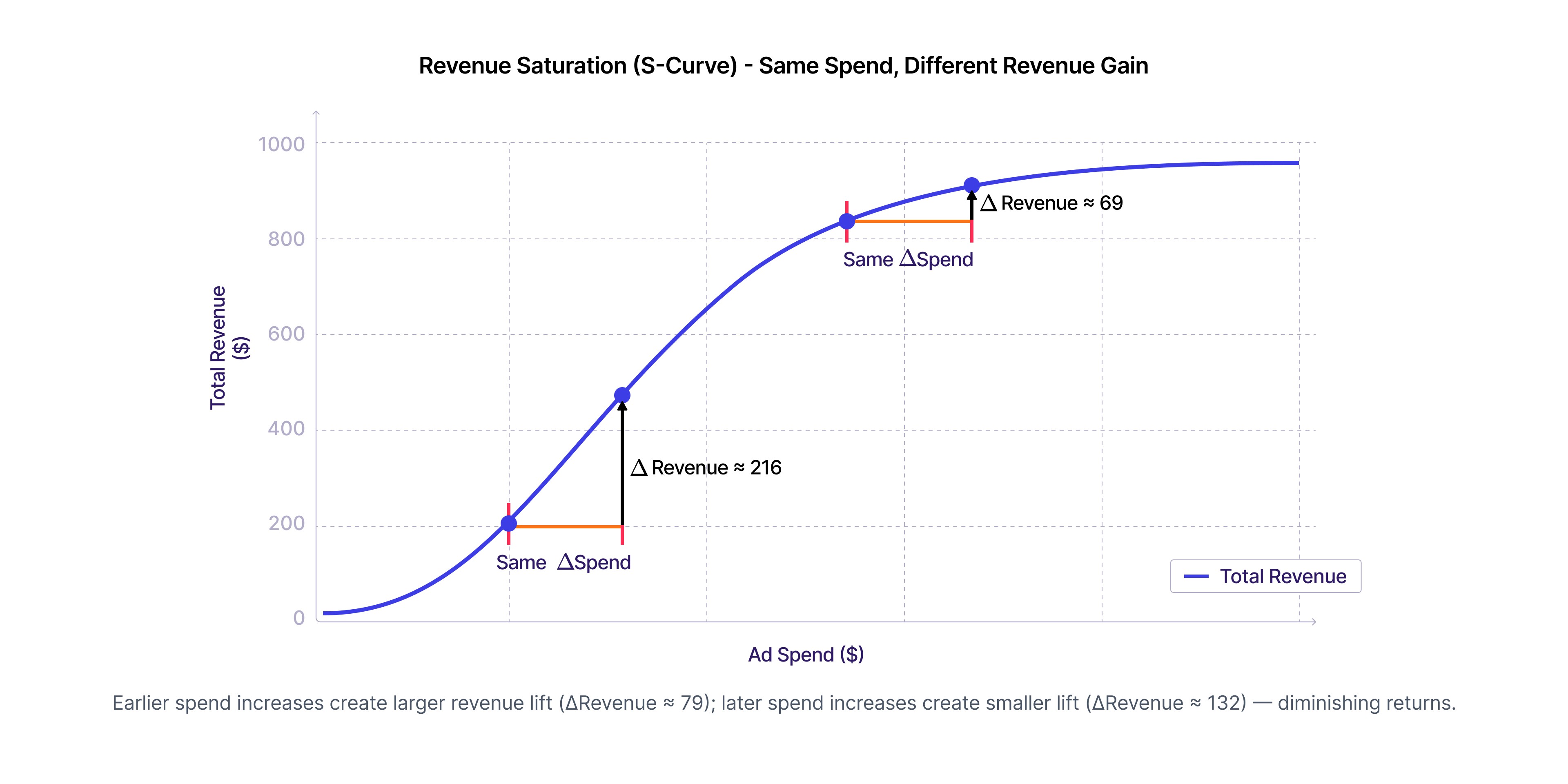
In this example, the earlier increment in ad spend led to a larger change in total revenue than the later one.
So, while ROAS is a measurement of past performance, mROAS can be an indicator of future returns — answering the question: where am I on the curve, and is it worth continuing to invest?
Now let's plot both mROAS and ROAS on the same axes to better show their differences:
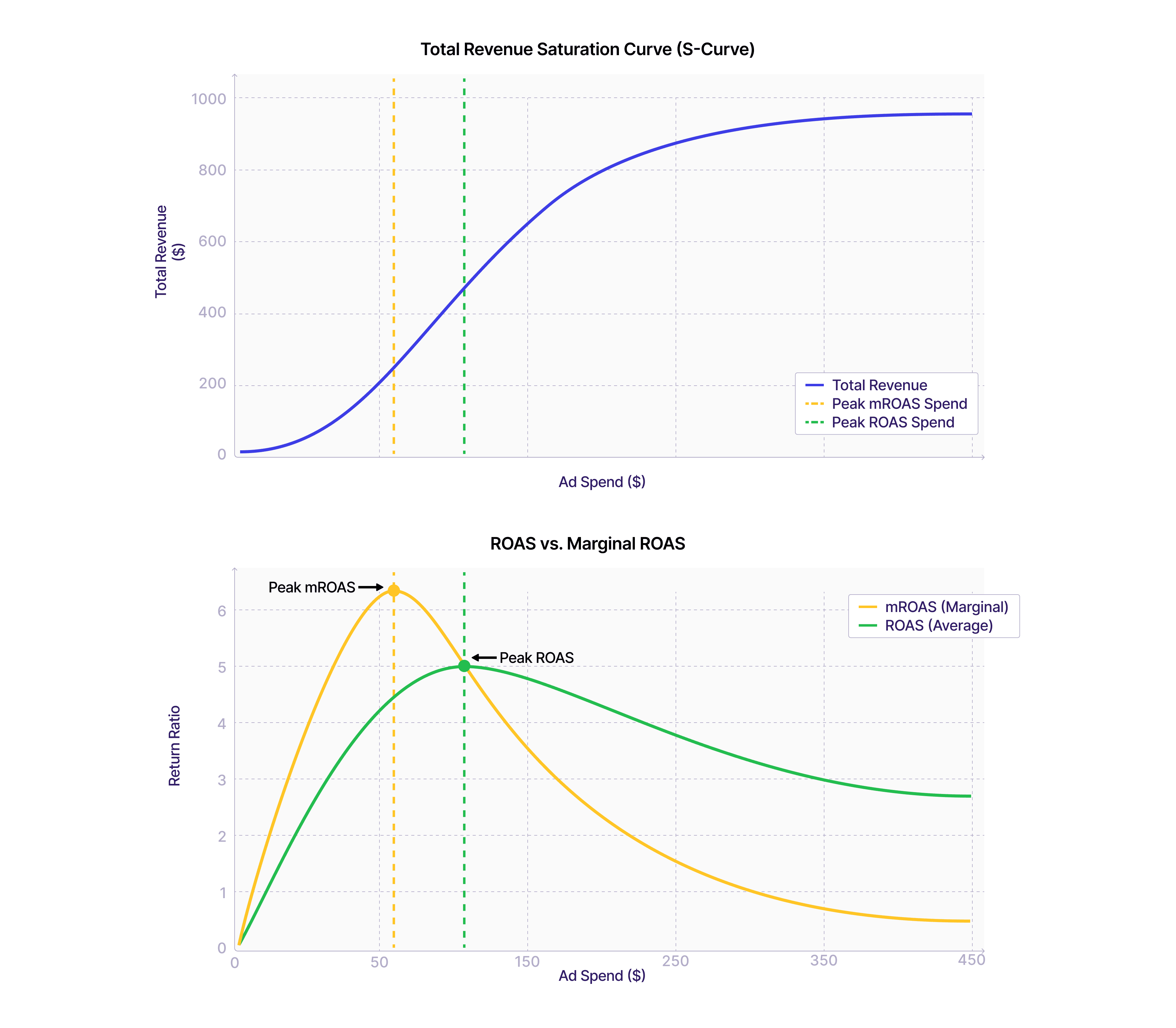
Starting from the top-most graph,
The revenue curve follows an S-shape — as you spend more on ads, you reach more people, and revenue increases.
The rate of increase slows down after a bit (yellow line), as the easier-to-convert part of the audience buys and exits the market.
That point maps onto the peak of the mROAS curve — every dollar spent beyond that starts returning less than the dollar before — hence the slowing down of the rate of increase.
ROAS has not peaked at this point! It continues to increase before peaking at about $100 in ad spend — because while every dollar after the mROAS peak is less efficient than the last, it's still generating a higher return than the overall average (about ~$6 for every dollar spent), and is pulling the average up.
ROAS peaks at $100 in ad spend, with a average ROAS of about $5.
There are a few key points we should discuss here:
The peak of the mROAS curve
For companies that want to maximize the efficiency of their ad spend, this is the point where the next dollar spent starts to be less efficient than the last. They should consider shifting that next ad dollar to a different ad channel, with a higher mROAS.
The gap between the two peaks
This gap illustrates why ROAS can be misleading: your efficiency has already started to drop, even while ROAS is still rising. Importantly, the peak of the mROAS curve does not represent a universal stopping point for spend, but rather a signal that each additional dollar is becoming less efficient and should be evaluated against alternative opportunities.
The peak of the ROAS curve
This is where companies typically start reallocating budgets, because they've noticed that ROAS is finally starting to dip.
Why marginal ROAS is important
Now that we've got the theory down to a "T", let's illustrate it with a simple multi-channel example.
Say you've spent $10,000 on Platform A at a historical average ROAS of × and you have another $10,000 to allocate. Going by ROAS alone, it'd be easy to choose to allocate that next $10,000 to Platform A. After all, historical data seems to suggest that Meta would give the highest returns.
Platform | ROAS |
Platform A | 1.80× |
Platform B | 1.75x |
What that analysis misses is that you've already spent $10,000 on Platform A (remember our chess analogy?), and you're probably closer to flatter part of the curve, rather than the initial, high-return phase. In fact, plotting the curves gives you something like this:

Note: The figures in this example are simplified and illustrative, intended to demonstrate the decision-making logic rather than represent a specific real-world account. ROAS values in this chart are shown on a normalized scale to illustrate relative efficiency changes, not absolute account-level ROAS.
With the ability to measure mROAS, a few things become clear:
We've passed the peak mROAS for Platform A, which means that
Increasing spend by another $10,000 would lower overall ROAS.
We might have better overall returns by allocating some of that $10,000 to a different channel such as Platform B.
Based on your intended business objectives, your next step could be very different:
Peak overall efficiency
That's achieved at maximum ROAS — or $12,543 in this case. You would put an additional $2,543 into Platform A, then find the next most efficient channel (Platform B).
Peak incremental efficiency
Your ad spend exceeded this at around $7,322 in spend — and it would be more efficient to cut spend back to the point of peak mROAS. Your next ad dollar should definitely go to another channel, up till that channel's own peak in mROAS.
Maximizing sales:
When the primary goal is maximizing revenue or market share, brands may intentionally operate beyond peak mROAS and peak ROAS. In these cases, incremental efficiency is traded for additional scale, as long as incremental revenue remains profitable or strategically valuable based on customer lifetime value or growth objectives.
You can continue to increase spend as long as incremental revenue exceeds incremental cost, after accounting for margins, COGS, and operating expenses.
Many teams operationalize this by setting an internal efficiency benchmark (for example, a contribution ROAS target) and scaling spend until incremental returns fall below that threshold.
That's how Jordan Craig (a streetwear brand) uses this concept to guide their spend:
The team sets an internal ROAS benchmark (say, 1.80×), then scales spend until ROAS falls to that point.
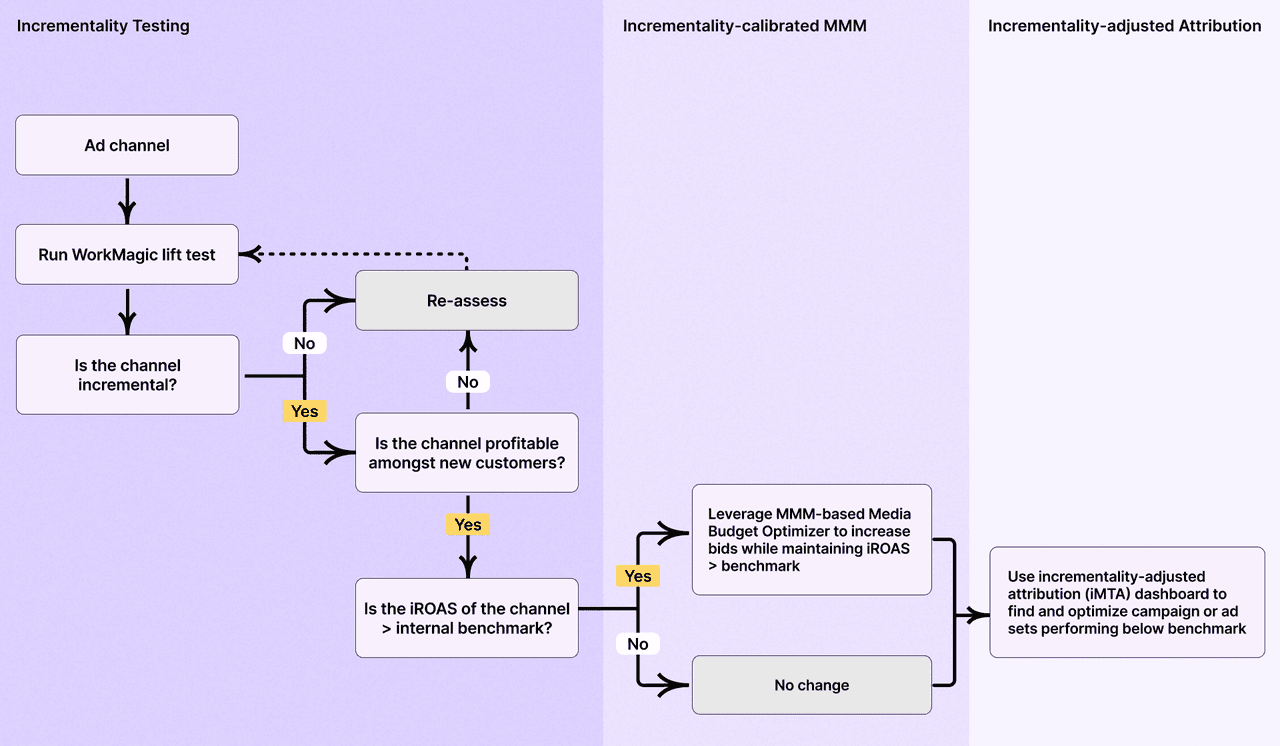
In practice, acting on marginal ROAS requires incrementality-based measurement. By combining causal experiments with incrementality-calibrated modeling, teams can estimate true mROAS and make informed budget decisions grounded in actual incremental impact rather than averaged performance metrics.
ROAS is useful for understanding how your ads performed in aggregate. Marginal ROAS goes a step further by answering a more important question: how effective will your next dollar of spend actually be? In an environment where diminishing returns set in quickly, that distinction matters more than ever.
When teams rely solely on ROAS, they often keep pouring budget into channels that look strong on average but are already past their point of peak efficiency. mROAS reveals where incremental returns start to fall off, making it possible to reallocate spend before efficiency quietly erodes. This is how marketers move from broad budget shifts to precise, dollar-by-dollar decisions.