How to Optimize Marketing Spend Across Multiple Channels

by
Lauren Lauth, VP of Measurement
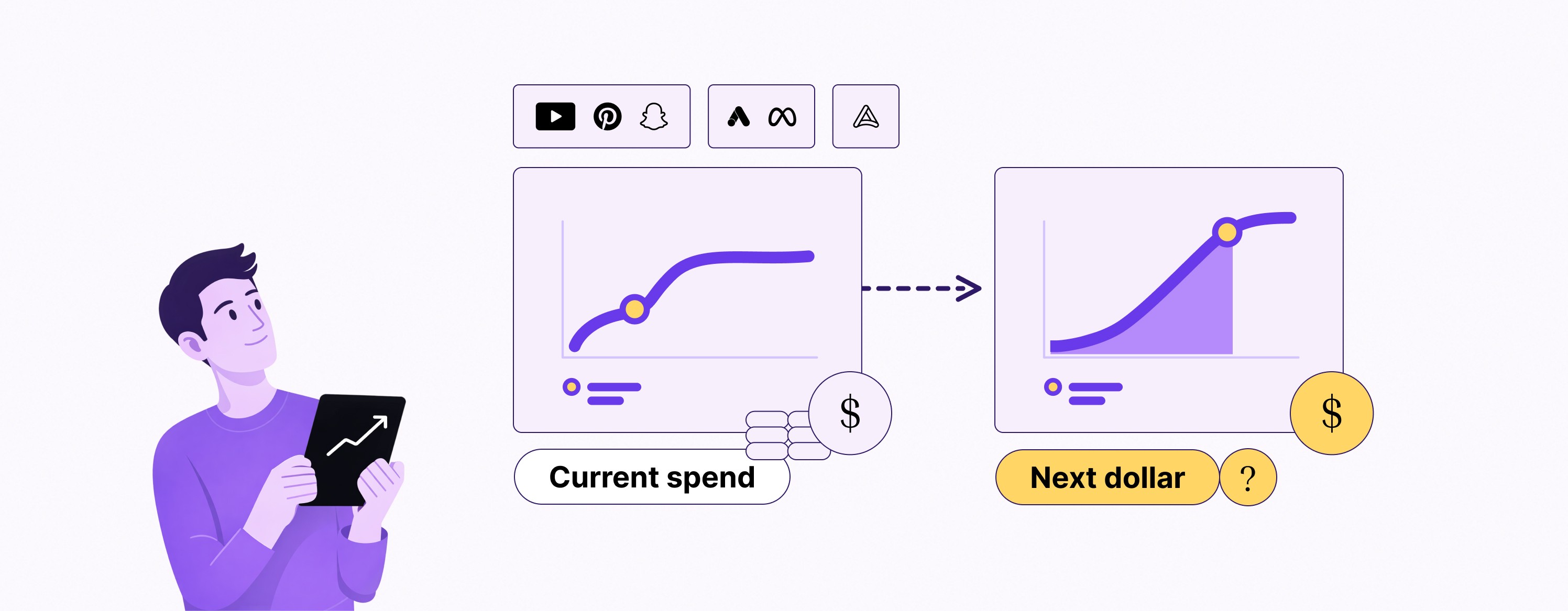
Most brands managing multiple ad channels rely on the same instinct: double down on what's performing, pull back on what isn't. The problem is that "performing" usually means platform-reported ROAS — a historical average that tells you what happened in aggregate, not what the next dollar will actually return.
Marketing spend optimization done properly requires three things in sequence: an incrementality baseline for each channel, saturation curves that map diminishing returns across your full mix, and marginal ROAS as the signal that tells you where each successive dollar should go. Without all three, you're reallocating based on incomplete information.
How to allocate marketing budgets across channels
The correct way to allocate marketing budgets across channels is to rank every active channel by its current marginal ROAS — the return the next dollar will generate at your current spend level — and direct the next budget increment to whichever channel has the highest marginal return. Repeat the calculation each time spend shifts, since moving dollars changes where each channel sits on its curve. This requires incrementality baselines and calibrated saturation curves for every channel in your mix.
Step 1: Establish an incrementality baseline for every channel
Before you can model how a channel responds to more or less spend, you need to know what it's actually driving. That means running incrementality testing across your channels to establish a causal baseline for each one.
This step is foundational. If your saturation curves are built on attributed revenue — which includes organic baseline sales and halo effects that belong to other channels — the curves will be wrong, and any allocation recommendations you derive from them will be wrong too. Incrementality corrects the signal: it replaces correlated revenue with caused revenue, giving your models a clean foundation to work from.
For LifePro, understanding how marketing spend affects revenue projections was what made BFCM planning defensible. Using incrementality-calibrated MMM to establish what each channel was actually driving — rather than what each platform claimed — gave their team confidence to commit to a budget strategy grounded in causal outcomes rather than attributed ones.
Step 2: Build a saturation curve for every channel you're spending on
Once you have incrementality baselines, you can build a saturation curve for each channel — and optimize marketing spend based on patterns in how each channel's returns change as investment increases. A saturation curve maps that relationship across a range of spend levels, showing where each channel sits on its diminishing returns curve and, critically, where the curve starts to flatten.
Budgeting for a multi-channel marketing platform requires curves for every channel in your mix, not just your top performer. The average WorkMagic client has about 3.5 ad platforms connected, each with its own curve and its own point of peak efficiency. Knowing one channel's curve tells you almost nothing about how to allocate across all of them.
Building accurate saturation curves requires advanced modeling calibrated for adstock, seasonality, and promotions — and grounded in incrementality results, so the curves reflect true causal returns rather than platform-reported attribution. For a full breakdown of how saturation curves work across a multi-channel mix, see Saturation Curves Explained.
Step 3: Use marginal ROAS to decide where every dollar goes
With saturation curves in place across your full channel mix, marginal ROAS becomes the allocation signal. It's the slope of each channel's saturation curve at its current spend level — not what the last thousand dollars returned, but what the next dollar will return.
This is the mechanism that answers how advertisers can improve budget allocation across channels: rank each channel by current marginal ROAS, direct the next budget increment to whichever channel has the highest marginal return, and recalculate as spend shifts. A channel with a 3.5× average ROAS can have a marginal ROAS of 0.9× if it's past its saturation peak. The average looks fine. The marginal signal tells you to stop.
Optimizing paid media campaigns at this level of granularity — dollar by dollar, channel by channel — is what separates marketing budget optimization from simple ROAS-chasing.
The full workflow: how to use spend data to optimize future plans
The optimization loop runs like this:
Run incrementality tests to establish causal baselines across your active channels
Feed those results into your MMM to build calibrated saturation curves for each channel
Calculate marginal ROAS at your current spend levels across the full mix
Allocate the next budget increment to the channel with the highest marginal return
Rerun the model as spend shifts, since moving dollars changes where each channel sits on its curve
This is what it means to use spend data to optimize future plans: not to analyze what happened last quarter, but to model what the next dollar will return — then execute against that model and update it continuously. Saturation curves shift with competitive pressure, seasonality, and creative fatigue. A model calibrated on last quarter's data may not reflect this week's reality.
It also can't be run manually at scale. The interactions between three or four channels, each with a shifting curve and a budget constraint, require a model to optimize — not a spreadsheet. The model needs to be grounded in incrementality, updated with fresh spend data, and oriented toward the actual business objective: blended ROAS, contribution margin, or new customer CAC.
When all three layers are in place — causal baselines, saturation curves, and marginal ROAS — budget allocation stops being a judgment call governed by fixed rules and becomes a calculation governed by data. The next dollar has a right answer. The job is building the measurement stack that lets you find it.