What is incrementality-calibrated MMM? Why accuracy matters now

by
Lauren Lauth, VP of Measurement
Your standard MMM is probably wrong.
Not because the math is bad. Because it's built on guesses. Traditional marketing mix models estimate channel lift from historical correlation, and that correlation is confounded by brand awareness, seasonality and a dozen factors nobody measured. So the model tells you TikTok drove 8% of revenue when the real number is 3%, or it buries Meta at the bottom of the list when Meta is your strongest channel.
Incrementality-calibrated MMM fixes that by anchoring the model to something you actually observed: lift test results from live channels.
What is incrementality-calibrated MMM?

Incrementality-calibrated MMM is a marketing mix model trained on historical data and continuously refined by live incrementality test results. Rather than leaning on correlation alone to estimate channel lift, the model gets recalibrated every time you run a geo incrementality test or a comparable experiment.
The calibration itself is straightforward. You run a lift test on a channel, measure the true incremental impact, and feed that number back into the MMM. The model then revises what it believes about that channel's saturation curve, its diminishing returns and its overall efficiency. Test more channels over time and the model gets steadily more accurate.
Traditional MMM works differently. It treats historical data as settled fact and rarely revisits its assumptions about what drives revenue.
Why standard MMM underestimates or overestimates lift
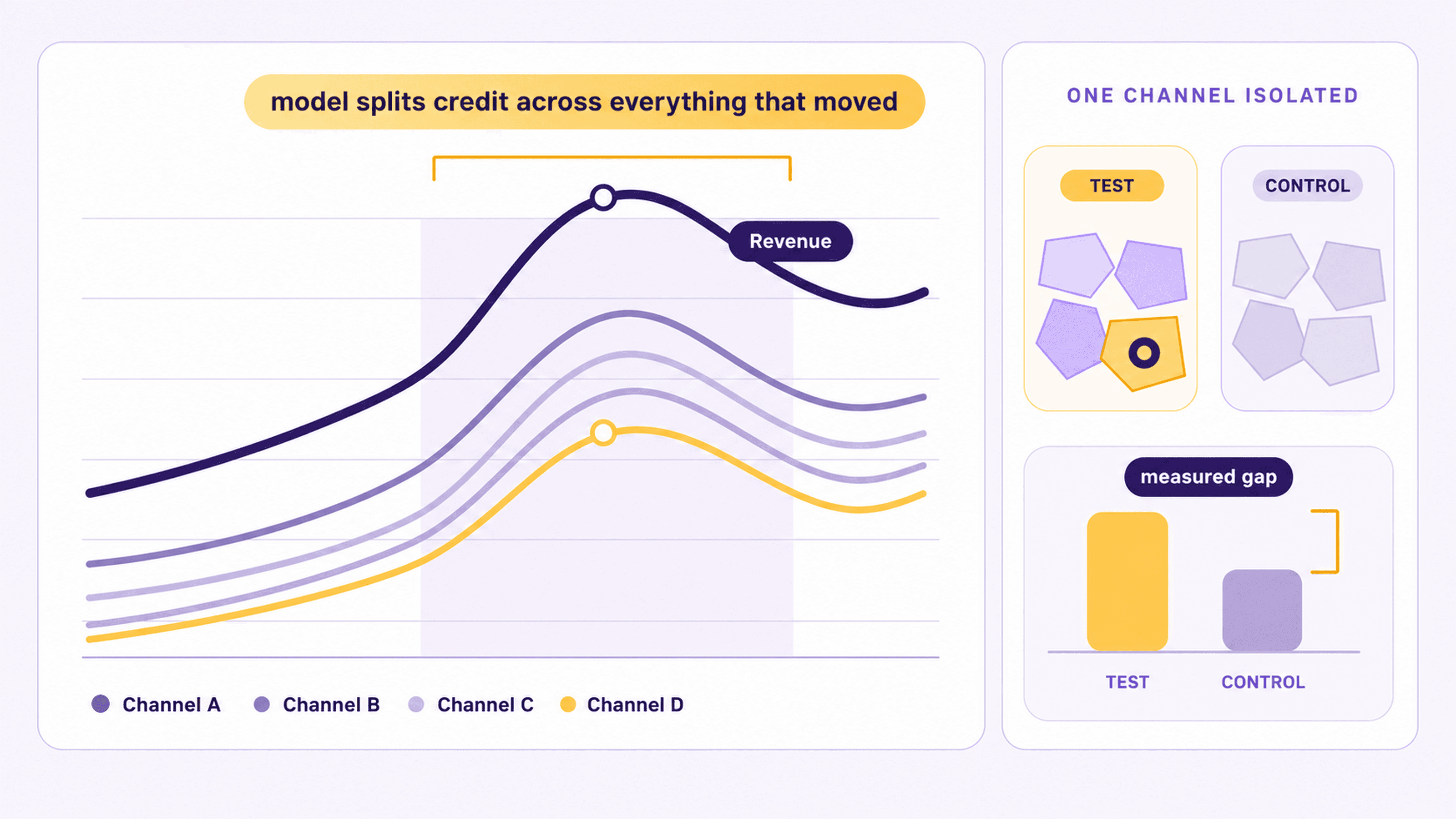
Standard MMM has no way to check itself against reality. It sees correlation in the data, a spike in Meta spend lining up with a spike in revenue, and treats that as causation. But causality doesn't show up in historical analysis. The revenue spike might have come from organic search trending, a TikTok video taking off or a seasonal gifting surge.
Why standard MMM underestimates incremental lift walks through the mechanics. When several channels spike together, which is exactly what happens in peak season, the model spreads credit across all of them and deflates each one's estimated impact. It never learns which channel actually moved the number.
Incrementality tests settle it. A geo lift test isolates one channel by running it in test geographies while holding everything else steady. What comes back is causal: test geos saw X% more revenue than control geos. That's the number your MMM had been trying to infer.
How incrementality calibration improves MMM accuracy
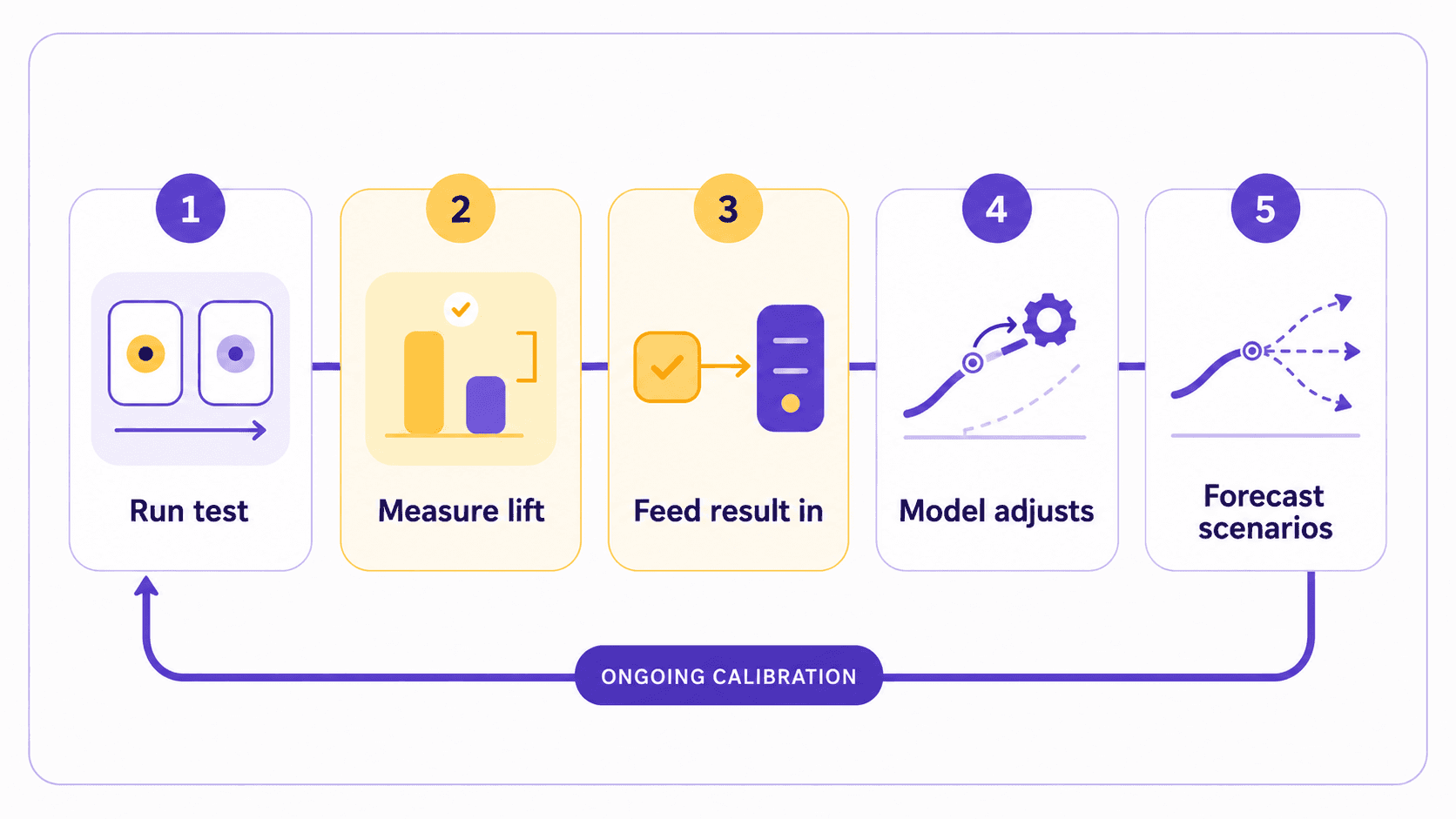
Once a test result goes into the model, the model has a real anchor. From there it can revise its assumptions about that channel's saturation curve, its elasticity, and how it interacts with everything else you're running.
How calibration works in practice:
Run a lift test on a channel Meta,TikTok,email,CTVMeta, TikTok, email, CTV Meta,TikTok,email,CTV.
Measure the true incremental lift, for example "test geos saw 5% incremental revenue lift."
Feed that result into your MMM as a calibration point.
The model adjusts its historical analysis to match what you observed.
Use the recalibrated model to forecast revenue under different budget scenarios.
You can calibrate several channels at once. How to calibrate MMM with geo lift tests covers the mechanics in depth, but the underlying principle is simple: more test data, more accurate forecasts.
Aspect | Standard MMM | Incrementality-calibrated MMM |
|---|---|---|
Data source | Historical correlation only | Historical data + live lift tests |
Causality assumption | Inferred from patterns | Validated by experiments |
Recalibration | Rarely, if ever | Ongoing, with each new test |
Saturation curves | Estimated from correlation | Grounded in real diminishing returns |
Accuracy on unmeasured channels | Guesswork | Directionally sound, not overconfident |
Actionability | Directional only | Campaign, ad set and ad-level insights |
A real example: what calibration means in revenue terms
David Protein ran a full MMM analysis and found they'd been over-attributing revenue to paid Meta by 36%. Their attribution model had been crediting Meta with far more revenue than the lift tests supported.
After moving to incrementality-calibrated models, they saw a 34% lift in revenue and a 37% lift in profit margin. The gain wasn't only accuracy, it was strategic. Once the true incremental impact of each channel was visible, they could move budget into channels that were underinvested and pull it out of the ones that looked good in correlation and underperformed in causality.
That 34% came straight out of making budget decisions on ground truth instead of guesses.
When to recalibrate your MMM
One lift test calibrates your MMM, but the relationship between channel lift and business conditions doesn't sit still. Audiences saturate, creative wears out and competitors change what they're doing.
When to recalibrate MMM and why covers the triggers in detail. The short version: after each significant test, or at least quarterly if you're testing consistently. Fresh data is what keeps the model sharp.
Who needs incrementality-calibrated MMM?
If you're already running incrementality tests, the results should be feeding a model. You're paying for ground truth either way, so it's worth building something predictive on top of it.
The data requirements for calibrated MMM covers what you need: at least two years of historical spend and revenue, clean conversion tracking, and ideally two to three lift tests to establish an initial calibration. Any DTC brand running paid acquisition across multiple channels almost certainly has this already.
Enterprise MMM buyers and performance marketers tend to file incrementality testing and MMM as separate tools. Incrementality-calibrated MMM treats them as one system. Testing supplies the ground truth. MMM scales that truth across every channel and time period.
The parent pillar on marketing mix modeling for DTC covers the full landscape of methodologies and when each one applies. This article stays on the calibration piece.
Frequently asked questions
Can you calibrate MMM with just one lift test?
Yes. One test gives you a single data point, and accuracy improves from there. Multiple tests are better, since they let you calibrate different channels and check that your saturation curves hold up under varying conditions. Start with one and add over time.
Does incrementality-calibrated MMM replace attribution modeling?
No. They answer different questions. Attribution shows halo effects and touchpoint influence down to the ad level; MMM shows channel efficiency and budget elasticity. Run together, incrementality-adjusted attribution gives you tactical and strategic views without double-counting.
How long does it take to build an incrementality-calibrated MMM?
Usually two to four weeks from data collection to first forecast, with the model training on two years of history. Recalibrating against a new lift test is much faster, typically three to five days, because the structure is already built.
What if I'm not running regular lift tests?
Start with one. A single geo incrementality test costs a fraction of enterprise MMM software and gives you the ground truth a model needs. If you're making budget decisions at any real scale, testing pays for itself.
Ready to see how incrementality-calibrated MMM compares to your current approach? Book a demo and we'll show you the difference ground truth makes.