MMM definitions and concepts

by
Lauren Lauth, VP of Measurement
The problem with guessing which channels actually work
Most DTC and enterprise brands can't tell whether their spend is efficient or just habitual. The attribution tools overclaim by design. Facebook takes credit for 40% of revenue, Google for 20%, TikTok has its own story. You end up with overlapping claims that add to well over 100% and no way to referee them.
Marketing Mix Modeling asks a narrower and more honest question: if you moved a dollar from channel X to channel Y, what happens to revenue?
Everything else is the math that gets you to that answer.
What is marketing mix modeling?
Marketing Mix Modeling is a statistical framework that isolates each channel's true impact on a business outcome, usually revenue, profit or customer acquisition. It answers what last-click attribution can't. Which channel is claiming revenue that would have arrived anyway? Where are you paying a premium for reach you've already exhausted? What's the optimal split across everything you're running?
The model works from two or more years of historical spend and sales data, measuring the relationship between what you invested and what you earned. It assigns each channel a coefficient, a number representing impact, adjusted for time delays, saturation and seasonality.
The core formula is simple enough to write on a whiteboard: Total Revenue = $$Channel A Impact × Spend $$ + $$Channel B Impact × Spend $$ + Organic Baseline + Seasonality
Every dollar of revenue is accounted for once. No overlap, no double-counting.
Key MMM concepts every marketer needs to understand
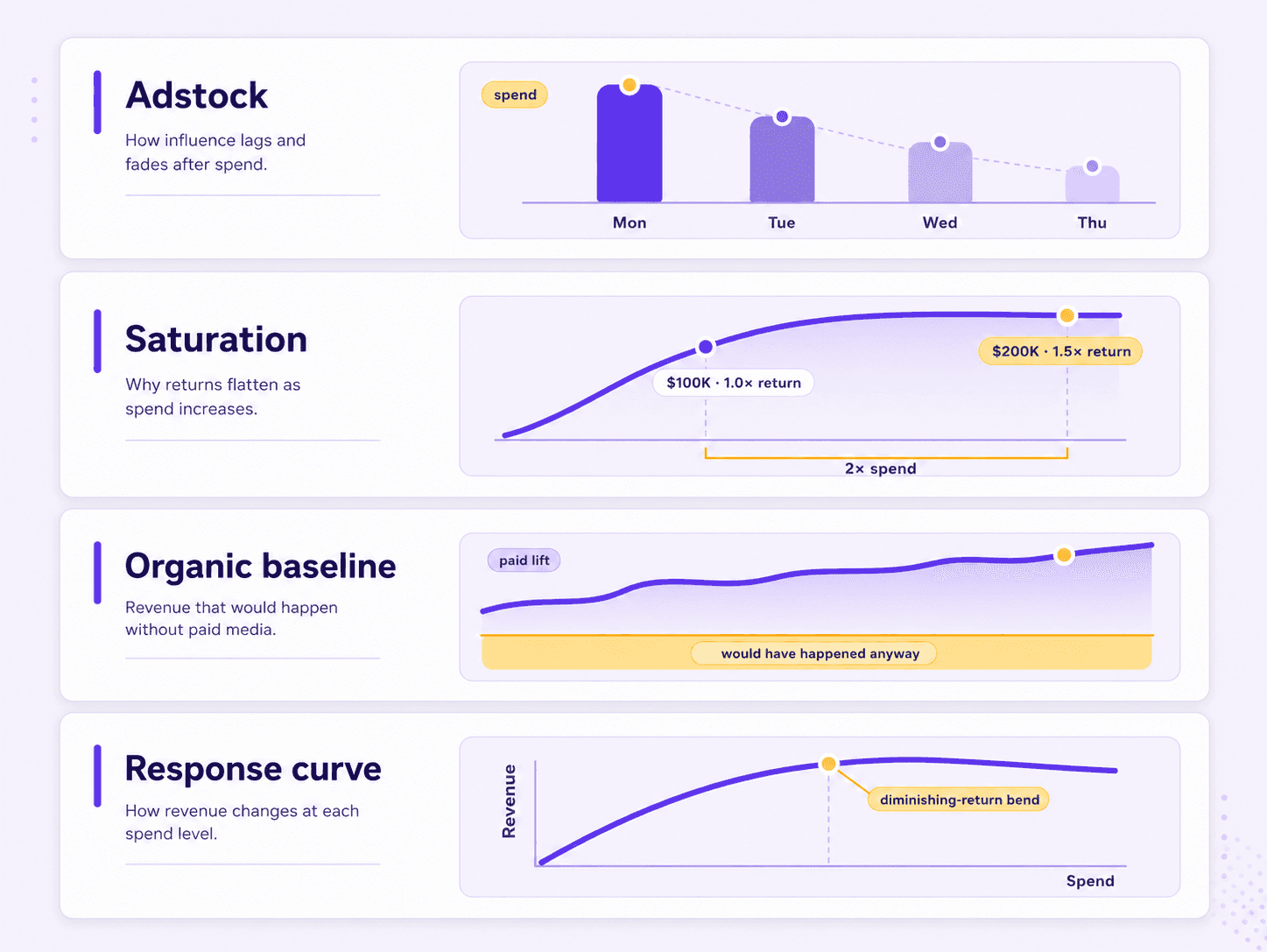
Adstock: Spend today doesn't create sales today. A YouTube ad someone watches Monday might turn into a purchase Thursday. Adstock measures that lag and decay: how long an impression keeps influencing behavior and how fast that influence fades. Without it, your model credits the wrong channel for the sale.
Saturation function: No channel scales in a straight line. Spend $100K on Meta and you get X sales. Spend $200K and you don't get 2X, you get 1.5X, maybe 1.2X. Saturation functions put math behind that curve so the model doesn't overpromise on aggressive scaling in a single channel.
Organic baseline: Sales don't start at zero. With no paid marketing at all, some customers still arrive through direct traffic, word of mouth and search. Organic baseline in MMM separates that natural demand so what you're measuring is incremental paid impact rather than total revenue.
Response curves: A response curve plots spend on the X axis against revenue on the Y axis and shows the real shape of the relationship. Response curves explained covers why overspending one channel leaves money on the table. Past the bend, each additional dollar buys less than the one before it.
Classical vs. Bayesian: which methodology matters
Bayesian vs. Classical MMM comes down to how each approach handles statistical uncertainty. Classical MMM uses frequentist hypothesis testing. Bayesian MMM starts from prior knowledge and updates its beliefs as new data arrives. For most teams the choice matters less than whether the model updates frequently and reflects your actual business constraints.
How to tell if your model is actually working
Once a model is built, its quality matters more than its methodology. How to evaluate MMM model fit walks through the two numbers to read: R², the share of revenue variance the model explains, and MAPE, mean absolute percentage error, or how far predictions land from actual results. A strong model explains 70%+ of variance with MAPE under 15%.
Building vs. buying MMM
Some teams build their own on open-source tools. Robyn vs. Meridian compares the two most common frameworks. Both are capable, and both need data engineering, statistical expertise and ongoing maintenance to stay useful. Managed platforms handle the integration, modeling and daily refresh instead, and fold in incrementality tests to validate what the model produces.
Getting started with MMM
Marketing Mix Modeling for DTC walks through methodology, setup and real outcomes. To get going you'll need 45 days minimum of recent spend data, though 10+ months is meaningfully better, along with two years of historical revenue, clean channel definitions and a single clear KPI. Teams often ask whether media mix modeling and marketing mix modeling are the same thing. In practice the terms get used interchangeably, though media mix technically refers to paid media only, not every marketing lever.
Frequently asked questions
What's the minimum data I need to run MMM?
Forty-five days of recent spend data across your channels is the floor. Ideally you'd have 10+ months across the major platforms and two years of historical revenue. The more history the model sees, the better it separates seasonal patterns from real channel impact.
Can MMM measure multiple KPIs like halo effects or retail lift?
Yes. MMM can model any KPI you have aggregate data for: revenue, profit, margin, new customers, repeat rate, even retail sales driven by digital advertising. Each one needs its own model, but the approach doesn't change.
How often should I rebuild my MMM model?
The model should refresh daily with current spend and sales data so saturation curves and channel coefficients stay aligned with what's happening now. Seasonal patterns get re-evaluated continuously as new data lands.
Does MMM work with inconsistent spend patterns or intermittent channels?
Yes, provided you have at least 45 days of recent data. Intermittent channels like seasonal paid search bursts are handled through saturation curves and time-series decomposition. The model learns from what happened during those windows and extrapolates from there.
Ready to move from attribution guesswork to causal measurement? Book a demo to see how WorkMagic's incrementality-calibrated MMM works.