How Does Data-Driven Attribution Work? A Complete Breakdown

by
Lauren Lauth, VP of Measurement
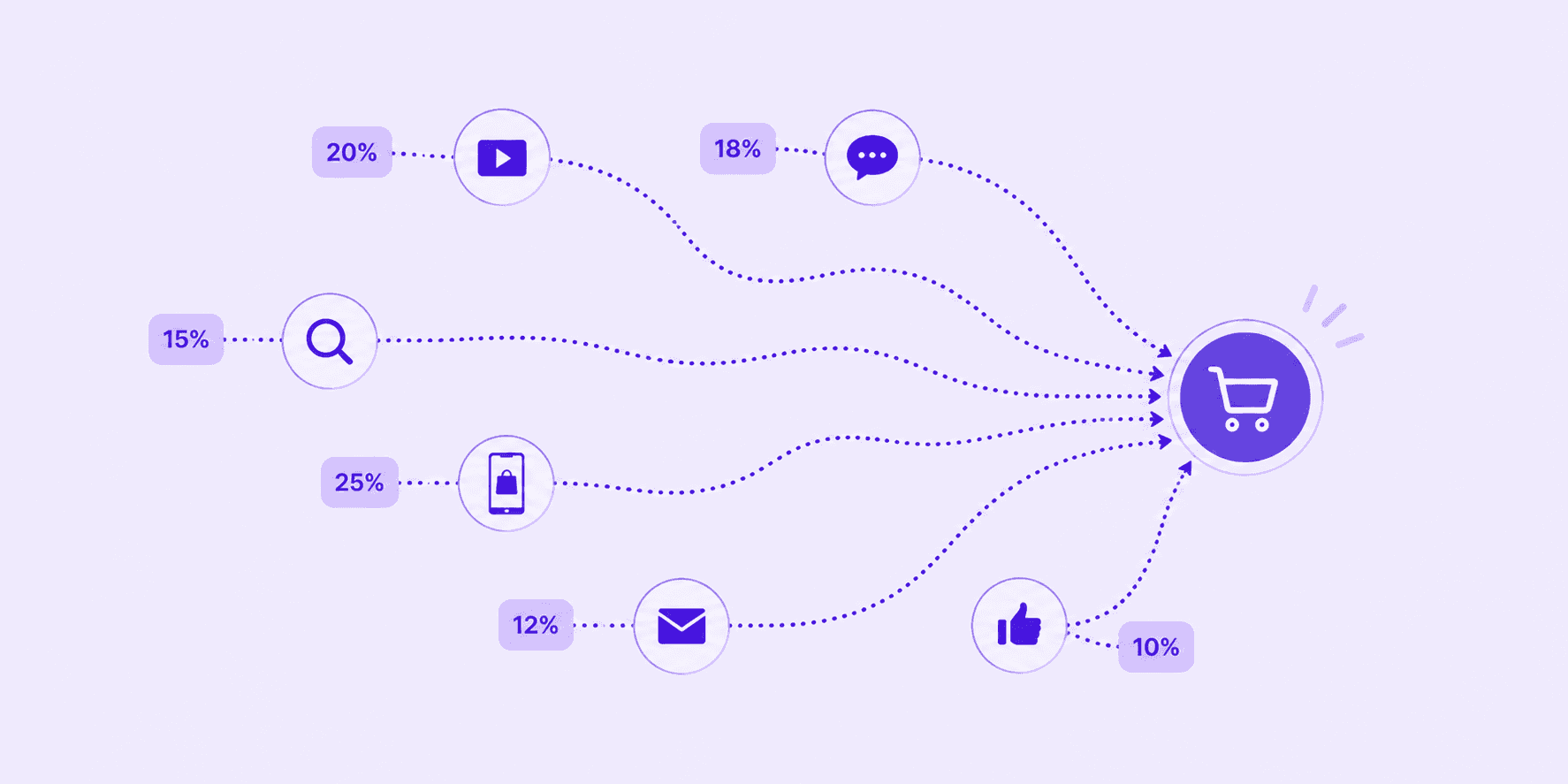
Data-driven attribution works by comparing converting and non-converting customer paths, then using machine learning to assign fractional credit to the touchpoints most associated with conversion.
Most marketing measurement still defaults to last-click attribution, which assigns 100% of conversion credit to whichever ad a customer clicked immediately before buying. That model misses every earlier touchpoint that actually moved the customer toward purchase. Data-driven attribution (DDA) is the industry's algorithmic answer: a machine-learning model that distributes credit across the full conversion path based on each touchpoint's measured contribution.
What is data-driven attribution?
Data-driven attribution is an algorithmic attribution model that uses an advertiser's own conversion data to learn how much credit each touchpoint deserves in a customer journey. Where rule-based models hard-code the credit split (last-click gives everything to the final touch, linear divides credit evenly, time-decay weights toward recency), DDA learns the weights from observed behavior. Touchpoints that consistently appear in converting paths but rarely in non-converting ones get more credit. Touchpoints with little signal either way get less. The model is unique to each account because it trains on each account's own data. Our companion guide, All You Need to Know about Data-Driven Attribution, goes deeper.
How data-driven attribution works, step by step
Most DDA implementations follow a similar four-step process.
Path collection. The platform logs every ad interaction (clicks, video views, and in some cases qualifying impressions) for users who converted and users who did not. The output is a dataset of conversion paths: ordered sequences of touchpoints leading to a sale or a missed sale.
Counterfactual comparison. The model compares converting paths against non-converting paths to find which touchpoint patterns correlate with conversion. The math is typically a Shapley-value-style algorithm that calculates each touchpoint's marginal contribution: how much does adding this ad to the path change the probability of conversion?
Credit assignment. Each touchpoint receives a fractional credit, a decimal weight rather than a whole-conversion assignment. A path with four touchpoints might split credit 25/35/15/25 instead of 0/0/0/100.
Account-specific training. The model trains on the advertiser's own historical data and refreshes continuously. Google requires a minimum conversion volume before DDA becomes available, since the algorithm needs enough signal to find stable patterns.
Where data-driven attribution shows up
DTC marketers encounter DDA in three main places.
Google Ads has used DDA as the default since 2021. Google data-driven attribution distributes credit across search, display, YouTube, and Discovery ads.
GA4 data-driven attribution became the default for most reports in 2023. Data-driven attribution in GA4 covers Google channels plus any non-Google touchpoints captured in the GA4 conversion path, though tracking limits constrain what GA4 can see off-platform.
Meta offers DDA through its reporting tools and Advantage+ features, covering touchpoints across Facebook, Instagram, and Audience Network.
Platform | What DDA can see | Main limitation |
Google Ads | Google Ads touchpoints | Mostly Google ecosystem visibility |
GA4 | Tracked web/app conversion paths | Gaps from privacy, offline, retail, and untracked channels |
Meta | Meta-observed touchpoints | Cannot fully see Google, TikTok, Amazon, retail, or offline halo |
Each platform's DDA only sees what that platform observes. The credit weights are accurate within a partial graph, never the whole journey.
A simple data-driven attribution example
Imagine a customer's path to a $100 purchase: she sees a Meta video ad for the brand, a week later clicks a TikTok ad and visits the site, two days after that searches the brand on Google and clicks a brand-search ad, then the next day clicks a promotional email and converts.
Last-click attribution gives 100% of the $100 to the email. DDA, trained on thousands of comparable paths, might distribute credit something like 20% to the Meta video (introduced the brand), 35% to the TikTok click (drove site engagement), 15% to the Google brand search (showed intent), and 30% to the email (closed the loop). Weights vary by account, but credit reflects each touchpoint's pattern across thousands of journeys, not its position in any single path.
Where data-driven attribution falls short
DDA is a real improvement over rule-based models, but three structural limits cap how accurate it can be.
It's bounded by platform visibility. Google's DDA can only model paths that touched Google. Meta's can only model paths that touched Meta. Even GA4 can't see what happens on Amazon, in retail stores, or on TikTok Shop. Every platform DDA solves a partial graph.
It measures correlation, not causation. DDA identifies which touchpoints precede conversion. It cannot prove that pausing a touchpoint would have stopped the conversion from happening. The model has no way to run a counterfactual against real spend.
It misses off-platform halo. Anything happening outside the platform's tracked surface is invisible to that platform's DDA. The gap is large: Comfrt found that 68% of TikTok Shop's true impact was a halo effect on Shopify, and Salt & Stone discovered 67% of YouTube's incremental orders happened on Amazon.
Fixing the gap: a three-rung ladder to causal attribution
Stronger attribution comes from layering incrementality testing above platform DDA, not abandoning it. The ladder has three rungs.
Rung 1: platform DDA. Google, Meta, and GA4's native models. Useful, but bounded by each platform's view and stuck at correlation.
Rung 2: cross-channel DDA with signal enhancement. WorkMagic's multi-touch attribution stitches first-party data across every channel into a brand-specific model. Touchpoint coverage is no longer bounded by what one platform can see, so the model maps the full customer journey. Still correlational, but the correlations now reflect cross-channel reality.
Rung 3: incrementality-adjusted attribution. Incrementality-adjusted attribution runs in-market geo lift tests on each channel and feeds the lift results back into the brand's MTA model on an ongoing basis. The credit weights now reflect causal contribution: how much revenue actually disappears when a channel is paused, not how often it appeared in converting paths. The same logic extends to portfolio-level decisions through incrementality-calibrated MMM.
DDA beats last-click. It is not, on its own, the endpoint. For tools that operate at each rung, see performance marketing attribution software.
Frequently asked questions
How does the data-driven attribution model work?
DDA collects conversion paths, compares converting paths against non-converting ones, and uses a machine-learning algorithm (typically Shapley-value-based) to calculate each touchpoint's contribution. Each touchpoint gets a fractional credit weight unique to the advertiser's own data.
How does data attribution work?
Attribution assigns conversion credit to marketing touchpoints. Rule-based models declare the split (last-click, first-click, linear, time-decay). Data-driven models learn the split from observed behavior. Causal models go a step further and measure what would have happened without each touchpoint.
What's the difference between data-driven attribution and last-click attribution?
Last-click gives 100% of the credit to the final touchpoint before conversion. DDA distributes credit across every touchpoint in the path based on each one's measured contribution. DDA captures earlier influence; last-click ignores it.
Is data-driven attribution accurate?
DDA is more accurate than rule-based models within the data the platform can see. It cannot measure incremental lift (whether the conversion would have happened anyway) and it cannot capture off-platform halo. Combining DDA with incrementality testing closes both gaps.