Marketing Attribution Software: What It Can (and Can't) Tell You

by
Lauren Lauth, VP of Measurement
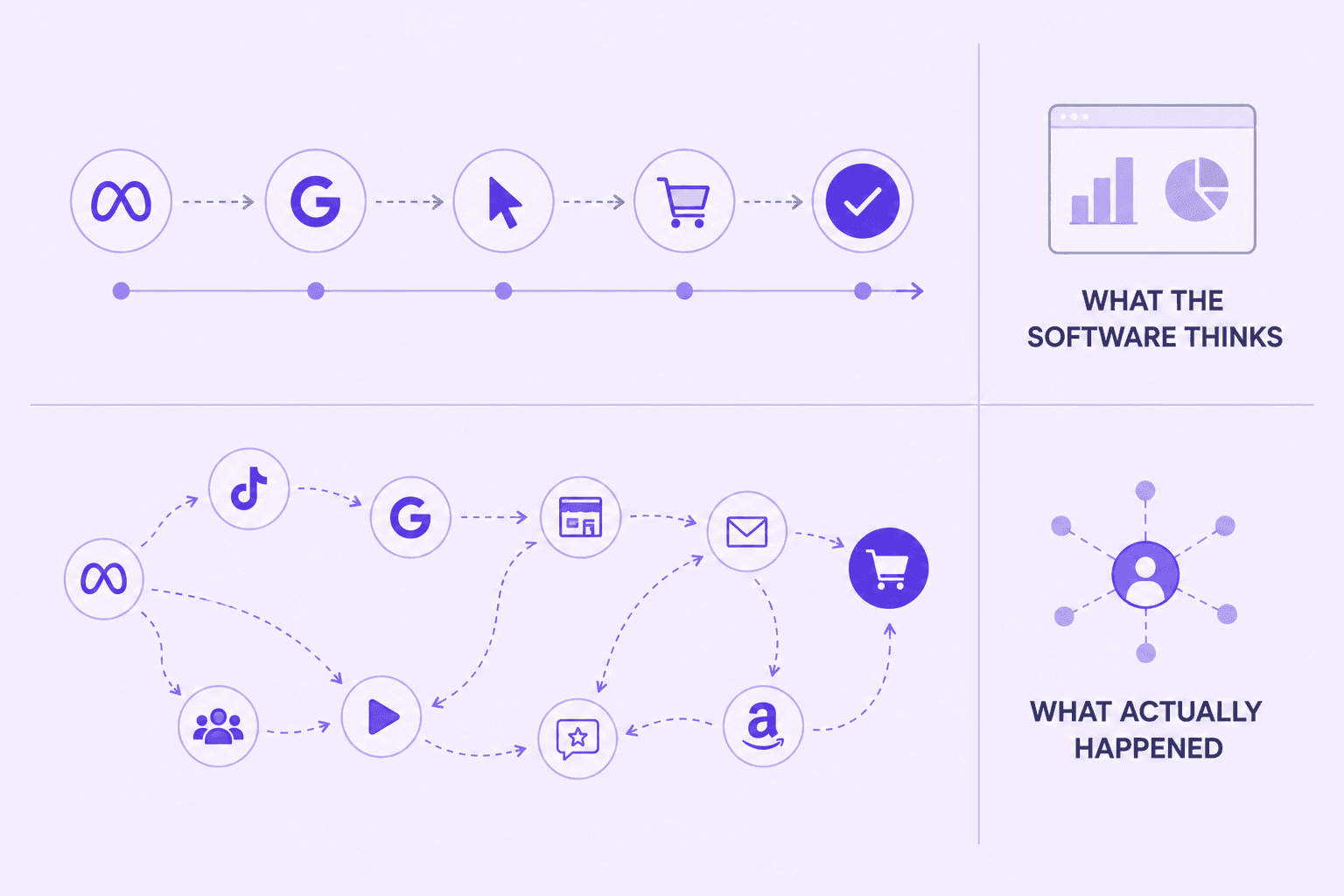
Every DTC brand running ads across Meta, Google, TikTok, and Amazon is using some form of attribution software. Most are paying for more than one tool. And most are making budget decisions based on data those tools, by design, cannot fully provide.
This isn't a knock on the software category. These tools do real, valuable work. The problem is a gap between what attribution platforms measure and what marketers assume they measure. Closing that gap starts with understanding exactly what you're working with.
What marketing attribution software actually does
Attribution platforms collect touchpoint data (ad clicks, page views, email opens, video completions) and assign credit for conversions across those interactions. The output: ROAS and CPA metrics by channel, campaign, and creative.
That is genuinely useful. A good ecommerce attribution platform lets you compare creative performance within a channel, spot underperforming campaigns quickly, and make fast optimization decisions without waiting weeks for results. For in-platform choices like which ad set to scale or which creative to pause, correlation-based signals are often enough.
The important caveat: attribution software measures what it can observe. It records which touchpoints preceded a conversion and distributes credit among them according to a model (last-click, linear, time-decay, data-driven). What it cannot do is establish causality. It reports correlation between ad exposure and purchase, not proof that the ad caused the purchase.
That distinction is consequential. But it doesn't make attribution software useless. It makes understanding its role essential.
What to look for when evaluating attribution tools
Buyers evaluating platforms should ask five questions:
Channel coverage. Does the tool connect to every channel you run: Meta, Google, TikTok, Amazon Seller Central, retail POS? Gaps in connectors mean gaps in the dashboard.
Tracking methodology. Server-side tracking is more durable than pixel-based tracking under iOS privacy changes. Understand how the tool captures data before browser-level signals disappear.
Attribution window flexibility. A 7-day click window and a 28-day click window tell very different stories for a considered-purchase category. You need the ability to adjust windows and compare outcomes.
Reporting speed. For in-flight optimization, same-day or next-day data matters. Tools with multi-day data lags limit your ability to act.
Calibration capability. This is the criterion most buyers skip entirely: can the tool ingest external benchmarks, such as results from holdout-based tests, to weight or adjust its attribution model? Attribution software that can be calibrated against causal ground truth becomes significantly more valuable.
The four things attribution software structurally cannot measure
Understanding the ceiling of any attribution platform means understanding four specific gaps. These are structural constraints, not tool failures.
1. Organic baseline. Would that sale have happened without the ad? A customer who was already planning to repurchase might have converted regardless. Attribution software records the last touchpoint; it has no mechanism for calculating what would have happened in the absence of advertising. That requires a holdout group.
2. Cross-channel halo effects. When a customer sees a TikTok ad and buys on Amazon two days later, the TikTok pixel records nothing. The Amazon purchase is invisible. Nordic Naturals ran a pause-to-measure geo lift test and found that 99.6% of TikTok's incremental impact landed on Amazon, completely invisible to standard attribution. Their attribution tool wasn't broken. It simply could not see outside its own data environment.
3. Revenue on unconnected platforms. Even tools with broad connector libraries rarely reach Amazon, Target, Walmart, or physical retail POS. For omnichannel brands, a significant portion of actual revenue falls outside the attribution platform's scope by default.
4. Counterfactual incrementality. The most important question in budget allocation is: what additional revenue did this spend actually generate? Answering it requires comparing a treated group to a control group. Attribution models cannot construct that comparison. They can only redistribute credit among observed touchpoints.
These gaps are documented in detail in WorkMagic's analysis of marketing attribution challenges and the distinction between attribution signals and causal attribution.
Why these gaps aren't the software's fault
Attribution platforms operate inside the same walled-garden ecosystem as the ad platforms they measure. Meta can report on Meta clicks. Google can report on Google clicks. Neither can see what happens outside their own data infrastructure after an impression is served.
This is a structural constraint of the digital ad ecosystem, not a product failure by any specific vendor. Every attribution tool faces the same ceiling. The brands that get the most from their attribution software understand where that ceiling is and build their measurement stack accordingly.
The measurement stack: where attribution software fits
Think of measurement as two layers working together.
Attribution software is the fast, always-on signal layer. It gives you daily visibility into creative and campaign performance, alerts you to anomalies, and provides the granularity needed for tactical optimization. It runs continuously and generates data at the speed required for in-platform decisions.
Incrementality testing is the causal layer. Geo incrementality testing uses geographic holdout groups to measure the true lift that ad spend generates: capturing halo effects across platforms, accounting for organic baseline, and establishing causality that correlation-based tools cannot.
These layers are complementary. Attribution software answers "what did people click?" Incrementality testing answers "what would have changed if we'd spent differently?" Both questions matter. Only one requires running a controlled experiment to answer reliably.
Incrementality-adjusted attribution brings those two layers together: the always-on signal granularity of an attribution platform, recalibrated against the causal benchmarks that geo lift tests produce.
The third layer is incrementality-calibrated MMM. Once incrementality results calibrate the attribution model, those same results feed into marketing mix modeling, which uses the causal lift data to build channel-level saturation curves, model diminishing returns, and project budget scenarios across the full media mix. Where attribution answers fast questions and incrementality testing establishes causal ground truth, MMM translates both into long-range planning. Together, the three layers form a triangulated measurement approach: attribution signals for daily decisions, incrementality for causal validation, and MMM for strategic allocation.
How incrementality testing changes what you do with attribution data
The before/after here is concrete.
Branch Furniture ran attribution on Meta and Google the way most DTC brands do. Then incrementality-based attribution revealed the true combined impact of both channels. The attribution tools didn't change. What changed was having causal ground truth to interpret them with: budget reallocation based on that data drove 113% revenue growth from Meta ads alone.
A D2C footwear brand ran an incrementality test on Meta, confirmed positive POAS, and built an incrementality-adjusted attribution model from the findings. Budget reallocation to the top-performing campaigns drove 34% revenue growth and a 37% net profit boost.
Neither outcome required replacing the attribution platform. Both required knowing where the platform's picture was incomplete.
Multi-touch attribution and last-click attribution each have specific blind spots that incrementality data can correct. The goal isn't to discard your attribution tools; it's to use them with the full context of what they can and cannot tell you. For channel-specific guidance, the Measuring Meta Performance one-pager and the 2026 Google Ads Report cover how to layer incrementality on top of each platform's native attribution.
Frequently asked questions
What is marketing attribution software?
Marketing attribution software collects data on the touchpoints a customer interacts with before converting (ad clicks, page views, email opens) and assigns credit for the conversion across those interactions. The output is ROAS and CPA metrics by channel, campaign, and creative, used to guide media spend decisions. These tools measure correlation between ad exposure and purchase, not causal proof that the ad drove the sale.
What is an example of attribution in marketing?
A customer clicks a Meta ad, visits the product page, then returns via a Google search two days later and purchases. An attribution tool records both touchpoints and distributes conversion credit between them, weighted by whichever model the platform uses (last-click, linear, data-driven, etc.). The limitation: it cannot tell you whether the customer would have purchased anyway, or whether a TikTok video they watched three days earlier influenced their decision without generating a trackable click.
What are the 4 types of marketing analytics?
The four types are descriptive (what happened), diagnostic (why it happened), predictive (what is likely to happen), and prescriptive (what action to take). Attribution platforms primarily operate in the descriptive layer, reporting on which touchpoints preceded conversions. Incrementality testing adds diagnostic and prescriptive capability by establishing causality and informing how budget should be reallocated.
What is the difference between attribution and incrementality?
Attribution distributes credit for conversions among the touchpoints that preceded them, based on observed correlation. Incrementality measures the causal lift that ad spend generates, using holdout groups to compare what actually happened against what would have happened without the ads. Attribution answers "which channels got the clicks?" Incrementality answers "which channels actually changed behavior?" Both are useful; only incrementality establishes cause and effect.