Attribution Analysis in Marketing: A Framework for DTC Brands

by
Isaac Lee, Content Marketing Lead
Search "attribution analysis" and most of what you find is about investment portfolios: Brinson attribution, fixed income analysis, portfolio performance modeling. If you're here about DTC and marketing measurement, that's a different field entirely. There, saved you a click.
Attribution analysis in marketing is the process of evaluating which channels, campaigns, and touchpoints contributed to conversions, and by how much. For DTC and omnichannel brands, doing it accurately requires understanding not just what the attribution models say, but where those models structurally fall short.
What is attribution analysis in marketing?
Attribution analysis in marketing is the process of measuring and evaluating the contribution of each marketing touchpoint, channel, or campaign to a conversion outcome. It answers the question: which of our marketing activities drove this sale?
The analysis draws on one of several attribution models (last-click, first-click, linear, time-decay, or data-driven) to distribute credit across the touchpoints that appeared before a conversion. The model you choose determines which activities receive credit and in what proportion.
Most marketing platforms run some version of attribution analysis by default. When Meta reports that a campaign drove 400 conversions, it is performing attribution analysis using its own model and attribution window. When Google Analytics shows which channels contributed to revenue, that is attribution analysis using whatever model the account has selected.
The challenge is that attribution analysis is only as accurate as the data it runs on; for omnichannel DTC brands, a significant portion of the relevant data is structurally invisible to platform-based attribution tools.
How attribution analysis works across channels
A complete attribution analysis across channels involves four steps:
Data collection. Gather conversion data from all channels where customers buy, not just the channel where the ad ran. For a DTC brand, this means Shopify, Amazon, TikTok Shop, and any retail point-of-sale systems, not just the ad platforms.
Touchpoint mapping. Identify the ad interactions that preceded each conversion: which platforms, which campaign types, which creatives, and in what sequence. This is where signal loss from iOS ATT and cookie deprecation creates gaps; some touchpoints are invisible before the analysis even begins.
Model selection. Apply an attribution model to distribute credit. Data-driven attribution uses machine learning to weight touchpoints based on observed conversion patterns. Rule-based models (last-click, linear, time-decay) apply fixed logic. Each produces a different credit distribution for the same set of conversions.
Analysis and decision-making. Compare attributed performance across channels, identify over- and under-performing activities, and use those findings to inform budget allocation and campaign optimization.
This process works well within a single platform where all the relevant data is accessible. Across platforms and channels, it runs into a set of structural problems that attribution analysis alone cannot solve.
What attribution analysis can and cannot tell you
For a broader look at attribution's structural limits, see our article on the challenges of marketing attribution and attribution signals.
Attribution analysis tells you which touchpoints were present before a conversion occurred. It does not tell you which touchpoints caused the conversion.
This distinction is the core limitation of every attribution model, however sophisticated. A customer who was already planning to repurchase, happened to click a retargeting ad two hours before completing their order, shows up as an attributed conversion. The attribution analysis records the touchpoint accurately. It cannot filter out the baseline demand that was going to convert regardless.
Incrementality testing addresses this by establishing what would have happened without the ad. Attribution analysis cannot.
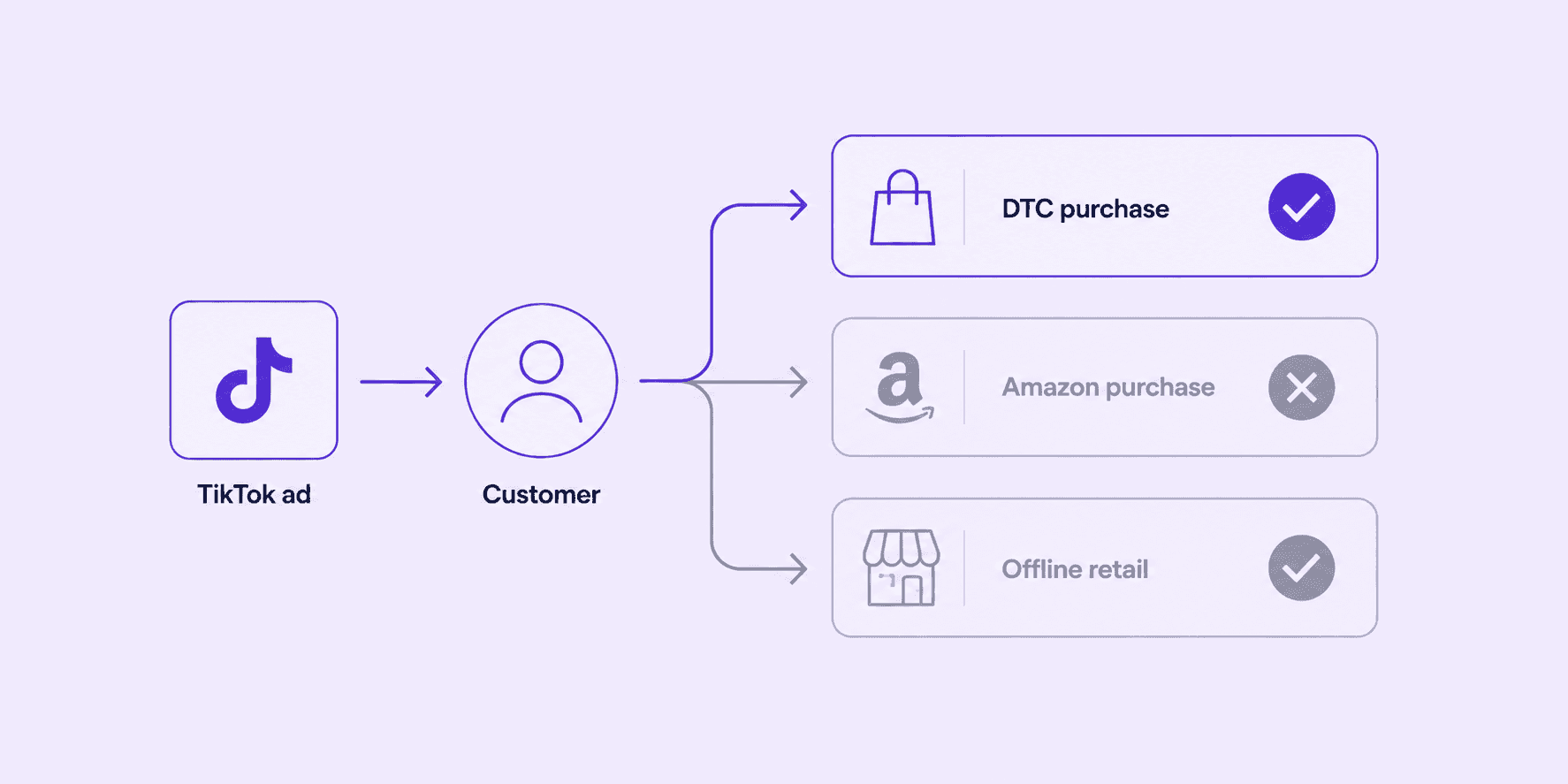
The second limitation is scope. Attribution analysis can only include touchpoints that the tracking infrastructure can observe. When a customer sees a Meta ad and purchases on Amazon, that conversion does not appear in Meta's attribution analysis. It has no pixel to fire, no click ID to record. The causal relationship between the ad and the purchase is real. The attribution analysis misses it entirely.
For DTC brands selling exclusively through their own site, this has limited impact. For omnichannel brands, it is the defining gap in their measurement data.
The DTC omnichannel challenge in attribution analysis
The customer journey for an omnichannel DTC brand does not stay within a single platform. A TikTok ad drives a customer to search the brand on Amazon. A YouTube campaign lifts branded search on Google. A Meta prospecting campaign drives sell-through at Target. Each causal link is real. None of them appears in the originating platform's attribution analysis.
Nordic Naturals ran a geo lift test on TikTok and found that 99.6% of TikTok's incremental impact landed on Amazon. Their standard attribution analysis showed almost nothing, because almost nothing was happening on the DTC site the campaign was pointing at. The attribution data looked like a failing campaign. The causal data showed a highly effective one.
An entertainment brand showed the same pattern at scale: a pause-to-measure test found 62.5% of TikTok's incremental impact on Amazon and retail, channels entirely outside TikTok's attribution view. Following the test, the brand's iROAS rose 166% and a TikTok spend increase drove 64% higher sales.
These aren't outliers. They reflect a predictable gap that arises whenever customers can choose where to complete a purchase that advertising influenced.
How to do attribution analysis that reflects causal impact
A marketing attribution analysis built for omnichannel accuracy combines two layers:
Geo incrementality testing as the causal baseline. Geo incrementality testing compares total revenue between matched geographies, one exposed to ads and one held out, across all channels simultaneously. It captures conversions on Amazon, retail, and TikTok Shop alongside DTC. The result is a causal measurement of each channel's total impact, not just the portion attribution can see.
Incrementality-adjusted attribution for daily reporting. Once geo lift results are established, they calibrate attribution so that day-to-day reporting reflects causal contribution rather than raw platform-reported credit. The organic baseline is accounted for. The cross-channel halo is factored in. Attribution analysis becomes a reliable operational tool rather than a source of systematic overcounting.
This combination is what separates a performance attribution analysis that drives accurate decisions from one that looks rigorous but leads to budget misallocation: under-investing in channels with large halo effects and over-investing in retargeting that captures demand already created. The Triangulated Measurement playbook details how to connect these layers into a single, self-calibrating measurement program.
Frequently asked questions
What is attribution analysis in marketing?
Attribution analysis in marketing is the process of evaluating which channels, campaigns, and touchpoints contributed to conversions and by how much. It uses attribution models (last-click, data-driven, linear, time-decay) to distribute credit across the ad interactions that preceded a sale. Attribution analysis tells you which touchpoints were present before a conversion, but it cannot determine whether those touchpoints caused the conversion or whether the sale would have happened without them. For a complete picture, attribution analysis needs to be calibrated with incrementality testing results.
What is performance attribution analysis in marketing?
Performance attribution analysis in marketing is the evaluation of how marketing spend across channels contributed to business outcomes such as revenue, new customers, or conversions. It typically involves selecting an attribution model, collecting conversion data across all relevant channels, and analyzing which campaigns and touchpoints drove performance relative to spend. For DTC brands selling across multiple channels, a complete performance attribution analysis must account for cross-channel halo effects: incremental impact that lands on Amazon or retail rather than the channel the ad was pointing at.
How do you do attribution analysis in marketing?
Attribution analysis in marketing involves four steps: collecting conversion data from all channels where customers buy, mapping the touchpoints that preceded each conversion, applying an attribution model to distribute credit across those touchpoints, and analyzing the results to guide budget and campaign decisions. For the most accurate results, the attribution model should be calibrated with incrementality test data so that organic baseline demand is separated from ad-driven conversions, and so that cross-channel halo effects are captured rather than classified as organic.
What is data-driven attribution?
Data-driven attribution is an attribution model that uses machine learning to distribute credit across touchpoints based on observed conversion patterns, rather than applying a fixed rule like last-click or linear. It analyzes which combinations of touchpoints most frequently precede conversions and weights credit accordingly. Data-driven attribution is more accurate than rule-based models for in-platform optimization, but it shares the same structural limitation: it can only distribute credit among touchpoints the platform can observe. Conversions that happen on Amazon or retail after a Meta or TikTok ad are not included in the analysis.