How to measure marketing effectiveness

by
Faizi Zahari, Growth Marketing & Product Lead
You're pouring money into ads and your attribution dashboard is lighting up green. What you don't know is whether those sales came from the ads or would have landed anyway. That gap, between what the numbers say and what's true, separates a business that's compounding from one quietly bleeding cash into channels that don't work.
What does it mean to measure marketing effectiveness?
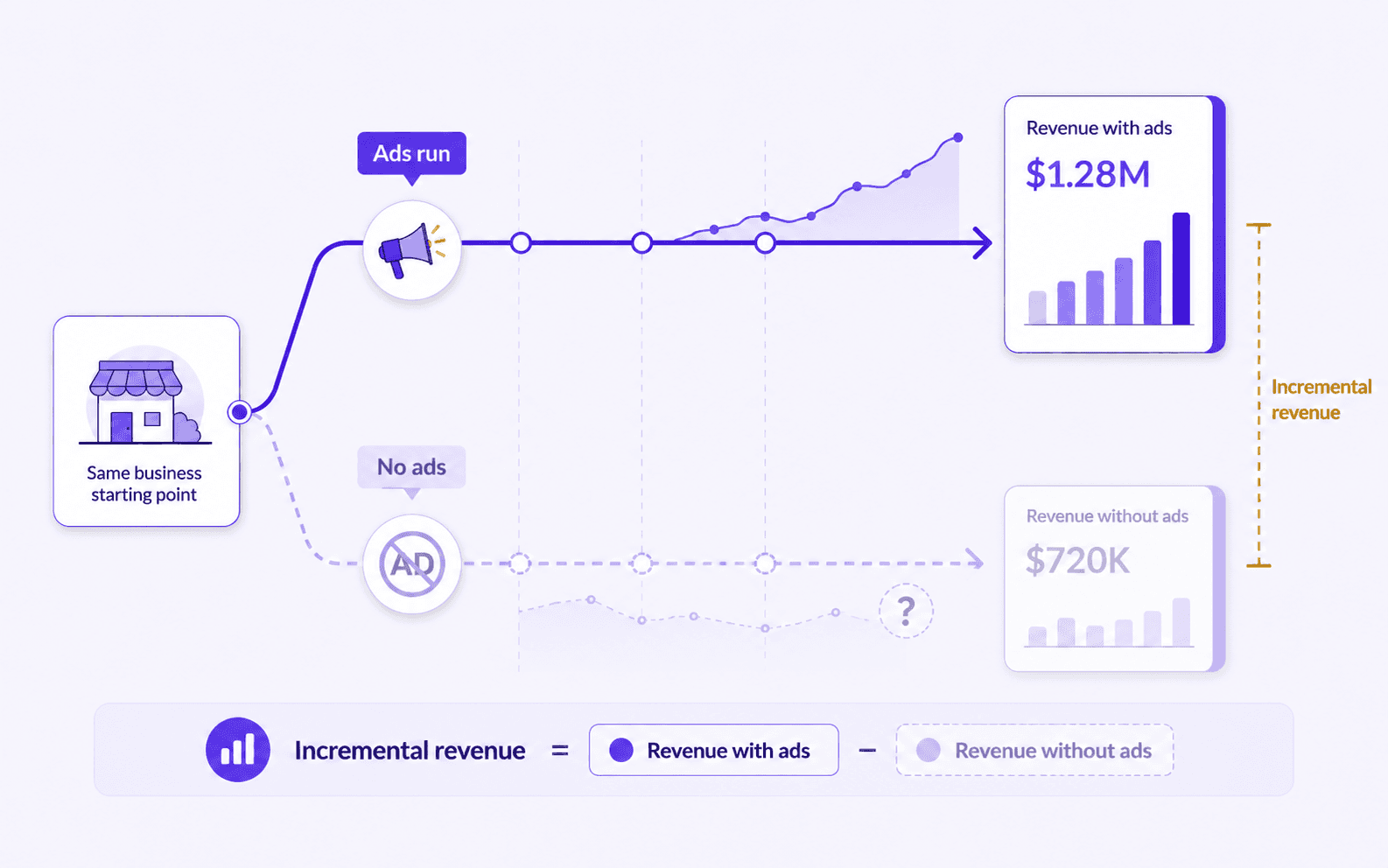
Marketing effectiveness has nothing to do with clicks or impressions. It's a measure of the revenue your marketing caused, stripped of the revenue you'd have earned regardless.
The core formula is simple: Incremental Revenue = (Sales with ads) − (Sales without ads). The second term is the problem. You can't run your business with the ads off and on at the same time.
That's the gap geo incrementality testing fills. It builds the counterfactual by comparing markets where ads run against matched control markets where they don't, which is as close to a real control group as marketing gets. It also belongs inside a broader marketing measurement strategy rather than standing on its own.
Why your attribution numbers are probably wrong
Your analytics platform breaks revenue down by channel. Last-click says TikTok drove 40%. Multi-touch nudges it to 45%. Layer on a probabilistic model and suddenly it's 60%.
None of those numbers tell you what happens if you turn TikTok off. They describe what happened while it was on.
David Protein's case study found they'd been overstating Meta attribution by 36%, which made every dollar look 36% more profitable than it was. Switching to incrementality-adjusted attribution and rebalancing spend toward what was genuinely working produced 34% revenue growth and a 37% profit lift.
Attribution answers which channel got credit. Effectiveness measurement answers which channel produced new sales. Only the second question has money attached to it.
How incrementality testing works
An incrementality test holds out a control group, usually a geographic market but sometimes a customer cohort or segment, and measures the sales difference between exposed and control while a campaign runs.
You need three things: the ability to measure sales by geography or cohort, a control group whose baseline characteristics genuinely match, and a window long enough to cover your full sales cycle.
The method doesn't care what the channel is. TikTok, Meta, CTV, podcasting, and out-of-home all work. If you can geotarget it, you can measure its lift. Results feed straight into marketing ROI analysis and optimization.
Incrementality vs. attribution vs. MMM: which one do you need?
Incrementality Testing | Attribution | MMM | |
|---|---|---|---|
Measures | Causal impact of a specific tactic | Channel credit across customer journey | Total marketing contribution |
Answers | Did this campaign drive new sales? | Which touchpoints influenced purchase? | How much revenue came from marketing? |
Best for | Launch validation, channel testing | Customer path understanding | Budget forecasting, strategy |
Timeline | Weeks | Ongoing | Weeks to months |
To improve marketing ROI, run all three: incrementality to validate where spend goes, attribution to read customer paths, and marketing mix modeling to forecast total impact.
Building a measurement framework that scales
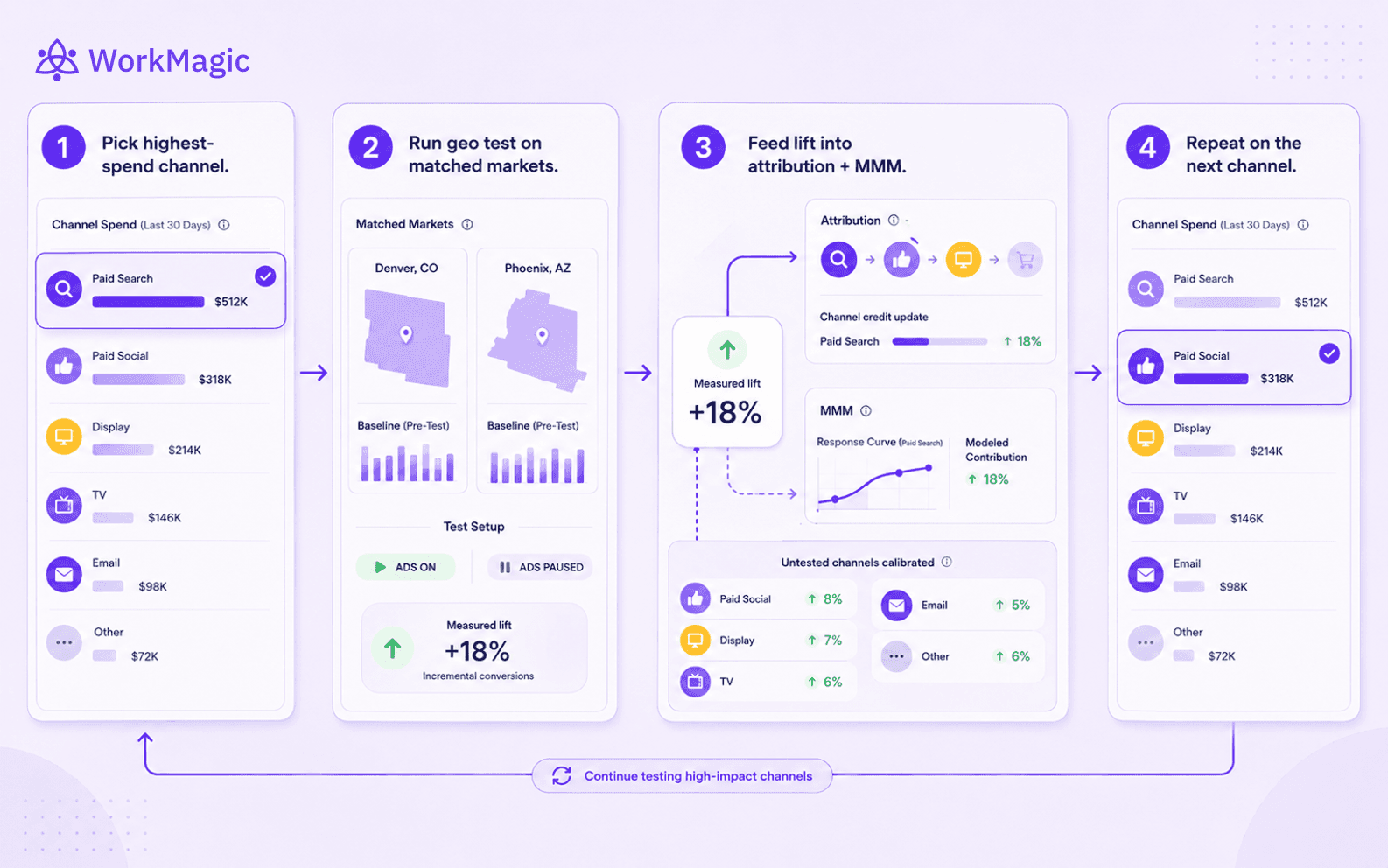
Start where the money is. For most DTC brands that means Meta or TikTok.
Run a geo incrementality test on one channel. Choose matched markets, two regions with comparable customer density and baseline sales. Ads run in the test market, the control market stays flat, and you read the difference after 2–4 weeks.
With one channel measured, use the result to calibrate your attribution and MMM systems. Both get meaningfully more accurate, including on channels you haven't tested, because they now have a reference point for what real lift looks like.
Work through your other major channels one at a time. Testing everything isn't necessary. Three or four validated channels give you enough grounding to optimize the rest.
Common mistakes when measuring effectiveness
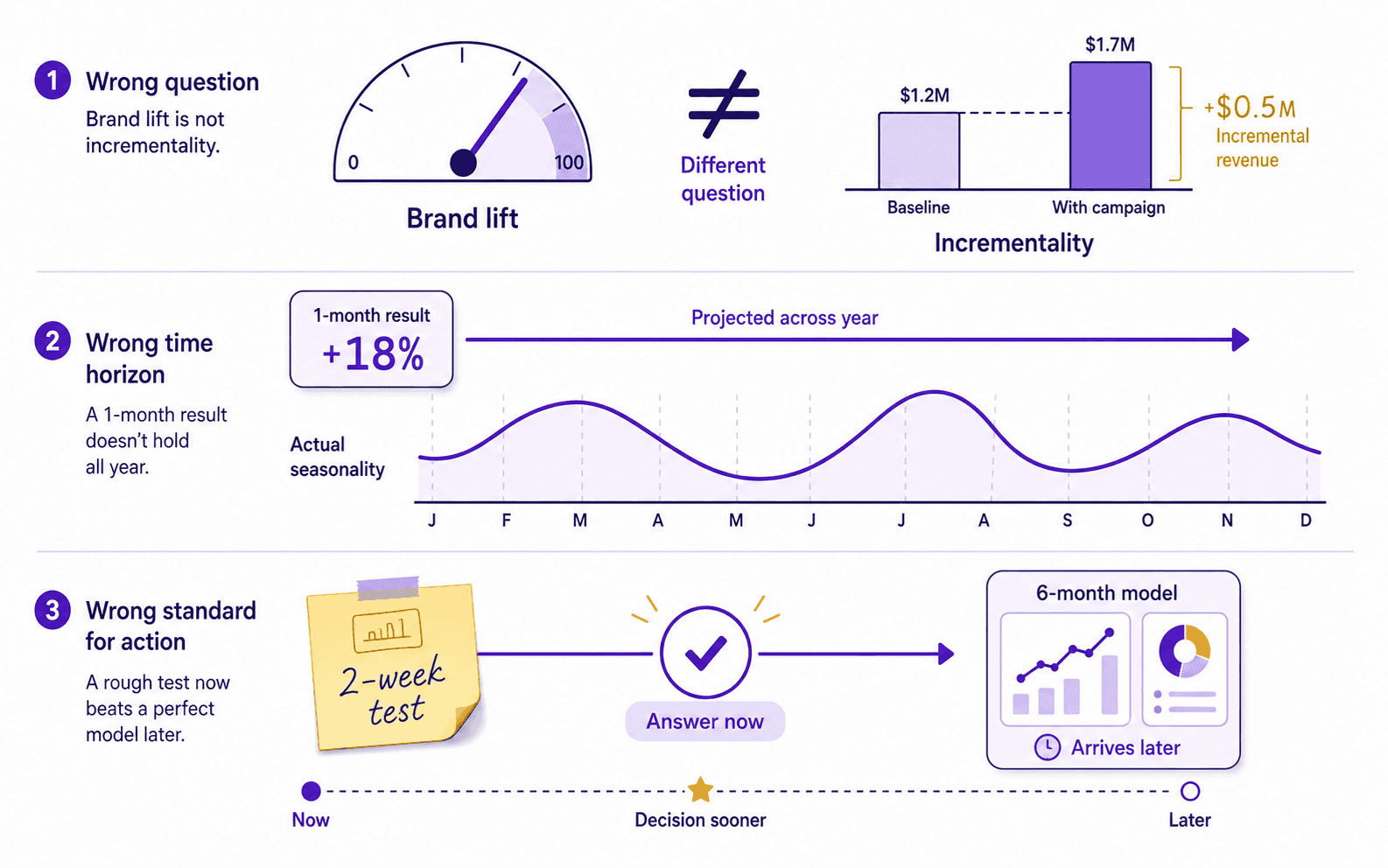
Don't confuse brand lift studies with incrementality. Brand lift measures awareness. Incrementality measures revenue. Both are worth running, and they answer different questions.
Don't assume a result from one month generalizes to the rest. Seasonality, competitive pressure, and saturation all change how incremental a channel really is.
Don't wait for perfect data. A rough test you run this week beats an immaculate model six months out. Every one of the types of marketing measurement involves trade-offs. Pick the one you can act on now.
Frequently asked questions
How long does an incrementality test take?
Most run 3–4 weeks, enough to capture a full purchase cycle. DTC brands selling lower-ticket items often have a readable result in 2 weeks. Subscription or higher-ticket businesses usually need 6–8.
Can I test channels without pixel data?
Yes. CTV, podcasting, out-of-home, and direct mail are all testable. If you can geotarget the media and track sales by geography, you can measure incrementality without a single click or view.
What budget do I need to run an incrementality test?
Enough to move the needle in your test market over the test window. For most DTC brands that lands somewhere between $10k and $50k in test spend. Smaller budgets can still work, but they need longer windows.
How do incrementality tests fit into my existing marketing stack?
They validate your highest-stakes spend decisions. The results calibrate attribution and MMM, which makes the rest of your analytics more accurate and more actionable. Run tests around major launches and channel transitions, then use the calibrated models for ongoing optimization.
Ready to measure what actually works? Book a demo