How to Improve Marketing ROI: The Incrementality-First Approach

by
Lauren Lauth, VP of Measurement
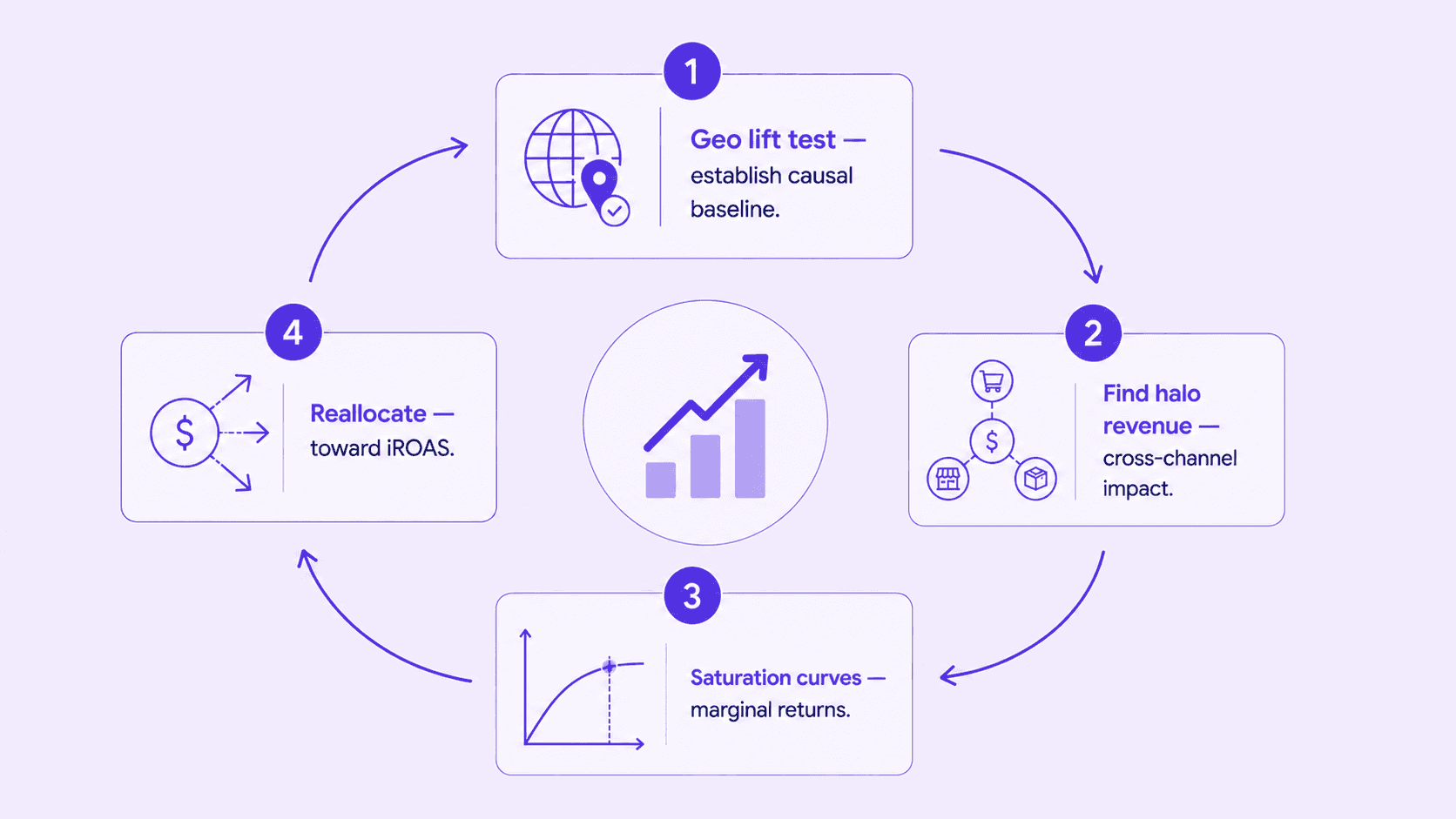
Most advice on improving marketing ROI focuses on tactics: sharper audience targeting, better creatives, A/B testing, first-party data strategies, conversion rate optimization. These things matter. But they all optimize toward a number, and if that number is wrong, optimizing toward it compounds the misallocation rather than fixing it.
The incrementality-first approach starts somewhere else: before optimizing campaigns, establish whether you're measuring the right thing. If your ROI figures are built on attributed metrics that include organic baseline demand and miss cross-channel halo effects, then improving those figures means getting better at capturing credit, not getting better at driving revenue.
What improving marketing ROI actually requires
Marketing ROI is typically measured as revenue attributed to marketing divided by the cost of that marketing. The problem is the numerator.
Attributed revenue includes organic baseline sales: purchases that would have arrived regardless of advertising. It credits the last-touch channel for conversions that upper-funnel campaigns influenced. It misses revenue that landed on Amazon or retail after a DTC ad. The result is a ROI figure that overstates the contribution of bottom-funnel channels, understates the contribution of channels with large halo effects, and includes demand the brand already had.
David Protein found that traditional attribution was overstating DTC orders by 36%. Their marketing ROI figures were built on a number that included a third of purchases that would have happened without the ads. Finance and marketing were optimizing against a number that didn't reflect causal reality. For a framework on how to align both teams around causal measurement, see the Aligning Marketing and Finance Performance one-pager.
Improving marketing ROI in a way that actually moves the business requires replacing attributed metrics with causal ones. That starts with incrementality testing. The Incrementality 101 playbook is a useful starting point for understanding the methodology.
Step 1: Measure what your marketing actually causes
For a precise definition of the metrics that matter (iROAS, incremental revenue, incremental sales), see our articles on incremental revenue and incremental sales
Geo incrementality testing compares total revenue between matched geographies, one exposed to ads and one held out, across all channels simultaneously. The difference is causal revenue: what the marketing actually drove, above what would have happened organically.
The output replaces attributed ROAS with iROAS (incremental ROAS). Where platform ROAS counts every conversion that followed an ad interaction, iROAS counts only the conversions the ad caused. The gap between the two is the organic baseline that was being credited to ad spend.
This single step often reframes the ROI picture significantly. Channels that looked highly profitable in attribution may show more modest iROAS. Channels that looked unremarkable, because their conversions were landing on Amazon rather than on Shopify, may show strong causal impact that attribution missed entirely.
Step 2: Find the revenue you didn't know you were driving
For omnichannel DTC brands, one of the most reliable ways to improve marketing ROI isn't to change what you're doing; it's to measure all of what your marketing is already driving.
Liquid IV ran a 3-cell geo lift test on TikTok and found that 62% of TikTok's incremental impact landed on Amazon. Their attribution analysis reflected almost none of it. The test changed the business case for TikTok entirely: TikTok Shop combined with Web Ads drove 3.53x better results than Web Ads alone, with a 71% higher iROAS and 49% lower iCPA — impact that had been invisible to the tools being used to make budget decisions.
True Classic found TikTok's real impact was 74% higher than any-click attribution had measured, with a 12% halo on Amazon and a 19% lift in Google organic search. The attributed picture suggested a moderately performing channel. The causal picture showed the brand's strongest driver of new demand.
Before changing campaigns, creative, or targeting, measure where your returns are actually landing. The fastest path to a higher marketing ROI number is often simply observing the revenue that current measurement frameworks are classifying as organic. WorkMagic's TikTok Incrementality Report documents what 100+ incrementality tests reveal about TikTok's true halo impact across channels.
Step 3: Redirect spend toward actual marginal returns
Once incrementality baselines are established, saturation curves show how each channel's causal returns change as spend scales. These curves reveal where channels still have room to generate incremental revenue and where they've passed the point of peak efficiency.
The allocation signal this produces is marginal ROAS: the return the next dollar will generate at the current spend level. Channels that look strong in attribution can have low marginal returns if they're approaching saturation. Channels that attribution undercounts (because of halo effects) can have strong marginal returns that aren't visible until geo lift data is in the picture.
Incrementality-calibrated MMM builds these curves across the full media mix, grounded in geo lift results rather than attributed data. The result is a budget allocation model that directs spend toward where incremental returns are highest, not where platform dashboards look best.
Branch Furniture used this approach: incrementality-based attribution revealed the true combined impact of Meta and Google, enabling precise budget reallocation that drove 113% revenue growth from Meta ads. The ROI didn't improve because the campaigns changed. It improved because the measurement and allocation changed.
One DTC footwear brand saw the same dynamic: incrementality-adjusted attribution changed which campaigns received budget. The reallocation drove 34% revenue growth and a 37% net profit boost. For a deeper walkthrough of this process, see our article on how to optimize marketing spend.
Step 4: Optimize campaigns toward incremental outcomes
Once causal measurement is in place, campaign-level optimization improves in kind. Rather than optimizing toward attributed conversions (which include organic baseline), campaigns can be optimized toward incremental conversions.
WorkMagic's Triangulated Measurement playbook explains how MTA, incrementality testing, and MMM work together as a self-correcting system — each method calibrating the others. In practice, that means attribution feeds day-to-day decisions, geo lift tests establish causal ground truth, and MMM incorporates those results for strategic planning.
Meta's Incremental Attribution optimization mode delivers to users where incremental impact is most likely, reducing spend on audiences who would have converted anyway. The measurement column in Ads Manager surfaces incremental conversions alongside standard attribution so the two can be compared directly.
Day-to-day reporting calibrated by geo lift results, via incrementality-adjusted attribution, ensures that ongoing budget decisions reflect the causal contribution of each channel rather than platform-reported credit. The feedback loop between causal measurement and campaign optimization tightens continuously.
The compounding benefit of incrementality-first optimization
Tactical improvements to targeting, creative, and conversion rate are more valuable when the measurement foundation is causal. A better-performing creative generates more incremental revenue, and now you can measure how much. A budget shift toward a higher-performing channel moves marginal returns in the right direction, and now you can see it.
The incrementality-first approach doesn't replace tactical optimization. It makes tactical optimization compound toward actual outcomes rather than toward better-looking dashboard numbers.
Frequently asked questions
How to increase marketing ROI?
Increasing marketing ROI requires two things done in sequence: measuring it accurately, then optimizing toward the accurate number. Most marketing ROI figures are built on attributed metrics that include organic baseline demand and miss cross-channel halo effects, which means optimizing toward them improves the appearance of performance without necessarily improving the underlying causal impact. The incrementality-first approach establishes causal baselines through geo lift testing, identifies revenue being generated on channels attribution misses, and redirects spend based on marginal returns from saturation curves. Those steps produce genuine improvements in incremental ROI, not just attributed ROI.
What does improve marketing ROI mean?
Improving marketing ROI means generating more incremental revenue per dollar of marketing spend, where incremental is defined as revenue that would not have occurred without the advertising. This is distinct from improving attributed ROI, which can be achieved by capturing more credit for organic demand or by concentrating spend in channels with favorable attribution windows. True marketing ROI improvement requires a causal measurement baseline: understanding what each channel actually drives, above what the business would generate without it, so that budget allocation reflects real returns.
What is the 70/20/10 rule in marketing?
The 70:20:10 rule allocates 70% of marketing budget to proven channels, 20% to emerging channels, and 10% to experimental investments. It is a risk management heuristic, not an optimization framework. It doesn't account for where each channel sits on its saturation curve, what its marginal return is at the current spend level, or whether its attributed performance reflects causal impact. A brand using the 70:20:10 rule to allocate a budget built on attributed metrics will consistently over-invest in bottom-funnel retargeting and under-invest in channels with large cross-channel halo effects.