What Is Marketing ROI? A Brief Guide for DTC Brands

by
Isaac Lee, Content Marketing Lead
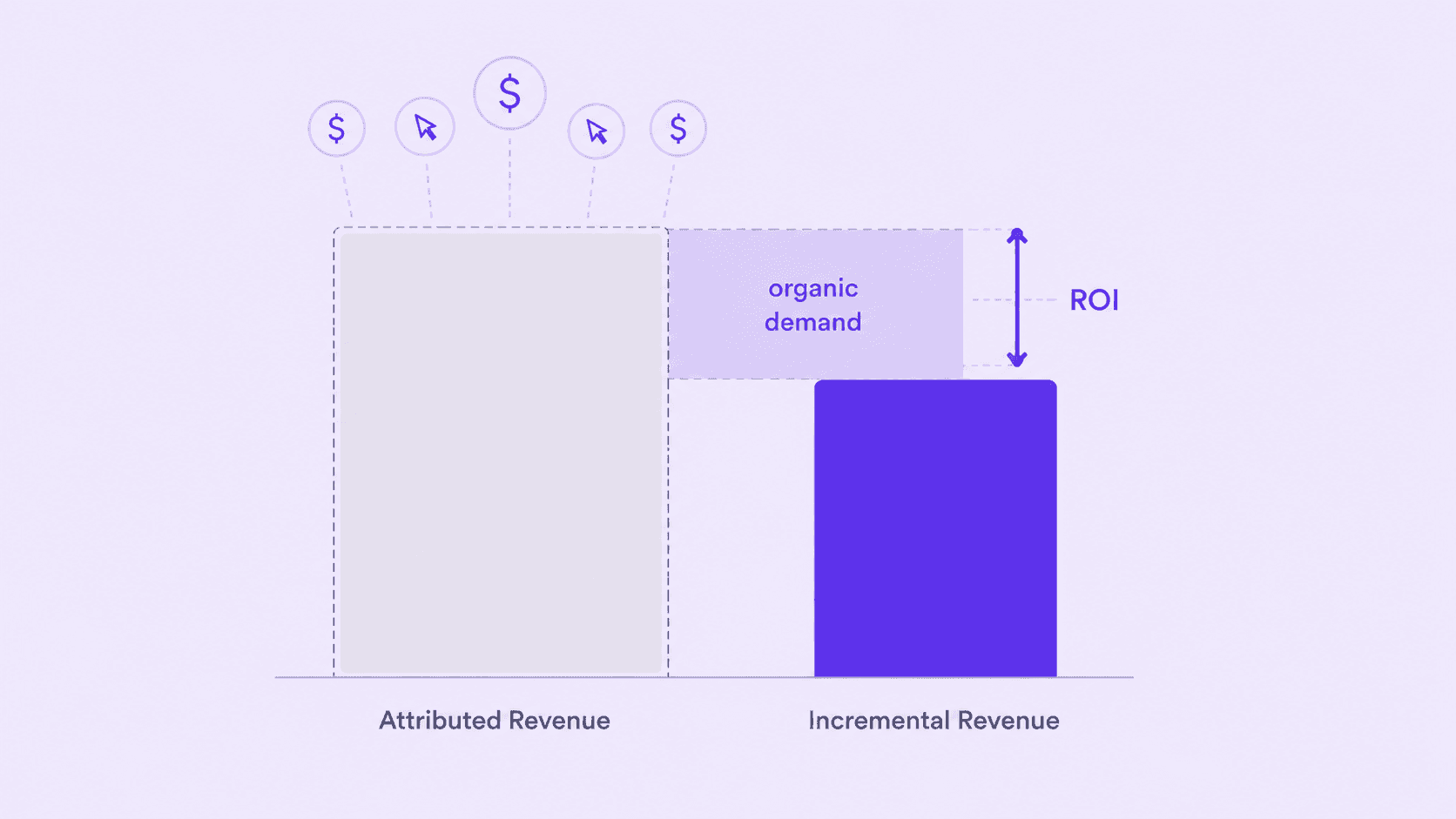
Marketing return on investment is the ratio of revenue your marketing generates to what that marketing costs. The concept is simple. The execution is where almost every brand goes wrong — not because they use the wrong formula, but because they plug the wrong revenue figure into it.
Most teams measure marketing ROI using attributed revenue: what their ad platforms and attribution tools report as conversions. That number includes purchases that were going to happen regardless of the ad, misses sales that landed on Amazon or retail after a DTC campaign, and can't separate demand the brand created from demand it captured. The result is an ROI figure that looks precise but doesn't reflect what marketing actually caused.
Accurate marketing ROI requires incremental revenue: what marketing caused, above what would have happened without it. Everything else in this article follows from that distinction.
What is marketing ROI?
Marketing ROI — or return on marketing investment — measures the revenue a marketing program generates relative to its cost. A positive ROI means marketing produced more value than it consumed. A negative one means spend exceeded causal return.
The formula:
Marketing ROI = (Revenue Generated by Marketing − Marketing Cost) / Marketing Cost × 100
At 200% ROI, every dollar spent returns two dollars beyond what it cost. At 0%, it breaks even. The ratio tells you whether the investment is worth making and, when compared across channels, where each dollar performs best.
The practical challenge is in "revenue generated by marketing." An ad platform gives one number. A geo lift test gives a different one. The platform number reflects which conversions occurred near the ad. The geo lift number reflects which conversions the ad caused. These are not the same, and the gap between them is real money being either over- or under-invested based on a mismeasured signal.
The incrementality-adjusted version of the formula makes this explicit:
Marketing iROI = (Incremental Revenue − Marketing Cost) / Marketing Cost × 100
Incremental revenue is measured through controlled experiments: a test group exposed to ads versus a holdout group that isn't, with the revenue difference between them captured across every channel where customers buy — not just the one the ad pointed at.
ROAS and iROAS: the DTC version of ROI
Most DTC brands don't track marketing ROI at the campaign level. They track ROAS — and for good reason. ROAS is the channel-level efficiency metric every platform reports, every media buyer optimizes against, and every weekly performance review opens with.
ROAS (Return on Ad Spend) = Revenue Attributed to Ads ÷ Ad Spend
ROAS is, functionally, the DTC proxy for marketing ROI at the channel level. Where ROI asks "did this investment generate profit," ROAS asks "did this spend generate revenue." Both are useful. Both are only as good as the revenue figure going into the numerator.
Platform-reported ROAS uses attributed revenue — conversions the platform's model assigned to the campaign. It systematically overstates returns for retargeting and branded search (high attribution affinity, lower actual incrementality) and understates returns for awareness channels whose conversions land elsewhere.
iROAS (Incremental ROAS) = Incremental Revenue ÷ Ad Spend
iROAS replaces attributed revenue with the revenue a channel actually caused, measured through a geo lift test across all channels where customers buy. When Comfrt ran an incrementality test on Snapchat, the result wasn't just a verified ROAS figure — it revealed a halo effect on TikTok Shop that last-click measurement had never recorded. At doubled spend, the channel generated over $2M in incremental revenue across surfaces attribution couldn't see. The platform ROAS and the iROAS told two different stories about the same campaign.
At the portfolio level, the equivalent metric is MER (Marketing Efficiency Ratio): total revenue divided by total marketing spend. MER avoids channel-level attribution disputes by measuring the whole business at once — all spend, all revenue. It's the most attribution-resistant metric available, and the one most finance teams now use as the headline number in performance reviews.
For a full breakdown of how ROAS, MER, iROAS, CAC, and contribution margin per marketing dollar work together and where each one falls short, see measure marketing efficiency.
How to measure marketing ROI
Measurement method determines the ROI figure you get. The same campaign, measured three different ways, produces three different numbers.
Attribution tools assign revenue to touchpoints based on observed click and view data. They produce a fast, granular, channel-level ROI signal useful for day-to-day optimization. What they cannot do is establish causation: they record which ads were nearby when conversions happened, not whether those ads caused them. For omnichannel brands, they also miss every conversion that occurs outside their tracking ecosystem — a TikTok ad that drives a purchase on Amazon, a Meta ad that lifts retail sales.
MER sidesteps the attribution problem entirely by using total business revenue as the numerator. It doesn't tell you which channel produced what — but it tells you whether the business as a whole is growing efficiently relative to total spend, without any platform claiming double-credit for the same sale.
Incrementality testing is the only method that establishes causation. Geo incrementality testing runs a controlled experiment across matched geographic markets: one group sees ads, one doesn't, and the revenue difference is measured across all sales channels simultaneously. The output is causal revenue — what the campaign actually drove — including halo effects on Amazon, retail, and any other surface the customer transacted on.
Branch's geo lift test on its San Francisco store used the same method: 63% of the store's incremental impact occurred outside in-store POS, as an offline-to-online halo lifting ecommerce orders in surrounding markets. Neither attribution nor platform ROAS had any way to see it. The geo test measured it directly.
For a practical walkthrough of all three measurement methods and how they interact, see the guide on incrementality testing.
How to improve marketing ROI
Improving marketing ROI starts with measuring it correctly. Budget decisions made against inflated attribution figures optimize the appearance of performance, not the underlying causal contribution.
Once causal baselines exist, three levers move the number in the right direction.
Find the revenue you didn't know you were driving. For omnichannel brands, halo effects — the revenue a campaign generates on channels it was never pointed at — are often the largest source of unmeasured return. Discovering this doesn't require changing campaigns; it requires measuring where customers actually transact after exposure, not just where the platform pixel can see. This reframes underperforming channels and changes where spend should scale.
Reallocate toward marginal returns. Attributed ROAS rankings don't reflect where the next dollar generates the most incremental revenue. Geo lift data, incorporated into saturation curves, shows where each channel has room to grow and where it's approaching efficiency ceilings. The allocation signal that results is marginal iROAS, not average platform ROAS.
Calibrate daily reporting with causal data. Once geo lift tests establish the true incrementality factor per channel, incrementality-adjusted attribution feeds those numbers back into day-to-day reporting. The dashboard doesn't change; the revenue figures driving it do. Every budget decision made after calibration is grounded in what channels actually cause, not what platforms claim.
For the full step-by-step framework — including how to identify halo revenue, build saturation curves, and optimize campaigns toward incremental outcomes — see how to improve marketing ROI.
Marketing efficiency
Marketing efficiency is a specific dimension of marketing ROI: how much output (revenue, customers, contribution margin) does marketing produce per unit of input (spend, headcount, creative)? It's a ratio, and it's what most CFOs are asking when they ask about ROI.
The core efficiency metrics are ROAS at the channel level, MER at the portfolio level, and CAC at the acquisition level. Each one captures something different. A channel can post a high ROAS while degrading blended MER. A campaign can hit CAC targets while compressing gross margin. No single metric tells the full story.
The structural problem with all standard efficiency metrics is that they measure correlated efficiency, not causal efficiency. A last-click ROAS of 4× tells you that for every dollar spent, $4 of attributed revenue followed. It doesn't tell you whether that revenue would have occurred without the ad. Incrementality testing is what converts efficiency from a reporting metric into a causal one — producing iROAS, incrementality-adjusted MER, and incremental new customer CAC, each of which reflects what marketing actually drove.
For the full treatment of efficiency metrics, how to measure them accurately, and how to set the right benchmarks for your margin profile, see measure marketing efficiency.
Marketing effectiveness
Marketing effectiveness is a different question from efficiency. Efficiency asks: how much output per dollar? Effectiveness asks: did marketing cause the right business outcomes?
A campaign can be efficient — high reported ROAS — and ineffective, if most of those conversions would have happened anyway. It can appear inefficient by attribution — low immediate ROAS — and be highly effective, if it built brand, drove halo effects across retail and Amazon, and brought in new customers attribution missed.
The distinction matters because optimizing efficiency without measuring effectiveness reliably misallocates spend. Branded search and retargeting consistently look efficient by attribution: they're positioned at the bottom of the funnel, adjacent to conversions already in motion. They frequently have lower incremental contribution than their ROAS implies. Awareness and discovery channels look less efficient; they frequently have higher causal impact that attribution doesn't capture.
Causal measurement is what makes effectiveness measurable. Without it, "marketing is working" and "marketing is getting credit for work that would have happened anyway" are indistinguishable in the dashboard.
(A few) frequently asked questions
What is marketing ROI?
Marketing ROI (return on marketing investment) measures the revenue a marketing program generates relative to its cost. The formula: (Revenue Generated − Marketing Cost) / Marketing Cost × 100. The critical variable is how "revenue generated" is defined. Attributed revenue from platform dashboards includes organic demand and misses halo effects. Incremental revenue, measured through geo lift tests, reflects only what marketing actually caused — and is the only version that accurately supports budget decisions.
What is the difference between marketing ROI and ROAS?
ROAS (return on ad spend) measures revenue per dollar spent on ads at the channel level. Marketing ROI measures profit relative to total marketing investment, including non-media costs. ROAS is used for campaign and channel optimization; ROI is used for portfolio-level performance assessment. Both are distorted when the revenue figures driving them come from attribution rather than incrementality testing. The causal versions are iROAS (incremental revenue per ad dollar) and incremental ROI, both derived from geo lift tests.
What is iROAS?
iROAS (incremental ROAS) is the causal version of ROAS. Where platform ROAS counts every conversion that followed an ad interaction, iROAS counts only the conversions the ad caused — measured by comparing revenue in a test group exposed to ads against a matched holdout group that was not. iROAS also captures cross-channel halo effects that platform ROAS misses entirely, because it measures total revenue across all channels simultaneously, not just the conversions the platform's pixel observed.
What is a good marketing ROI for DTC brands?
There is no universal benchmark. Marketing ROI depends on gross margin, repeat purchase rate, average order value, customer acquisition economics, and retail mix. A high-margin, high-LTV brand can sustain a lower short-term ROI than a low-margin, low-repeat business. The more useful internal benchmark is the minimum incremental contribution required to acquire or retain customers profitably at the brand's current margin profile. MER — total revenue divided by total marketing spend — is the most reliable top-line efficiency signal for tracking ROI trends over time without attribution noise.