How to Measure Marketing Efficiency: ROAS, MER, and Beyond

by
Isaac Lee, Content Marketing Lead
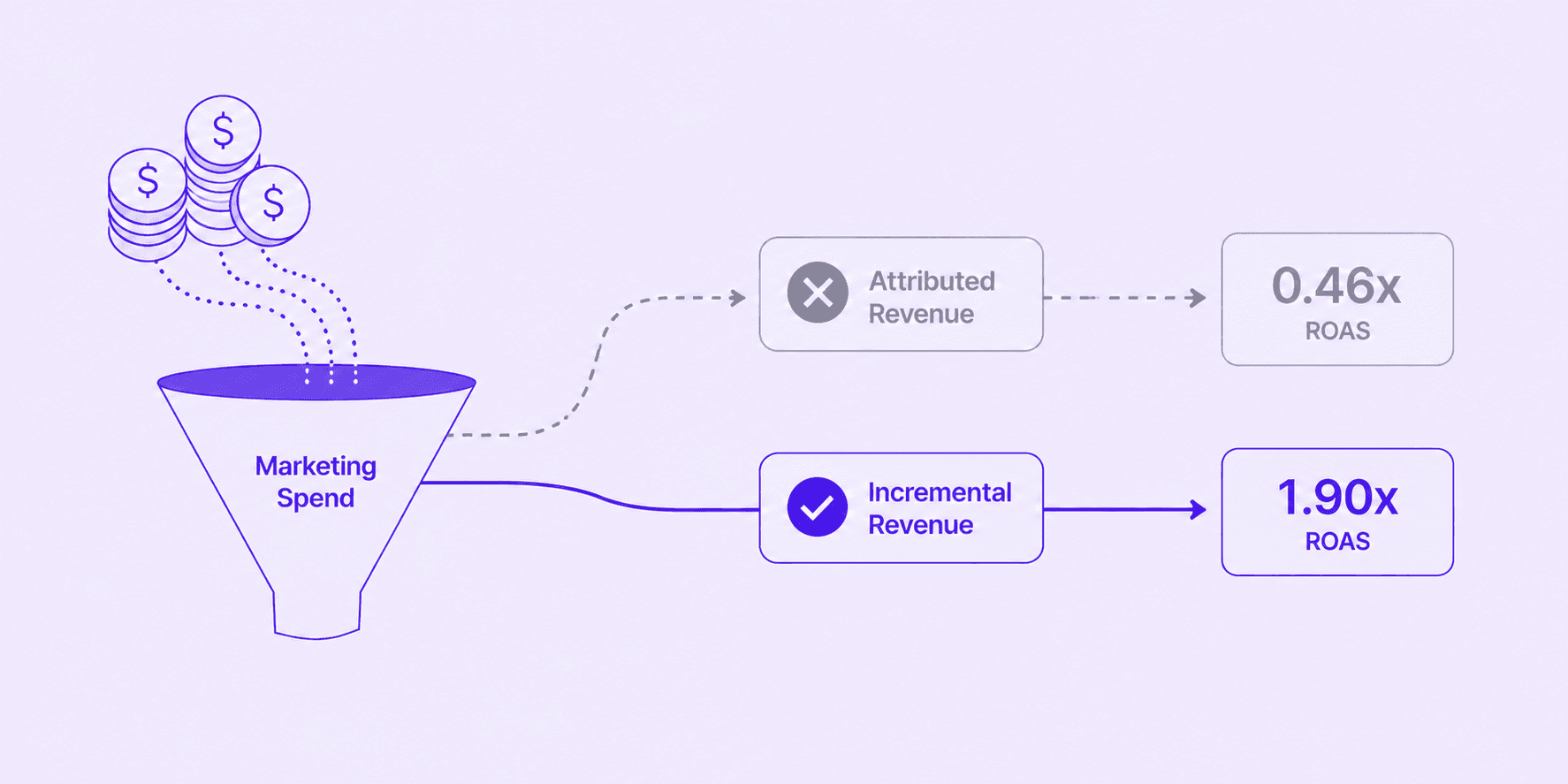
Marketing efficiency is the ratio of business output to marketing input: revenue, customers, or contribution margin produced per dollar spent. It's the metric every CFO asks about, and the one every CMO is judged on. The trouble is that the most familiar marketing efficiency metrics (ROAS, MER, CAC) capture correlation, not causation. They measure what showed up in the report, not what marketing actually caused to happen.
For DTC and omnichannel brands, that gap is the difference between scaling a channel that's working and scaling one that's claiming credit for sales that would have happened anyway. Real efficiency optimization starts with metrics, but it doesn't end there. It ends with knowing which dollars caused incremental revenue.
What is marketing efficiency?
Marketing efficiency measures the business output marketing produces for each unit of input. Output usually means revenue, orders, new customers, pipeline, or contribution margin. Input usually means media spend, total marketing spend, headcount, creative production, and agency fees. The blunt DTC version of the question: how much revenue did we generate for every dollar invested?
Higher efficiency means more output per dollar. Lower efficiency means the marketing engine is spending more to produce the same result, or generating less return at scale. Most brands track several efficiency metrics in parallel because no single metric captures the full picture. A channel can post a high ROAS while degrading blended efficiency. A campaign can hit aggressive CAC targets while shrinking gross margin.
Marketing efficiency examples for DTC and omnichannel brands
The efficiency metrics that show up most often on a DTC P&L review:
Paid social ROAS by campaign or platform
Blended MER across all channels (Meta, TikTok, Google, affiliates, and email)
CAC by acquisition cohort
Incremental contribution per marketing dollar during a geo lift test
Halo from digital media in omnichannel markets
Marketing efficiency vs. marketing effectiveness
Efficiency and effectiveness are often used interchangeably. They shouldn't be.
Efficiency asks: how much output did we get per dollar? It's a ratio. Inputs and outputs are observable, divisible, and easy to track in a dashboard.
Effectiveness asks: did marketing cause the right business outcome? It's a causal question. Did the spend grow the business in a way it wouldn't have grown without us?
A campaign can be highly efficient (great reported ROAS) and ineffective (most of those sales were going to happen anyway). It can be inefficient short-term (low immediate ROAS) and highly effective long-term (built brand, drove halo, brought in new customers). The two metrics answer different questions, and the most expensive marketing mistakes happen when teams optimize one while ignoring the other.
Why efficiency without effectiveness can mislead
Last-click ROAS measures correlated efficiency, not causal efficiency. It tells you which ads were nearby when conversions happened, which is not the same as which ads caused them. Branded search and retargeting reliably show up adjacent to purchases that were already in motion, so they look efficient on paper while contributing little additional revenue.
Incrementality testing is the only way to measure whether revenue would have happened without the spend. Without that calibration layer, "high efficiency" can mean "good at harvesting demand created elsewhere," not "good at creating demand."
The core marketing efficiency metrics
Five metrics show up in most modern DTC efficiency conversations. Each one captures something different, and each has structural blind spots.
ROAS (return on ad spend)
Formula: revenue attributed to ads ÷ ad spend.
ROAS is the workhorse metric for platform-level optimization. Every ad platform reports it, every media buyer optimizes against it, and most performance reviews still open with it. Its weakness is in the numerator: "revenue attributed" is whatever the platform's attribution model decided to credit, which inside walled gardens means click-based or modeled conversion data weighted toward what the platform can see. The fix is to compare platform ROAS against incrementality-adjusted ROAS. The gap between the two is how much the reported number is overstating reality.
MER, the marketing efficiency ratio
Formula: total revenue ÷ total marketing spend.
The marketing efficiency ratio sits above platform ROAS in usefulness for executive-level efficiency reviews. It avoids channel-by-channel attribution arguments by comparing all revenue to all spend at the business level. Most ecommerce finance teams now run MER as the headline efficiency number. Like ROAS, MER doesn't establish causality. It tells you what happened in aggregate, not what marketing caused. The value comes from interpreting MER alongside incremental contribution, gross margin, and base demand.
CAC and new customer CAC
Formula: marketing spend ÷ customers acquired.
CAC connects efficiency to acquisition economics. Blended CAC averages across all customers acquired; new customer CAC isolates true acquisition cost, which matters more when retention or returning-customer demand is strong. CAC can look efficient when marketing claims customers who would have purchased anyway, especially via retargeting and branded search. New customer CAC adjusted for incrementality is the version that actually informs budget decisions.
Incremental ROAS (iROAS)
Formula: incremental revenue caused by marketing ÷ marketing spend.
Incremental ROAS is the causal version of ROAS. It's estimated through geo lift tests, holdout groups, conversion lift studies, or incrementality models. Because it isolates the revenue marketing actually caused (versus revenue that correlated with marketing exposure), iROAS is the metric that answers the actual budget question: where should the next dollar go? Graza's Meta geo lift test found Meta's true impact was 2.7× higher than last-click reporting suggested, allowing the team to scale spend ~60% and improve POAS by 9% and MER by 20%.
Contribution margin per marketing dollar
Formula: incremental contribution profit ÷ marketing spend.
Revenue efficiency and profit efficiency are different problems. A campaign with lower ROAS may be more valuable if it drives new customers, higher-margin products, or long-term halo. Contribution margin per marketing dollar moves the optimization target from revenue to profit, which is what scales sustainably. A D2C footwear brand boosted net profit by 37% by reallocating Meta budget against incrementality-adjusted attribution rather than reported ROAS.
How to measure marketing efficiency accurately
A reliable marketing measurement view needs three things: a blended top-line view, an attribution layer, and an incrementality calibration. Five steps put them in the right order.
Step 1: Start with a blended view
Begin with total revenue, total marketing spend, MER, new customer revenue, and contribution margin. For omnichannel brands, layer in retail and ecommerce revenue as well. The blended view tells you whether the business is growing efficiently in aggregate before any channel diagnostics happen.
Step 2: Separate attributed performance from incremental performance
Attribution answers "where should we assign credit?" Incrementality answers "what did marketing actually cause?" Both have value, but they aren't substitutes. Most teams conflate them and end up optimizing against attributed numbers as if they were causal. They aren't.
Step 3: Run geo lift tests for major channels and markets
Geo incrementality testing is the practical way to establish causal contribution at the channel level. Match test and control markets, then increase, decrease, or pause spend in the test geographies. Measure incremental revenue lift versus control across ecommerce, retail, and any halo surface in the measurement window. The output is a defensible incrementality factor for each tested channel.
Step 4: Adjust ROAS and MER using incrementality
Incrementality-adjusted attribution translates lift test results into a day-to-day reporting layer. The math is straightforward: if platform ROAS reads 4.0× but your incrementality testing shows that an incremental ROAS of 4.8x — go with the iROAS number. It's been carefully measured through a geo lift test, and includes the halo effect of your ads, as well as a more accurate reading of the directly-driven sales from those ads. That number is what budget decisions should reference, not the platform-reported 4.0×.
Step 5: Reallocate spend based on marginal efficiency
Channels become less efficient as spend scales. The relevant question for budget allocation is marginal lift (the next dollar's incremental contribution), not average ROAS or average MER. Branch Furniture grew Meta revenue by 113% by reallocating against incrementality-based attribution rather than last-click numbers. The channels didn't change. The way they were measured did.
Why platform ROAS alone isn't enough
Meta, TikTok, and Google are optimization systems, not neutral measurement systems. Their reporting is valuable for in-platform decisions: which creative to scale, which audience to suppress, when to raise bids. It's structurally insufficient for cross-channel marketing performance comparison.
Each platform sees only the part of the customer journey that touched its inventory. A customer exposed to TikTok, YouTube, and Meta who converts after a Google branded search click leaves four different stories in four different platforms, none of which can be reconciled inside any one of them. View-through windows, click capture rules, modeled conversions, and privacy restrictions add additional variation. The issue isn't intent; platforms aren't trying to mislead. It's that no platform can measure what happened outside its own data.
A brand-level incrementality layer is what makes channels comparable on the same causal basis. Without it, channel efficiency rankings reflect the differences in how each platform measures itself, not the differences in how each channel performs.
How to improve marketing efficiency
Improving efficiency isn't primarily about cutting costs. It's about moving each dollar to where it causes the most profitable growth.
Cut spend that's attributed but not incremental
The fastest efficiency lever for most brands is identifying spend that looks efficient by attribution but doesn't pass an incrementality test. Branded search at saturation is the canonical example: high reported ROAS, near-zero incrementality. Cutting that spend rarely moves total revenue, but it directly improves how every remaining dollar is deployed.
Scale channels with proven incremental contribution
Once incrementality data identifies channels that are underweighted relative to their causal contribution, scale them. Discovery channels (TikTok, CTV, YouTube, Pinterest) frequently fall in this bucket because last-click and platform attribution structurally undercount them.
Measure halo effects across channels and stores
Paid social can lift Amazon, retail, direct, and branded search. CTV can lift ecommerce in markets where the brand has retail distribution. Salt & Stone's geo lift test found 67% of YouTube's incremental orders landed on Amazon rather than the Shopify site campaigns were directing traffic to. Without halo measurement, those channels look inefficient. With it, they look essential.
Optimize creative and audience strategy against incremental lift
Creative and audience optimization against last-click ROAS systematically favors demand-harvesting variations over demand-creating ones. Running tests through an incrementality lens (which versions cause more lift, not which ones win the last click) shifts the optimization target toward sustainable growth.
Use efficiency thresholds by margin, not revenue alone
A 3.0× ROAS target for a 70% gross margin product is generous; the same target for a 25% margin product is loss-making. Efficiency thresholds should be denominated in contribution margin, not topline revenue, and adjusted for the long-term value of new customers versus returning ones.
Marketing efficiency benchmarks: what's "good"?
There's no universal "good" MER, ROAS, or CAC. Benchmarks vary by category, gross margin, repeat purchase rate, AOV, retail mix, and growth stage. A high-margin beauty brand and a low-margin consumables brand operating against the same ROAS target are running fundamentally different businesses.
The more useful benchmark is the minimum incremental contribution required to acquire or retain customers profitably given the business's margin profile and target growth rate. That number is internal, defensible, and connects efficiency directly to financial outcomes.
Metric | What it measures | Better budget-decision version |
ROAS | Attributed revenue per ad dollar | Incremental ROAS |
MER | Total revenue per marketing dollar | Incrementality-adjusted MER |
CAC | Cost per acquired customer | Incremental new customer CAC |
CPA | Cost per conversion | Incremental CPA |
Revenue lift | Sales change after spend | Test-vs-control incremental lift |
The bottom line: efficient marketing is causal marketing
Marketing efficiency isn't a single number on a dashboard. It's the discipline of putting each dollar where it causes the most profitable growth, and refusing to confuse correlated efficiency with causal efficiency.
Last-click ROAS, platform-reported MER, and click-based CAC are useful operating signals. They aren't sufficient as budget decision tools. Incrementality testing turns efficiency from a reporting metric into a budget allocation system, and incrementality-adjusted attribution puts the calibrated numbers into daily reporting where the team actually works. For DTC and omnichannel brands, the question isn't "how do we hit a higher ROAS this quarter?" It's "how do we deploy each marketing dollar so it generates the most incremental contribution we can defend?"
For deeper companion reading, see how to optimize marketing spend and how to build a marketing measurement plan.
Frequently asked questions
What is marketing efficiency?
Marketing efficiency is the ratio of business output to marketing input. Output usually means revenue, customers, or contribution margin; input usually means media spend or total marketing spend. The most common metrics are ROAS, MER, and CAC, all of which describe efficiency at different altitudes (campaign, business, customer). For DTC and omnichannel brands, the meaningful version of the question is how much profitable, incremental growth marketing produced per dollar, not just how much attributed revenue showed up in a dashboard.
How do you measure marketing efficiency?
Use a layered approach. Start with blended metrics (MER, total revenue, contribution margin) for the top-line efficiency view. Layer in attribution (ROAS, CAC by channel) for tactical optimization. Then calibrate both with incrementality testing to establish what marketing actually caused. Adjusted ROAS and adjusted MER (platform-reported numbers multiplied by an incrementality factor) are what budget decisions should reference. Without the incrementality layer, efficiency metrics describe correlation, not contribution.
What is a good marketing efficiency ratio?
There's no universal benchmark. A "good" MER depends on gross margin, repeat purchase rate, average order value, retail mix, and growth stage. A 2.5× MER may be excellent for a high-margin DTC brand at scale and unworkable for a low-margin consumables business. The more useful internal benchmark: the minimum MER (or contribution margin per marketing dollar) required to acquire or retain customers profitably given the business's specific margin profile.
How can you improve marketing efficiency?
Improving marketing efficiency means moving spend from low-incrementality activity to channels and tactics with proven causal contribution. Practical levers: cut branded search and retargeting that's harvesting existing demand without driving incremental revenue; scale discovery channels that incrementality testing shows are undercredited; measure cross-channel halo so channels that lift Amazon, retail, or branded search aren't penalized for non-attributable lift; and set efficiency thresholds against contribution margin, not revenue alone.
What is the difference between marketing efficiency and marketing effectiveness?
Efficiency measures output per dollar (a ratio). Effectiveness measures whether marketing caused the right business outcomes (a causal question). A campaign can be efficient and ineffective (high reported ROAS, low incremental contribution) or effective and inefficient short-term (low immediate ROAS, durable brand and halo impact). Optimizing one without measuring the other reliably mis-allocates budget. Incrementality testing is what makes effectiveness measurable, which is what makes efficiency optimization reliable.
How does incrementality improve marketing efficiency?
Incrementality testing isolates the revenue marketing actually caused, separating it from sales that would have happened without the spend. That gives every efficiency metric a causal version: incremental ROAS, incrementality-adjusted MER, incremental new customer CAC. Once those numbers are in place, brands can scale spend on channels that produce real lift, cut spend that's claiming credit for existing demand, and report a single set of efficiency numbers that finance and growth teams can both defend.