Why types of marketing measurement matter for ROI?

by
Faizi Zahari, Growth Marketing & Product Lead
You're spending $50k a month on paid ads, and your spreadsheet has a dozen tabs where different attribution models each claim credit for the same conversion. Budget decisions get made anyway on numbers nobody in the room fully trusts.
The answer isn't more data. The issue is between the question you're asking and the measurement method you're using to answer it.
Marketing measurement splits into three broad approaches, and each one answers a genuinely different question about whether your spend is driving sales.
What are the three types of marketing measurement?

Attribution modeling asks which touchpoints contributed to a sale. It stitches the customer journey back together from impressions, clicks, and events, then divides credit across the steps. What you get is a view of which channels show up in conversion paths and roughly how big a role each one played.
Marketing mix modeling (MMM) asks what happens to revenue if you push 10% more spend into a given channel. It's a statistical read on history. The model looks for correlations between media spend and sales over time, then estimates elasticity at the portfolio level.
Incrementality testing asks whether the marketing actually caused the sale. Some people see your ads, some don't, and you compare what the two groups buy. Whatever gap you find is the causal effect.
All three count as real measurement. All three have blind spots, and the blind spots are what get brands into trouble.
How do these three types differ?
Type | Answers | Strengths | Limits |
|---|---|---|---|
Attribution | Which touchpoints got credit? | Granular (ad level, creative level), real-time, shows customer journey | Can only measure correlations between ads and revenue, doesn't measure true incrementality, misses dark funnel |
MMM | What's the spend elasticity? | Works at portfolio level, measures all channels together, includes offline data | Slow (needs months of data), low granularity, susceptible to unseen noise in data |
Incrementality Testing | What's the causal lift? | True causal effect, works for any channel, high confidence | Requires test budget and time, measures one thing at a time, results decay quicker |
If it helps: attribution tells you how your ad dollars are doing, MMM tells you what your ad dollars should do at different spend levels, and incrementality testing definitively proves what you ad dollars just did.
For deeper comparisons, see MMM vs. incrementality and MTA vs. incrementality. You can also review MMM vs. MTA to understand where mix modeling and attribution diverge in practice.
Why does your measurement type matter for budget allocation?
Most DTC brands default to attribution because it's fast and feels granular. The structural problem is baked into the method: attribution assumes the customer wouldn't have converted without seeing your ad. Often they would have.
Say someone finds you through organic search or a friend's recommendation, browses, and later clicks a retargeting ad. Attribution hands the credit to retargeting. You see the signal and fund retargeting harder. But that customer was already on their way. All you did was reroute them through a path that happened to be measurable.
Call it attribution leakage or last-click bias. Either way the result is the same: money piles into lower-funnel tactics while upper-funnel channels and brand awareness, where a lot of real opportunity sits, gets starved.
For a full breakdown of attribution's role and limits, see marketing attribution explained. Whatever number you report as marketing ROI is only as trustworthy as the method that produced it.
When to use each type of measurement

Attribution earns its place as your operational reporting layer. Reach for it when you need same-day visibility into which touchpoints preceded a sale, when you're adjusting bids or reading creative tests, or when waiting a month for an answer isn't an option.
MMM is for portfolio questions. Use it once you have six or more months of clean history, reasonably stable channel performance, and decisions to make at the business unit level. It's also the right tool for what-if planning: cut TikTok by 30%, what happens to revenue? You trade granularity for confidence at scale.
Incrementality testing is for when you need proof. A new channel you're unsure about, a line item you can't justify, a dashboard number that looks too good. It requires a test budget, since some spend gets withheld, and it moves slower than the other two. What comes back is a causal answer at the channel, tactic, or campaign level.
Brands past a certain size stop picking and run all three.
How to combine measurement types for complete ROI visibility
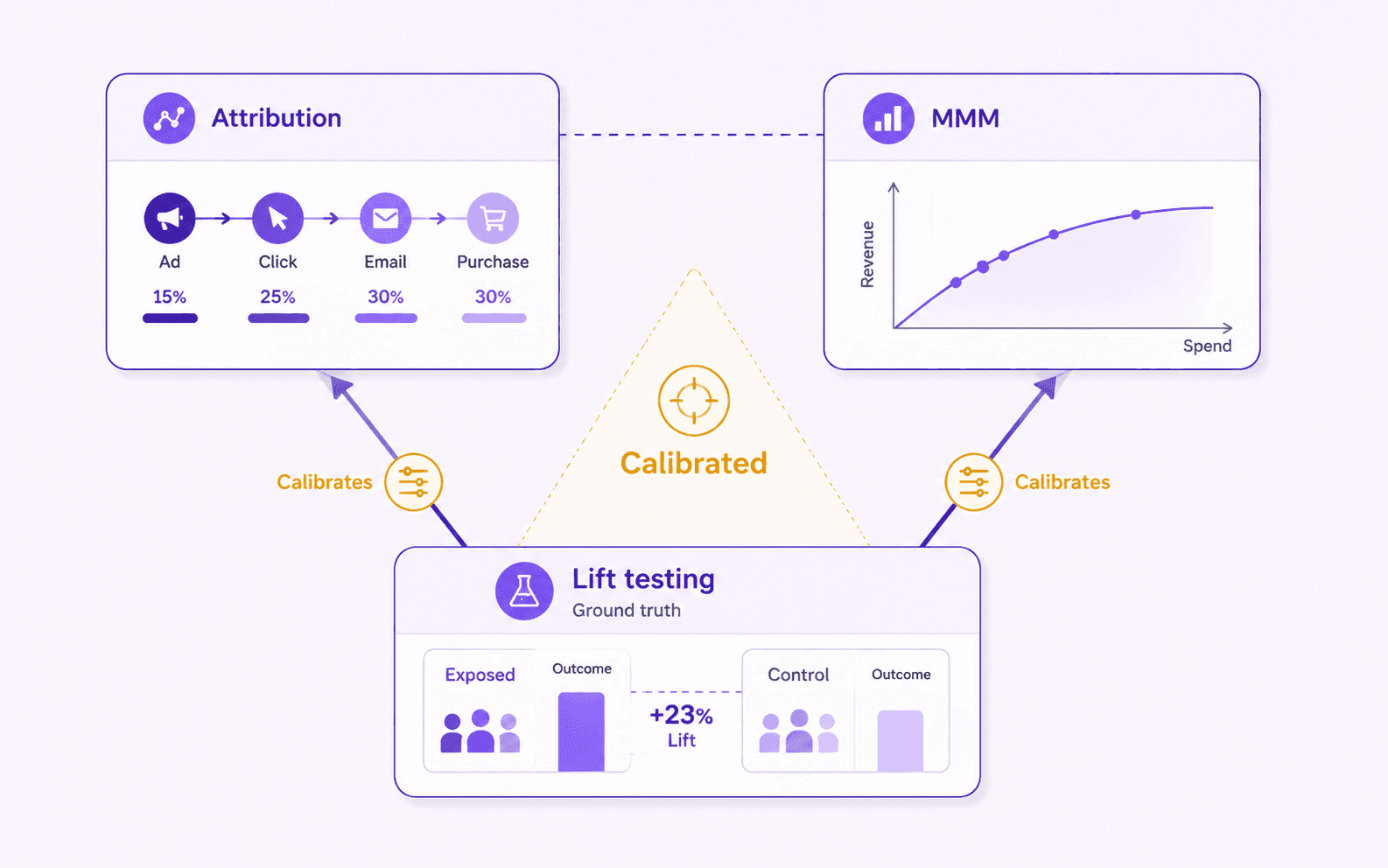
The strongest setups triangulate.
Incrementality testing is the anchor. Run controlled tests on the channels and campaigns carrying the most spend. Those tests give you causal lift with no attribution leakage and no correlation muddle.
Then feed the results back into attribution. If a test shows TikTok prospecting delivering 40% less lift than your model has been claiming, you change the scoring rules to match what the test found.
MMM runs alongside all of this, handling portfolio dynamics and trade-offs. Cross-check its elasticity estimates against your test results. Where the two disagree, you've found something worth investigating.
When all three line up, your allocation rests on causal evidence instead of correlation artifacts. That's triangulated measurement: one experimental method calibrating two modeled ones.
This approach is covered in depth in how marketing measurement works, our guide to building a complete measurement stack.
Real example: How a DTC brand corrected their measurement
True Classic had 15% of budget sitting in AppLovin on the strength of attributed ROAS. A test on that channel found roughly 60% of those attributed sales would have landed anyway through other channels. They trimmed AppLovin by 8%, moved the money to channels with better lift, and blended marketing ROI came up 22%.
Attribution had been telling them one story for months. The test told a different one, and the gap between the two was worth real money.
Frequently asked questions
What's the difference between marketing measurement and marketing attribution?
Measurement is the umbrella term for any method that estimates ROI and channel impact. Attribution is one method inside it, the one that reconstructs customer journeys and assigns credit to touchpoints. MMM and incrementality testing sit under the same umbrella and answer different questions. Treating attribution as the whole of measurement is where a lot of brands go wrong.
Can you measure channels without click data, like CTV or out-of-home?
Yes. Incrementality testing works on any channel where you can control exposure. CTV, podcasting, out-of-home, and direct mail all get measured through geo-based testing, which compares sales in exposed markets against control markets. No click data required, because you're measuring at the order level.
Which measurement type is most accurate?
Designed properly, incrementality testing gives you the highest-confidence causal estimate, because it's an actual experiment. MMM holds up well at the portfolio level if your data is clean. Attribution is the fastest and the most likely to overcredit correlation. The strongest setups run all three: incrementality for calibration, attribution for operational reporting, MMM for portfolio strategy.
Do I need all three measurement types?
Under $500k a month, optimizing mostly at the tactical level, incrementality testing on its own will give you most of the signal you need. Past $1M across eight or more channels, with real portfolio decisions on the table, triangulating all three usually pays for itself in better allocation. If you can only afford one, make it incrementality testing.
Ready to move beyond correlation-based measurement? Book a demo to see how incrementality testing can calibrate your entire measurement stack.