MMM vs. incrementality: what's the difference?

by
Faizi Zahari, Growth Marketing & Product Lead
What is marketing mix modeling?
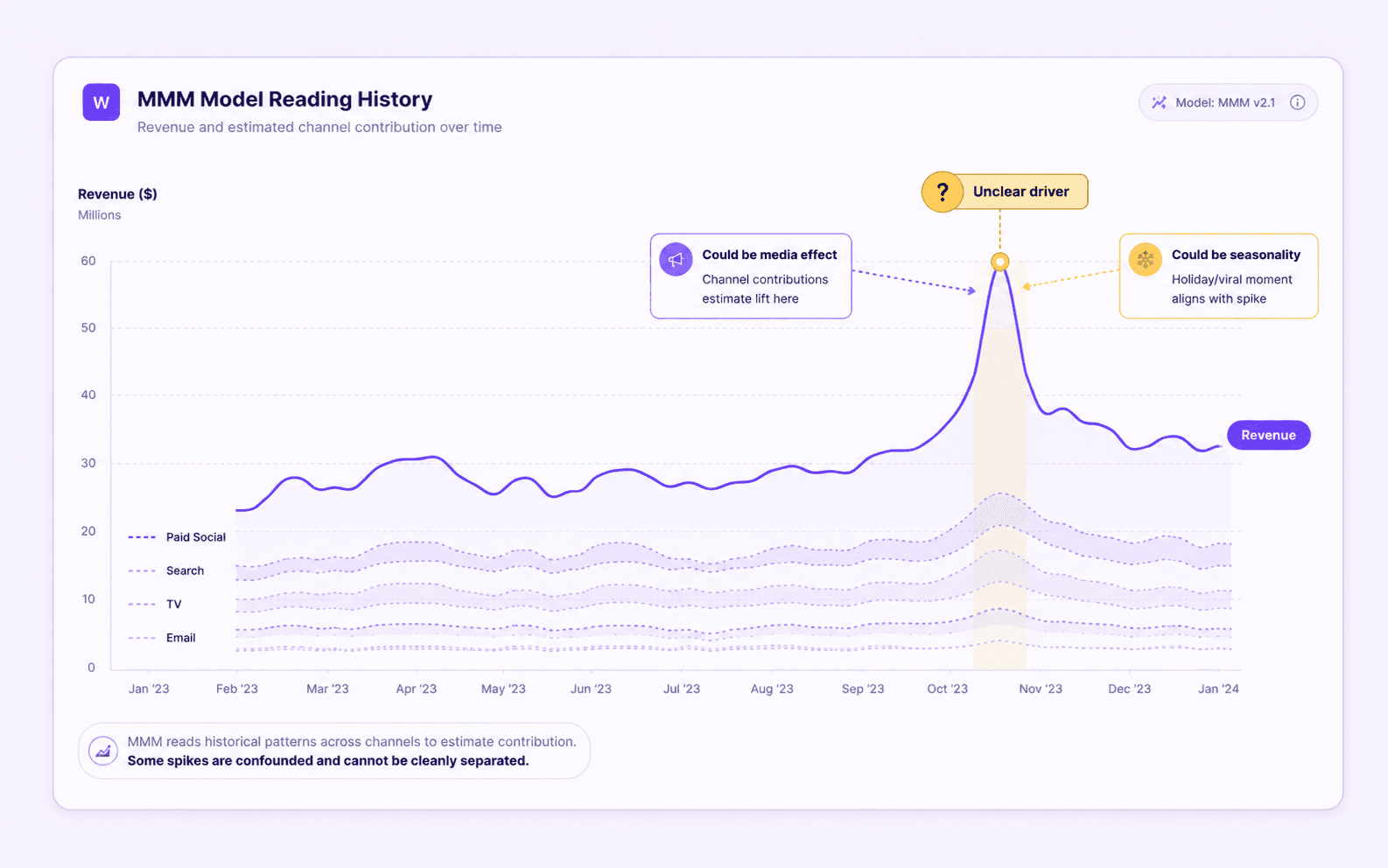
MMM is a statistical method that reads historical spend and revenue across all your channels and estimates which ones are driving sales.
Its advantage is that it runs on aggregated data. No event-level signals, no user IDs. That makes it workable for offline channels, brand campaigns, and any situation where attribution tracking has broken down.
The catch is what MMM has to assume. It never tests anything. It infers causality from correlation, so a viral moment or an unusually strong Q4 can skew the output badly. Hand the same dataset to two MMM vendors and you'll often get two different answers about which channel matters most.
What is incrementality testing?
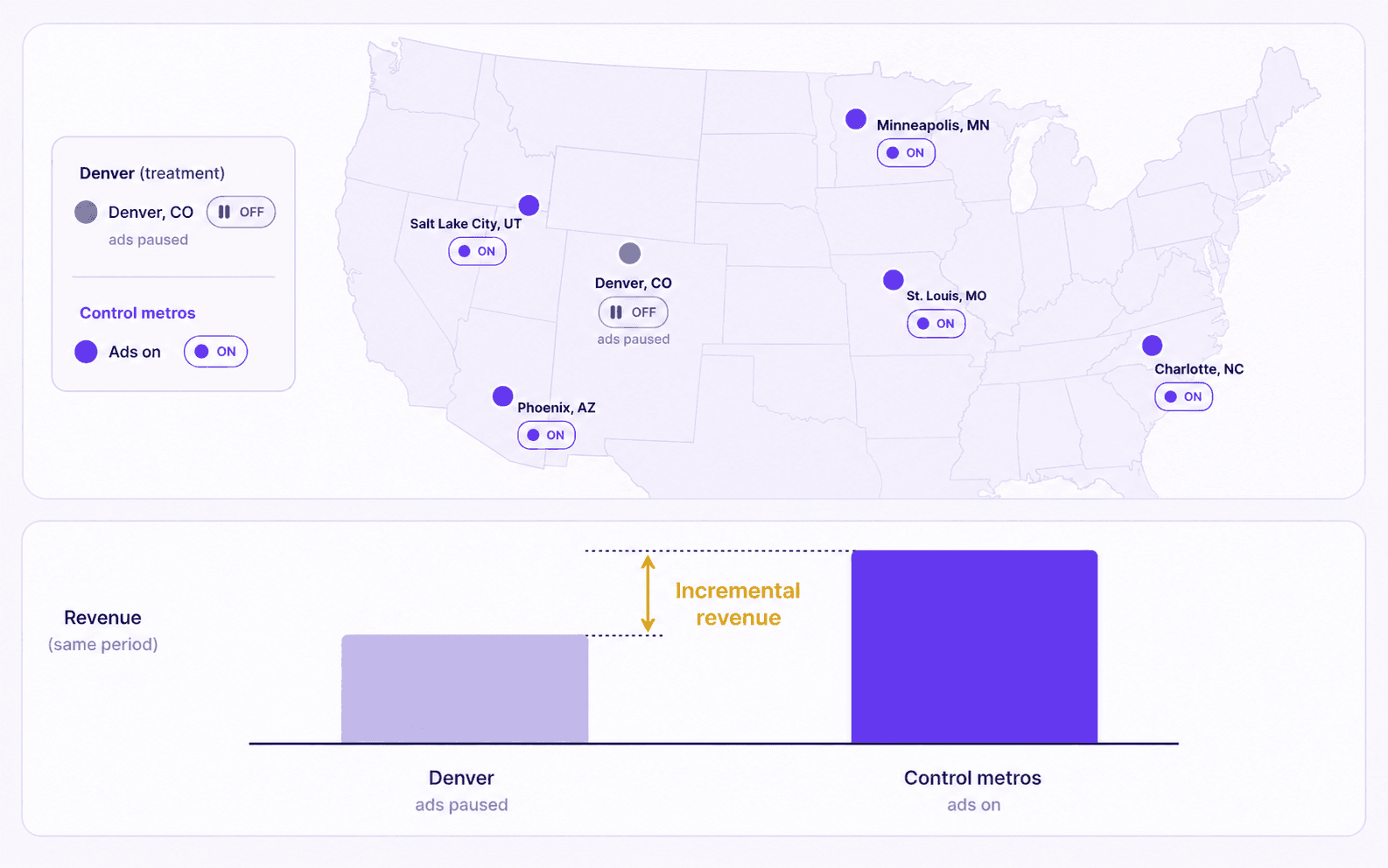
Incrementality testing isolates the lift you get from turning a campaign on or off.
The simplest version is a geo lift test. Pause ads in Denver, keep them running everywhere else, then compare Denver's revenue against your control cities. That gap is the incremental revenue your ads were producing.
It's about as close to a lab experiment as marketing gets. Nothing is being inferred. You flip the switch and watch what happens.
The downside is cost and pace. Tests take time to reach significance, they aren't cheap, and each one covers a single channel or campaign. You can't put your whole mix through a test the way MMM covers it in one pass.
MMM vs. incrementality at a glance
Aspect | MMM | Incrementality testing |
Data used | Historical spend + revenue | Live test pause/resume |
Causal proof | Statistical inference | Experimental isolation |
Speed | Fast (weeks to analyze) | Slow (months to power) |
Channels tested | All at once | One campaign at a time |
Cost | Low | High |
Accuracy risk | Confounded by external factors | Limited sample size |
Best for | Macro trends, long-term ROI | Tactical campaign decisions |
Why marketers are choosing both
MMM on its own is arbitrary without something to anchor it. That tension sits at the center of marketing measurement: you need the statistical model and the experimental check.
MMM builds a picture of historical data and estimates channel contribution. But contribution is a slippery word. It might mean correlation, partial causality, or halo. Two vendors will weight the same channels differently depending on the assumptions they built in, and without outside validation you have no way to tell which one is closer.
Incrementality testing settles it. Here is what happened when we turned channel X off. That result becomes your ground truth.
Feed the lift back into the MMM and the model recalibrates: we tested channel X, we measured 12% lift, adjust accordingly. The MMM gets less arbitrary, and attribution accuracy improves across every channel, including the ones you'll never have budget to test directly.
David Protein tested this approach. They ran incrementality tests on Meta, found their attribution was overstating Meta's contribution by 36%, and recalibrated their MMM on the corrected numbers. Revenue rose 34% and profit 37%, entirely from moving spend out of inflated channels and into ones their MMM now had reason to trust.
How incremental calibration works in practice
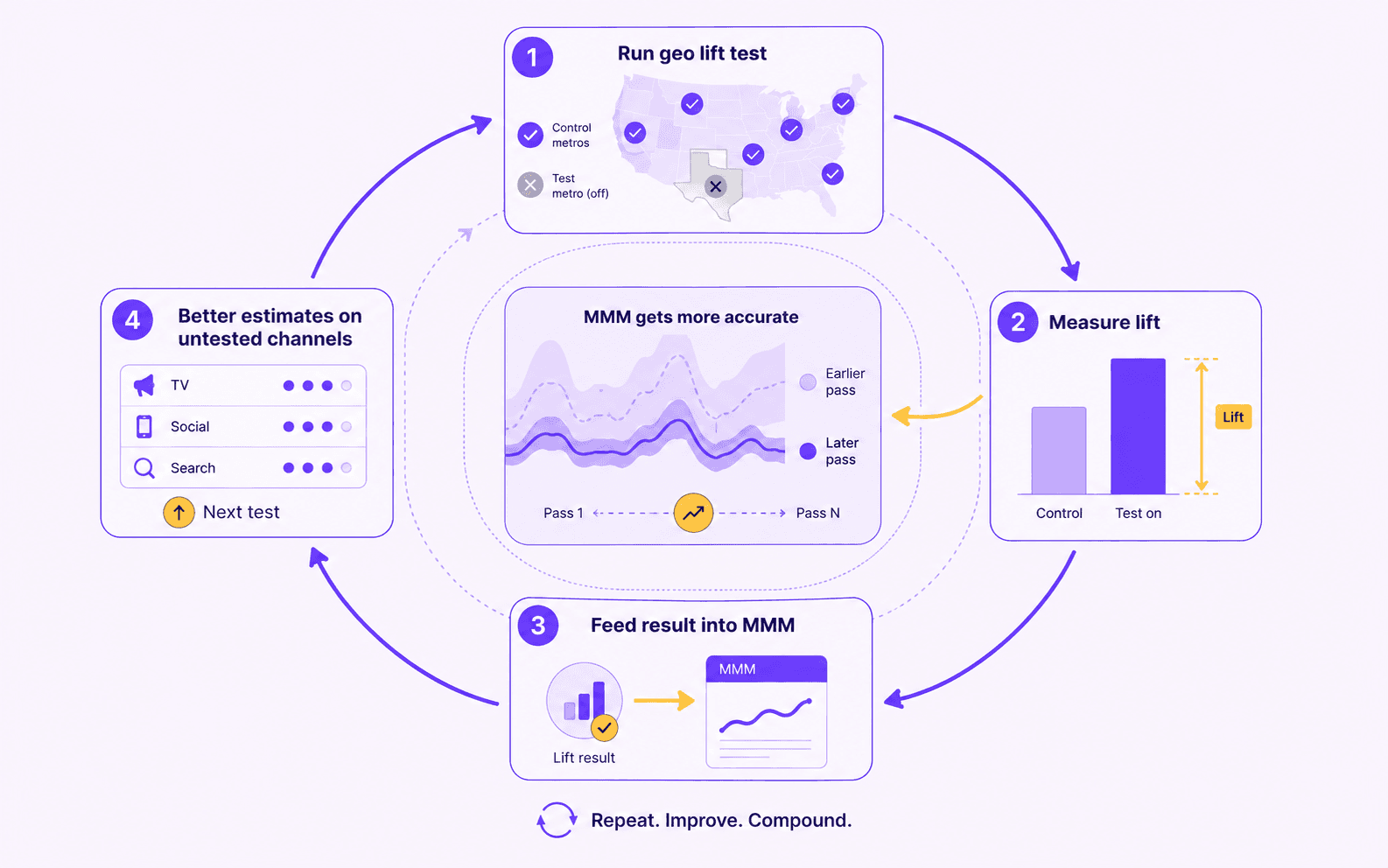
Begin with platform-level tests on your biggest channels. Meta, TikTok, Google, whatever holds the majority of your spend.
Run a geo lift test or a hold-out test on that channel for two to four weeks and measure the actual lift.
Feed the number into your MMM. The model updates, and the channel's contribution now reflects a tested result instead of a correlation.
Do it again on a second channel, then a third. Each round of geo incrementality testing teaches the MMM more about which historical signals track real causality and which are noise, which makes it sharper on channels you haven't touched.
The gains compound. You're not testing to replace MMM. You're testing to make MMM worth trusting. Once it's calibrated, incrementality-adjusted attribution carries that credibility down to the tactical level: ad sets, creative, audiences, campaigns.
Which should you implement first?
DTC brand on Meta or TikTok, and the question keeping you up is whether to scale a channel? Start with incrementality testing.
Tests are slow and they cost money, but the answer is definitive. A 15% lift on Meta is a real 15%. You can scale on that.
Mid-market, five channels, trying to get your arms around types of marketing measurement and cross-channel ROI? Start with MMM.
MMM is fast and cheap, and you'll have a directional read within weeks. Commission a test on your largest channel while it runs, though, and use that result to check the model. Then you have speed and ground truth instead of one or the other.
The brands that get furthest run incrementality-calibrated MMM, pairing the granularity of multi-touch attribution with the causal credibility of lift testing. That's the point where halo effects and channel synergy become visible and you can move budget without crossing your fingers.
If you're trying to understand the difference between incrementality testing and other measurement methods, see our explainers on MMM vs. MTA and MTA vs. incrementality.
Frequently asked questions
What if we can't afford incrementality testing?
Run it on your single largest channel first. One platform-level geo lift test costs a fraction of what you spend on that channel in a month, and it usually pays for itself in better allocation decisions. Pair it with MMM so the insight extends to channels you didn't test.
Can MMM and incrementality testing conflict?
They can look like they conflict, especially if the MMM was fit before any testing happened. Calibrate the model with the test result and the two converge. The test is the ground truth, so the model is what changes.
How long does an incrementality test take?
Platform-level tests usually need two to four weeks to reach statistical significance. Campaign-level tests run longer because the samples are smaller. If rigor matters, plan on four to eight weeks.
Should we run incrementality tests on every channel?
No. Start with your top one to three channels by spend. Each test makes the MMM smarter about the channels you haven't tested. After two or three, the marginal value of another test drops off sharply.
Ready to combine incrementality testing with MMM to make your attribution model trustworthy? Book a demo to see how incrementality-calibrated measurement works in practice.