MTA vs. Incrementality: What's the Difference?

by
Faizi Zahari, Growth Marketing & Product Lead
Most DTC brands lean on multi-touch attribution (MTA) to steer ad spend. The platform names the channel that converted the customer, you shift budget toward it, and revenue is supposed to follow. Often it doesn't.
MTA describes what happened. It can't tell you what would have happened if you'd spent differently, because it works by assigning credit to touchpoints after the fact. Incrementality testing goes after the question MTA structurally can't answer: did the ads cause the sale, or was the customer buying either way?
What's the difference between MTA and incrementality testing?
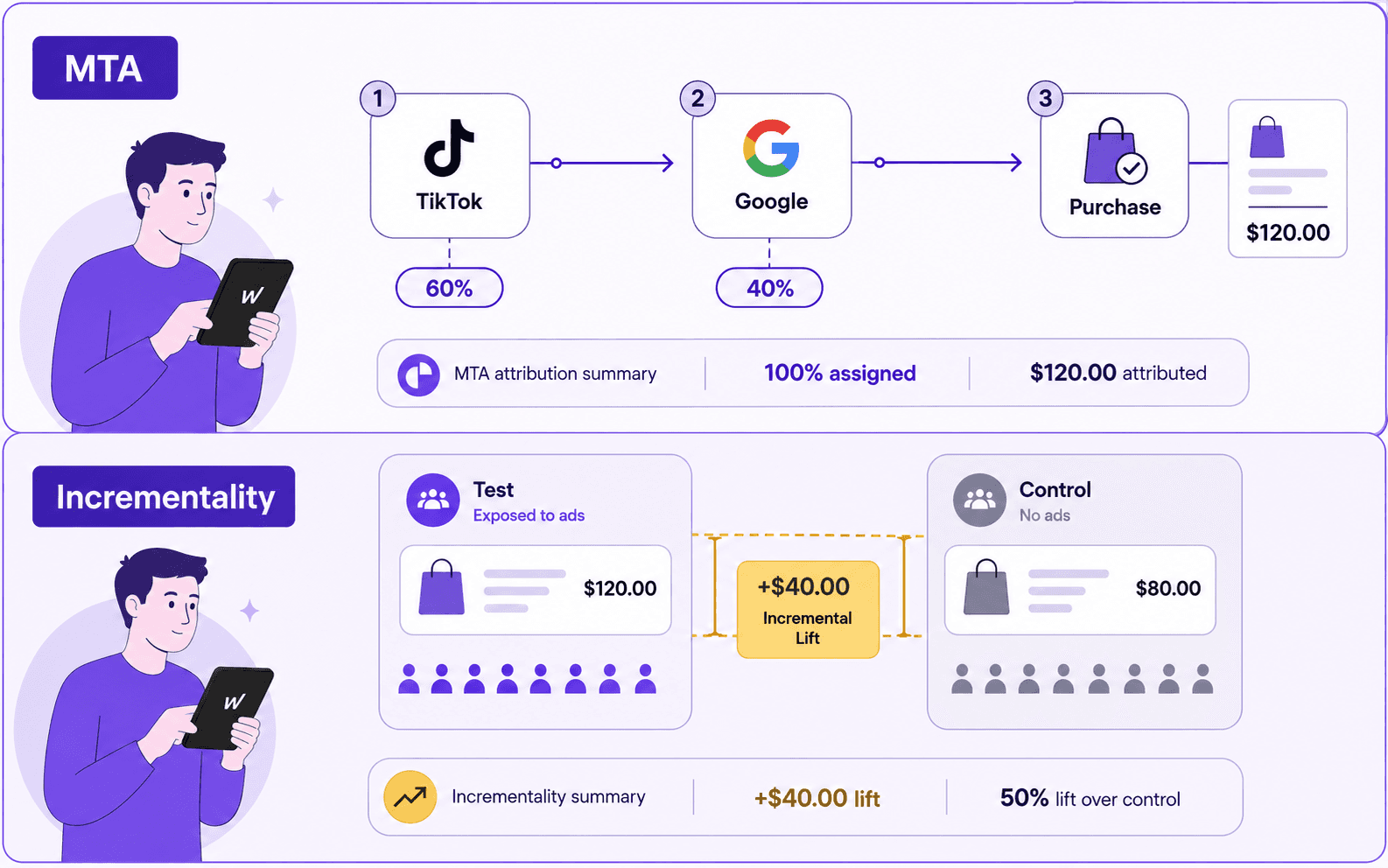
MTA watches which channels show up in a customer's path before conversion, then splits credit between them using a statistical model. Customer clicks a TikTok ad, then a Google ad, then buys? MTA decides how much of that sale belongs to each.
Incrementality testing skips attribution altogether. You pause ads for a random slice of your audience, watch what that control group buys anyway, and compare it against a group that kept seeing ads. The gap is your incremental impact.
Aspect | MTA | Incrementality Testing |
|---|---|---|
How it works | Assigns credit based on touchpoints | Compares behavior with/without ads |
Ground truth | Platform data (often over-reported) | Experimental lift measurement |
Speed | Real-time, dashboard-ready | Takes days/weeks to accumulate data |
Channel-level detail | Yes, down to ad level | Yes, by geo or audience segment |
Handles offline/halo effects | No | Yes, if designed to measure it |
Tells you what happened | Yes | Yes |
Tells you what caused it | No | Yes |
Boiled down: MTA is a correlation instrument. Incrementality testing is a causation instrument.
Why incrementality testing matters more than MTA alone
Platform-reported data leans toward showing more impact than really exists, and that bias is structural rather than accidental. When a brand in our case studies switched from platform-only attribution to incrementality-calibrated models, 36% of their reported Meta impact turned out to be over-attribution: phantom credit for ads that hadn't driven anything incremental.
Getting that wrong costs money. Believe a channel is 36% stronger than it is and you'll overfund it while the channels actually working stay under-resourced.
A test replaces the belief with a measurement. You run the experiment, observe the behavioral lift, and know how many incremental sales your ads produced.
Incremental Sales = (Test Group Conversions − Control Group Conversions) / Test Group Size
That number goes back into your attribution model. Once you know the real lift from a channel, you can dial MTA's credit up or down and take the bias out.
How to choose between MTA and incrementality testing
Working out the different types of marketing measurement is the first step toward picking the right one. In practice most brands don't pick. They run both.
Lead with incrementality testing if your platform numbers feel too good. Even a modest test, 1–2% of traffic paused for 2–4 weeks, will show you whether channels are over-reporting or whether there's real lift buried in the noise.
Lean on MTA when you need daily decisions about which ad-level creatives and audiences are working. Tests need time to build statistical power. MTA can move budget today.
The combination is where the value sits. Use tests to calibrate the MTA model so your day-to-day calls reflect measured lift instead of platform self-reporting. That matters most on Meta and other walled gardens, where incrementality gaps run widest.
How they work together (not against each other)
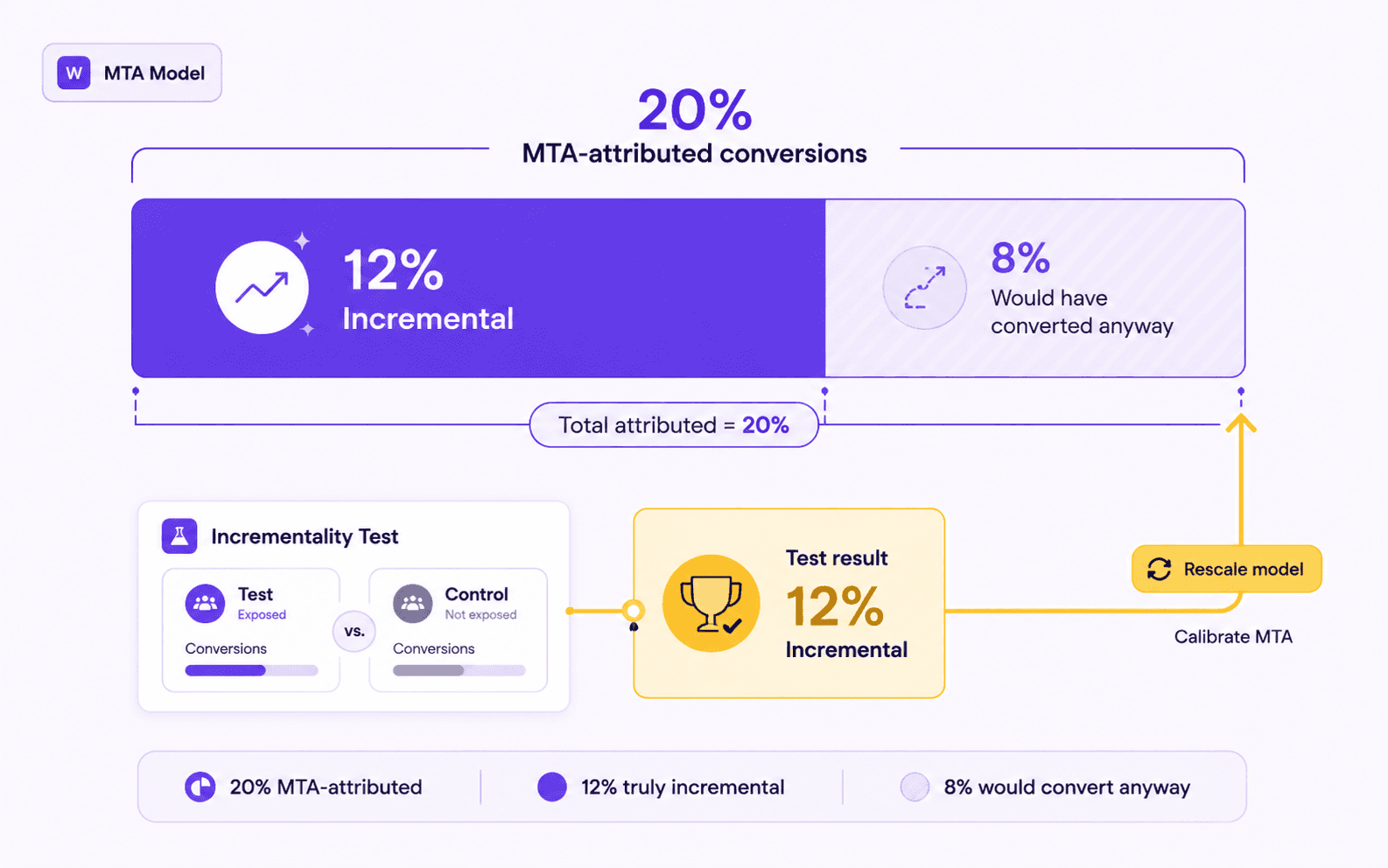
Brands often look at an incrementality result next to an MTA result, see the numbers disagree, and conclude one must be broken. Usually neither is. They're measuring different things.
MTA might show TikTok driving 20% of conversions while a test shows 12% incremental lift. Both can be accurate. The 20% includes TikTok's share of credit for customers who would have converted regardless. The 12% is what actually changed when TikTok went dark.
Put them into one system and each does the job it's good at. Tests supply the calibration signal, MTA supplies the daily granularity. Incrementality testing plays the same role alongside MMM in a complete measurement stack, with each method contributing something the others can't.
David Protein ran incrementality tests on Meta and found their attribution model was inflated. Recalibrating MTA against the test baseline lifted revenue 34% and profit 37%. No channels were cut. They moved spend toward channels the uncalibrated model had been undervaluing.
This is why marketing measurement systems that pair incrementality testing with MTA beat either method running alone. The test baseline takes the guesswork out of tactical decisions.
How to run your first incrementality test
You don't need much infrastructure. Pick one channel (Meta, TikTok, Google) or even a single campaign. Define the test population by geography. Pause ads for a random 10–20% of users in that geo and let it run 2–4 weeks.
The data requirement is modest: aggregated conversion data by test/control group and by day. With that, you can measure lift.
Keep the first one small. A geo-based test is inexpensive and it answers the trust question fast. Plenty of brands find 20–40% platform over-reporting on their first attempt, which tends to justify the exercise on its own.
Geo incrementality testing is the quickest route to ground truth. It works across channels and holds up for international brands running regional campaigns.
Frequently asked questions
Can you run MTA and incrementality testing at the same time?
Yes. MTA works on historical data, attributing conversions that already happened, while an incrementality test is a forward-looking experiment. The two don't interfere. Running them in parallel is common, so test results can calibrate the MTA model as they arrive.
How long does an incrementality test take?
That depends on conversion volume and how much statistical power you need. A single-channel test with 10–20% of traffic paused usually takes 2–4 weeks to hit 80% power. High-volume brands can go shorter. Lower-volume brands should plan for longer windows.
Which channels are easiest to test incrementally?
Paid channels are easiest because you control exposure. Meta, TikTok, Google, AppLovin, and YouTube all qualify. Organic and email are harder to pause without damaging the customer experience. Most brands start with their highest-spend paid channel.
Does incrementality testing replace MMM?
No. The two answer different questions. Tests are causal but narrow: one channel, one window. MMM models continuously across every channel and a longer horizon. The strongest stacks run both and let test results calibrate MMM assumptions over time.
Want to see your true incremental impact? Book a demo to learn how to run your first incrementality test.