How to calculate incremental lift? Why the math matters

by
Faizi Zahari, Growth Marketing & Product Lead
What is incremental lift and why you need to calculate it
Your attribution software is lying to you, or at least not telling the whole truth.
It's reporting all the orders that happened after someone saw your ad. But many of those orders would have happened anyway, even without your ad. The difference between what actually happened and what would have happened without your ad is incremental lift.
Understanding what incremental lift means for accurate attribution is the first step to making smarter budget decisions. You're measuring what your ads actually caused in terms of conversion, not whether or not they're correlated to conversion patterns.
Without calculating true lift, you're optimizing toward inaccurate numbers. You're making budget decisions based on false returns. The brands winning right now are measuring incrementality instead.
How do you calculate incremental lift? The step-by-step procedure
Incremental lift isn't theoretical. It's a concrete number you can calculate through a controlled test. Here's the process.
Step 1: Set up your test and control groups.
Divide your audience into two statistically equal groups: a test group that receives your ad (or message, or promotion) and a control group that doesn't.
The control group must be held out completely: no ad exposure, no spillover, no exceptions. This is your baseline for "what would have happened anyway." The test group is where you measure impact.
Size also matters. Small tests show noise instead of truth, and noise is what testing is supposed to eliminate.
For most brands, you need at least 5,000–10,000 customers per group, but it depends on your conversion rate and variance. Underpowered tests will show 0 incremental lift even when lift exists, not because the channel doesn't work, but because your sample was too small to detect a real difference.
Step 2: Run the test for long enough.
A 48-hour test is not a test. Results need time to stabilize. Most incrementality tests run for 7 days to 30 days, depending on your purchase cycle and audience size.
Shorter cycles (e-commerce, quick conversions) can test in 7–14 days. Longer cycles (B2B, insurance, automotive) need 21–90 days to capture the full impact. When measuring incremental sales in longer cycles, extend your test window accordingly.
Step 3: Count conversions in both groups.
Measure identical behaviors in both test and control. If you're testing a paid ad, measure purchases, sign-ups, or whatever your KPI is.
Control group conversions: what happened without your ad.
Test group conversions: what happened with your ad.
Make sure your data pipeline connects both groups to the same conversion source. If you're measuring through ad platform data, use their built-in cohorts. If you're using server-side data, ensure the groups are tagged correctly in your analytics system.
Step 4: Apply the formula.
The core calculation for incremental lift is:
Incremental Lift (%) = ((Test Conversions − Control Conversions) ÷ Control Conversions) × 100
You can also calculate absolute incremental conversions:
Incremental Conversions = Test Conversions − Control Conversions
Or incremental revenue directly:
Incremental Revenue = Test Group Revenue − Control Group Revenue
A concrete example
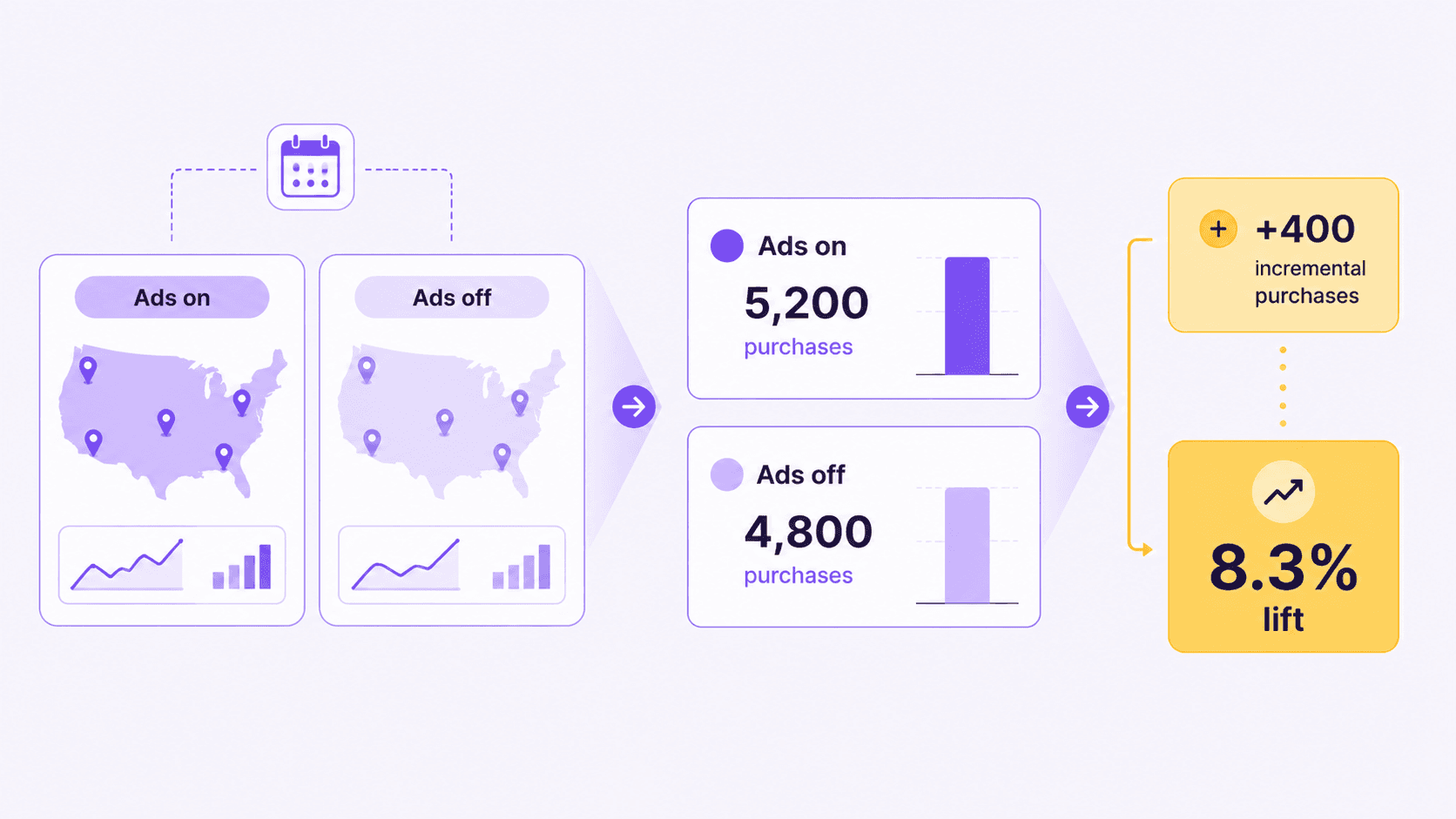
Say you run a geo incrementality test for your paid campaigns across 10 test markets and 10 matched control markets over 14 days.
Test group (10 markets with ads): 5,200 purchases.
Control group (10 matched markets, no ads): 4,800 purchases.
Incremental purchases = 5,200 − 4,800 = 400.
Incremental lift = (5,200 − 4,800) ÷ 4,800 × 100 = 8.3%.
Your campaigns are responsible for an 8.3% sales increase in those test regions. That's your true incremental impact, and the number you should be relying on the most when making a budgeting decision.
If your media spend in those test markets was $50,000, your actual incremental ROAS is:
(400 purchases × average order value) ÷ $50,000 = true incremental return.
Compare that to what your platform or MTA model reports as attributed revenue. Most brands find they're 20–40% off of the incremental number, and that gap is where budget optimization happens.
Why statistical significance matters
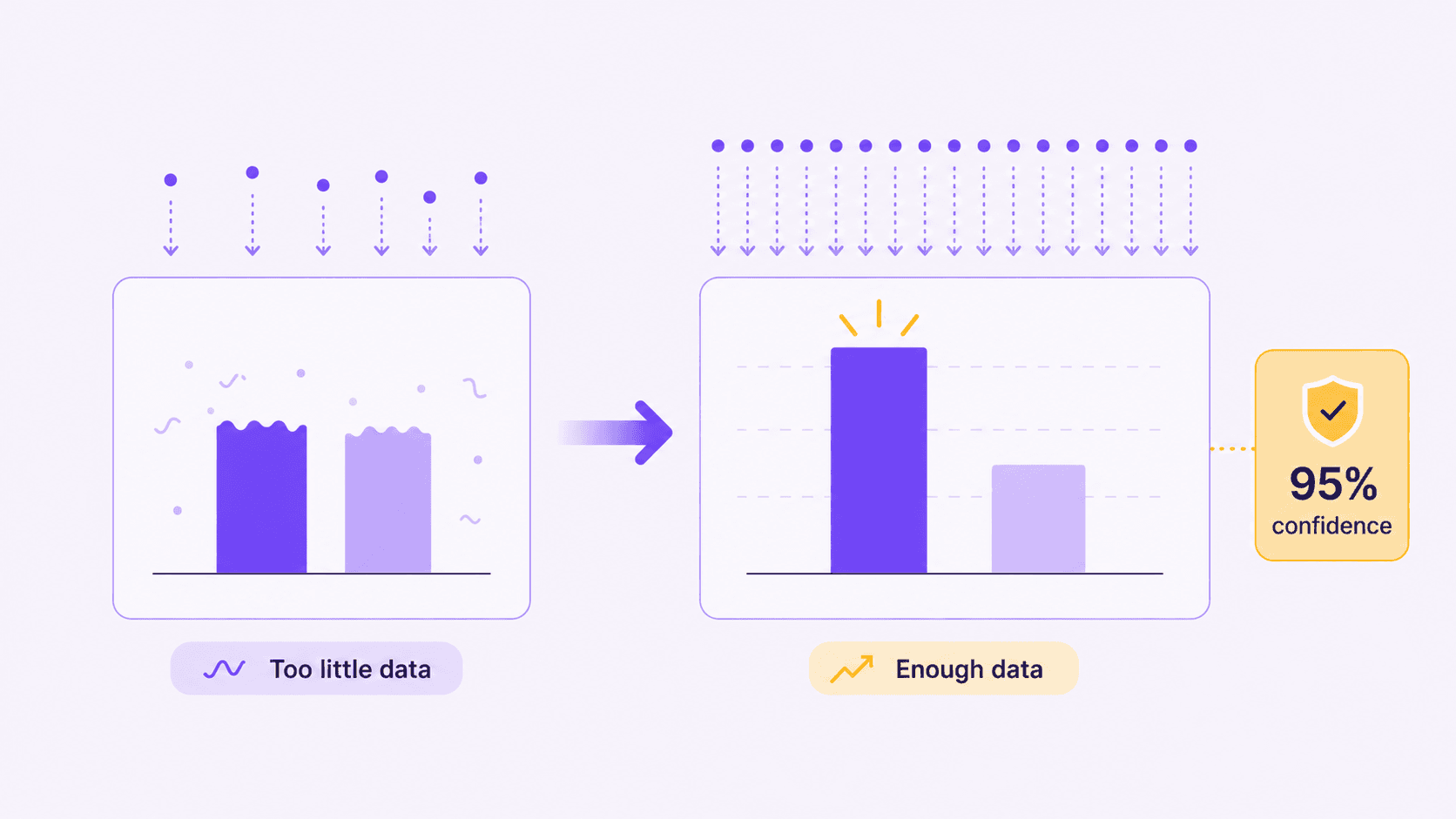
Not every difference between test and control is real. If you have 100 test conversions and 98 control conversions, that 2-conversion gap could just be random noise.
Statistical significance answers the question: "Is this difference real, or did it happen by chance?"
Most incrementality tests aim for 95% confidence, meaning there's only a 5% probability that the difference you see is noise. Some teams use a higher bar (99% confidence) for bigger decisions.
The size of your difference, the size of your sample, and the stability of your data all affect significance. Larger samples, larger differences, and lower variance all make it easier to reach significance and prove your results are causal.
Common mistakes that break the calculation
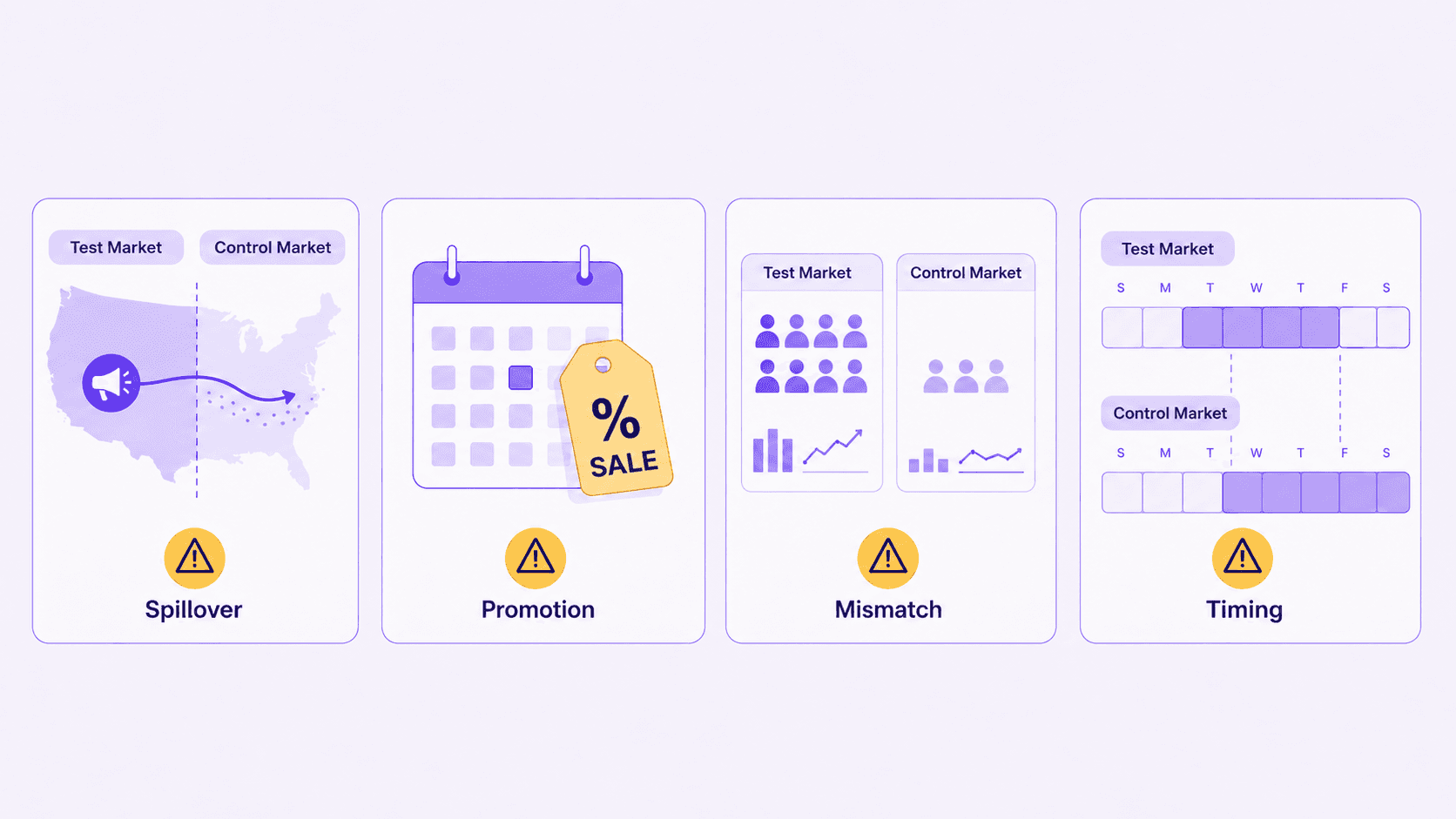
Letting the control group see ads anyway.
Even a tiny bit of spillover destroys the test. If ads leak into your control region through mobile users traveling, cross-device tracking, or matching audiences, the control group is no longer truly control.
Testing during promotions without context.
When you run a lift test during a flash sale or holiday promotion, you're measuring channel performance under promo conditions specifically—not business-as-usual. That number is still useful (it's a real causal measurement), but it doesn't generalize to non-promo periods.
Using mismatched test and control groups.
Your control markets must be similar to your test markets in size, demographics, seasonality, and baseline purchase behavior. If your test market is urban and your control is rural, you're measuring geography, not incrementality.
Mixing time periods.
If your test runs from Jan 1–14 but your control measurement is from Dec 28–Jan 10, seasonal shifts corrupt the comparison. Test and control must measure the same calendar period, side by side.
How to interpret the results
A positive lift number means your channel drove incremental sales. A near-zero result means it didn't (or the test wasn't big enough to measure it). A negative number means the channel cannibalizes sales from other channels or from organic, which does happen and reveals important cannibalization patterns worth understanding.
Each lift test is a snapshot of that period's true incrementality. If you retest the same channel three months later and get a different number, that's expected. Incrementality shifts with seasonality, promotions, pricing, product launches, and campaign setup.
This doesn't mean the channel is broken or no longer incremental, it's more likely that the market conditions have changed.
The most accurate way to use lift tests is to feed the results into an incrementality-adjusted attribution model, which continuously recalibrates your channel performance estimates as new tests come in. This transforms a single test result into ongoing causal measurement across your marketing mix.
Why one brand gained 34% incremental revenue
David Protein ran a lift test on Meta and discovered they were overestimating attribution by 36%. Their platform was claiming credit for sales that would have happened anyway.
After switching to incrementality-calibrated measurement, they reallocated budget away from over-attributed channels and toward genuinely incremental ones. The result: 34% revenue lift and 37% profit lift.
That lift didn't come from better creative or audience targeting. It came from the math, calculating true incremental revenue instead of guessing.
How incremental lift connects to your broader measurement
Calculating incremental lift for a single channel is valuable. But the real power comes when you feed those causal measurements into your full incrementality testing strategy.
Each test calibrates your attribution model. Multiple tests across different channels, different tactics, and different time periods build a complete picture of what's actually working. Channel incrementality tests show which channels are truly incremental. Tactic-level tests (e.g. Testing prospecting or retargeting campaigns) show which creative approaches and audience segments drive lift. Seasonal tests show how incrementality shifts over time.
The brands that are winning aren't the ones running one test and declaring victory. They're the ones running continuous incrementality testing, learning what truly drives causal impact, and continuously reallocating budget based on real data instead of platform claims.
Frequently asked questions
What sample size do I need to calculate incremental lift accurately?
Most incrementality tests need at least 5,000–10,000 customers per group to reach statistical significance. Larger sample sizes reduce noise and let you detect smaller lifts. If you're testing a low-conversion channel or expecting a small lift, you'll need a bigger sample. The formula depends on your baseline conversion rate, expected lift size, and confidence level (95% vs. 99%).
How long should I run an incrementality test?
Test duration depends on your purchase cycle. E-commerce brands often run 7–14 days. B2B and longer-cycle purchases need 21–90 days to capture the full customer journey. Too short and you miss late-stage conversions. Too long and external factors (promotions, seasonality, product changes) corrupt the test window.
Can I run incrementality tests on all my channels at once?
Yes, but each test must have a separate control group with no spillover between channels. Testing Meta, TikTok, and Google simultaneously is possible if you can ensure your control markets aren't exposed to any of those channels. Running multiple tests in parallel speeds up your learning cycle.
What if my incremental lift test shows 0 incremental conversions?
A 0 result means the difference between test and control groups did not reach statistical significance—not that no lift exists. Visible differences can occur by chance. To improve signal: extend the test duration, increase spend, or widen your audience. If you retest and still get 0, the channel may genuinely not be incremental under current conditions.
Book a demo to set up incremental lift testing for your brand.