Campaign Performance Analysis: Are Your Ads Actually Working?

by
James Gerber, VP of Strategy
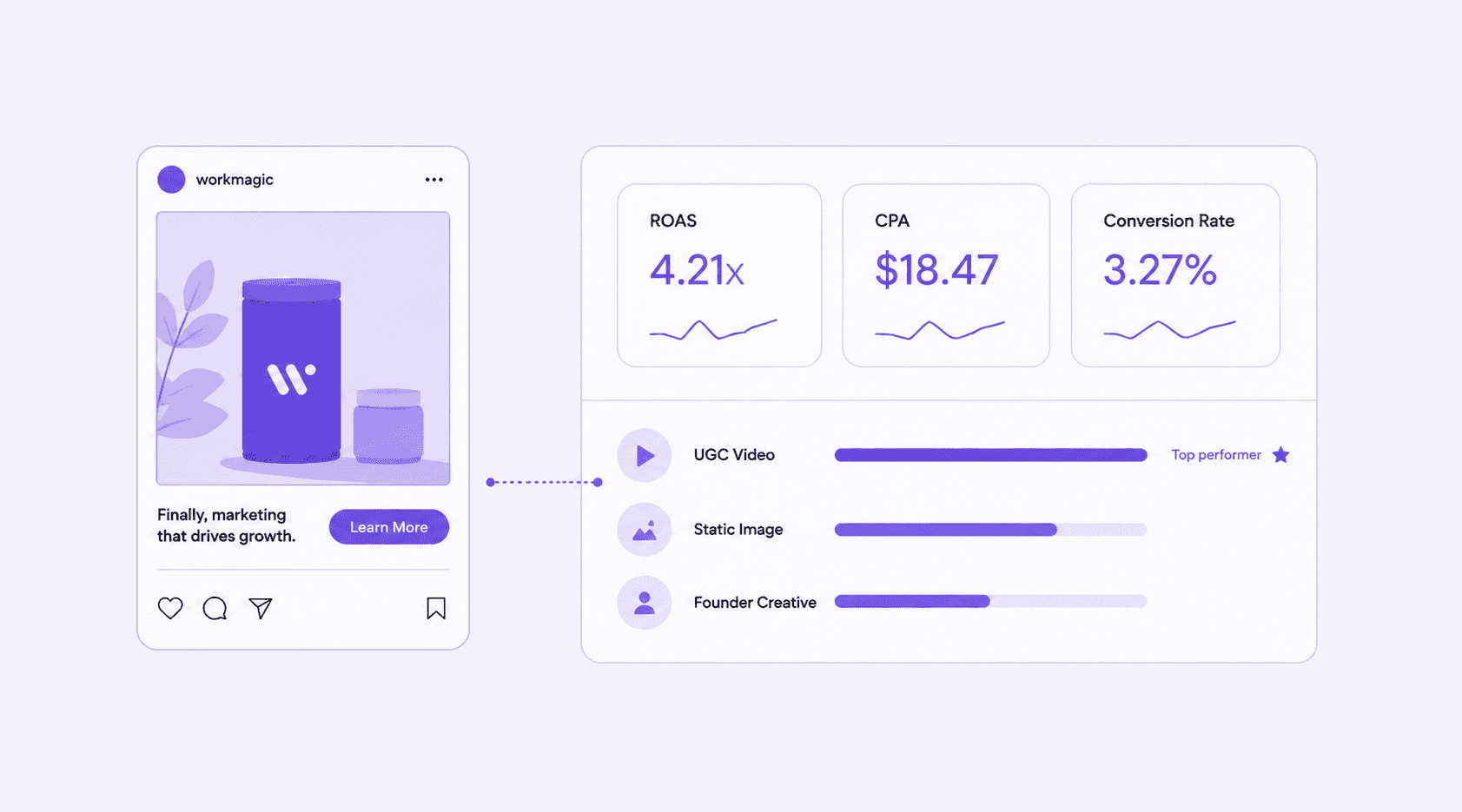
Believe it or not, "did the campaign hit its numbers?" is the wrong question, and one found in nearly every marketing meeting.
A campaign can hit every target and still be doing nothing.
Suppose your Meta campaign delivers a 4× ROAS. Clicks, conversions, cost per acquisition: all green. By every conventional measure, it worked. But what if half those purchases would have happened anyway? What if the buyers were already in your retargeting pool, days from converting regardless of the ad? Then your 4× ROAS reflects sales you would have captured anyway, not sales the campaign created.
This is the gap between a campaign that performed and a campaign that worked. Performance is about hitting numbers. Effectiveness is about causation: whether the campaign produced outcomes that would not otherwise have occurred. Standard campaign analysis answers the first question confidently. It cannot answer the second at all.
For DTC and omnichannel brands, the difference has real budget implications. Misreading performance as effectiveness means scaling spend on channels that are capturing demand, not creating it.
The standard campaign analysis framework and its ceiling
Conventional analysis covers the metrics every ad platform surfaces: click-through rate, conversion rate, cost per acquisition, return on ad spend. These measure what happened inside the platform's measurement window. They cannot measure what would have happened without the campaign.
The structural reason is straightforward: platforms measure within their own ecosystem. Meta can tell you how many conversions occurred after an ad impression. It cannot tell you how many of those buyers were already going to convert. That counterfactual sits outside the data any single platform can observe.
For a detailed look at how Meta's own incrementality tools work within these structural limits, see incremental attribution on Meta.
Last-click attribution compounds the problem by assigning full credit to the final touchpoint, ignoring everything that influenced the buyer before that click. A campaign can look like a strong performer on last-click while contributing zero net-new revenue.
Standard analysis still matters. CTR, CPA, and frequency inform creative and targeting decisions. The ceiling is that these metrics describe what happened; they say nothing about whether the campaign caused it.
The metrics that actually matter for DTC campaign analysis
Causal campaign measurement centers on a different set of numbers.
Incremental ROAS (iROAS) measures revenue generated above what would have occurred without the campaign, divided by spend. A campaign with a 3× reported ROAS might show a 1.4× iROAS once holdout-group data isolates its true contribution.
For a full breakdown of what incremental revenue means and how it differs from attributed revenue, see What Is Incremental Revenue?
Incremental CPA (iCPA) applies the same logic to acquisition cost. It reflects how much you paid for each customer the campaign actually produced, not customers who would have found you anyway.
Marketing Efficiency Ratio (MER) measures total revenue against total ad spend across all channels. It captures the full picture, including cross-channel effects that platform attribution misses.
Profit on Ad Spend (POAS) ties campaign outcomes to profit rather than revenue, accounting for margin, product mix, and fulfillment costs.
Learning how to calculate incremental lift is the foundation for moving from these concepts to actionable numbers. Without a measurement method that creates a genuine counterfactual, iROAS and iCPA remain estimates.
How to run a causal campaign analysis: the geo lift approach
No single measurement method answers every campaign question. WorkMagic's approach, which we call triangulated measurement, combines three methods: multi-touch attribution (MTA/DDA) for granular day-to-day signals; geo incrementality testing for causal ground truth; and marketing mix modeling (MMM) calibrated by that ground truth for strategic planning.
In practice, the workflow runs like this:
Start with attribution as the baseline. Data-driven attribution provides the initial framework for campaign and channel-level reporting. It tells you what happened within the platform's measurement window: which creatives drove clicks, which audiences converted, which campaigns are pacing against targets. This is the operational layer.
Run geo incrementality tests to establish causal lift. Incrementality testing solves the counterfactual problem by creating it deliberately. In a geo lift test, matched geographic markets are divided into test and holdout groups. The campaign runs in test markets; holdout markets see no ads. The difference in outcomes between the two groups isolates what the campaign caused: iROAS, iCPA, and new customer contribution grounded in observed behavior, not modeled attribution.
Calibrate both models with incrementality results. When geo lift results are fed back into the attribution model, day-to-day reporting begins to reflect causal contribution rather than correlation. When the same results are incorporated into MMM, the model's saturation curves and budget projections reflect true incremental returns across all channels, not just attributed ones. Each new test compounds the system's accuracy.
Immi applied this analysis to Axon by AppLovin, a channel traditional attribution had consistently undervalued. The geo lift test isolated Axon's true causal contribution and unlocked 4.2x revenue growth. The original platform numbers were not wrong; they were incomplete. The triangulated approach answered the question that platform data could not.
Halo effects: the campaign impact standard analysis always misses
Geo lift tests often surface a second finding that changes the economics entirely: halo effects on channels the campaign never targeted.
When Comfrt measured its TikTok Shop ads, the geo lift test revealed that 68% of the campaign's total incremental impact occurred on Shopify, not TikTok Shop. Buyers saw TikTok ads and converted on a different platform. Platform reporting saw only TikTok Shop conversions. The majority of the campaign's value was invisible.
Salt & Stone found the same dynamic running in a different direction. Measuring YouTube ads across both Shopify and Amazon showed that 67% of incremental orders occurred on Amazon. The iCPA dropped 67% once Amazon orders were included; the combined iROAS was 182% higher than YouTube's own reporting suggested.
In both cases, a campaign that might have looked marginal on platform metrics was actually one of the strongest performers in the mix. Standard campaign analysis had no mechanism to find this. WorkMagic's TikTok Incrementality Report documents halo patterns across 100+ TikTok tests; the Axon Incrementality Report covers the same ground for AppLovin's Axon platform.
Building a campaign analysis workflow that uses both
Platform metrics and causal measurement serve different purposes and should coexist, not compete.
Platform metrics are fast and continuous. CTR, CPA, and ROAS update in near-real time and inform daily optimizations: creative rotation, bid adjustments, audience exclusions. They are the right tool for in-flight decisions.
Geo lift tests provide the ground truth that periodic re-calibration requires. A sensible cadence runs incrementality tests on key channels two to four times per year, or when a significant budget change is planned. Results feed back into how platform numbers are interpreted: if a channel's iROAS is consistently 40% below its reported ROAS, that gap becomes the standing adjustment applied to its daily metrics.
Jordan Craig used this kind of recalibration to shift Google Shopping from a ROAS-optimized strategy to a profit-optimized one, achieving a 65% POAS lift after incrementality data clarified which campaigns were generating genuine margin rather than just volume.
Incrementality-adjusted attribution formalizes this connection: incrementality test results are used to weight attribution models, so the day-to-day numbers better reflect causal reality.
For teams building this workflow from scratch, the marketing measurement plan framework covers how to sequence platform tracking, test cadences, and attribution model updates across the full channel mix.
Frequently asked questions
What is campaign performance analysis?
Campaign performance analysis is the process of evaluating whether a marketing campaign achieved its intended outcomes. At the most basic level, this means comparing results against goals across metrics like ROAS, CPA, and conversion rate. At a more rigorous level, it requires determining whether the campaign caused those results, which demands causal measurement methods such as geo lift tests rather than platform attribution alone.
How do you measure the performance of a campaign?
Measuring campaign performance starts with platform metrics: ROAS, CPA, CTR, and conversion rate. These tell you what happened within the platform's measurement window. To determine whether the campaign caused its results, you need a counterfactual, which a geo lift test provides by comparing outcomes in markets that saw the campaign against matched markets that did not. Causal metrics including iROAS and iCPA emerge from this comparison and represent the most accurate measure of a campaign's true contribution.
What are the 5 C's of marketing analysis?
The 5 C's framework covers Company, Customers, Competitors, Collaborators, and Context. It is a situational analysis tool used to assess a brand's strategic environment before planning campaigns, rather than a framework for evaluating campaign results post-launch. Campaign performance analysis operates after the 5 C's have informed the brief.
What are the 4 types of marketing analytics?
The four types are descriptive (what happened), diagnostic (why it happened), predictive (what is likely to happen), and prescriptive (what action to take). Standard campaign reporting is primarily descriptive. Incrementality testing contributes diagnostic and causal insight: it explains whether a campaign was the cause of the results it appears to be associated with, which is the prerequisite for reliable prescriptive recommendations about budget allocation.